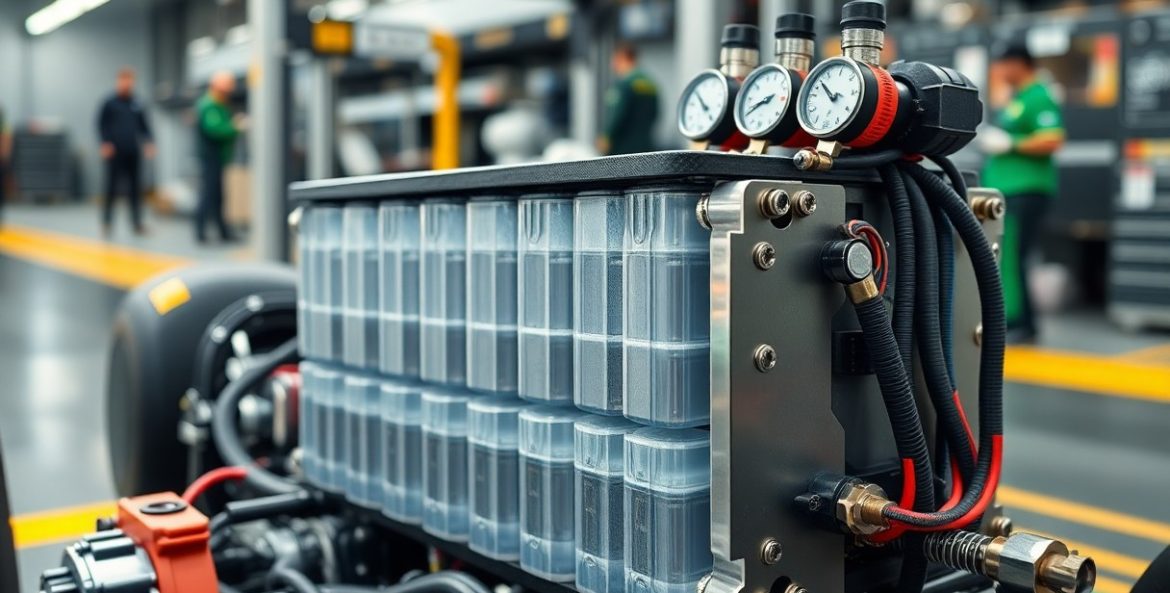
Racing demands that you select energy storage systems optimized for high discharge rates, rapid recharge and extreme durability while minimizing added weight. You must prioritize pack designs with robust cooling and a high-integrity BMS to mitigate the serious risk of thermal runaway and mechanical failure. Consider hybrid approaches-high-power lithium cells paired with ultracapacitors or solid-state options-to maximize power delivery and recover energy through regenerative braking without sacrificing reliability under sustained, high-stress conditions.
Types of Energy Storage Solutions
| Batteries | High energy density (100-250 Wh/kg for racing-grade Li‑ion chemistries), configurable C‑rates up to 10-20C with liquid cooling and active BMS; sensitive to thermal runaway if abused. |
| Flywheels | Very high power density and fast response (kW/kg-level bursts), rotor speeds often 40,000-100,000 rpm, long life (>1,000,000 cycles) but require robust containment and vacuum housings. |
| Supercapacitors | Extremely high power delivery (tens of kW/kg), very low internal resistance and >1,000,000 cycles, but low energy density (single-digit Wh/kg) so best for short bursts and regenerative braking buffering. |
| Hybrid Systems | Combine batteries + supercaps or batteries + flywheel to balance energy vs power; examples include KERS-style hybrids that use capacitors/flywheels for peak power and batteries for sustained energy. |
| Safety & Thermal Management | Active liquid cooling, cell balancing, and real-time BMS telemetry are mandatory for racing; maintain cell delta-T <5°C and avoid sustained pack temps >60°C to reduce failure risk. |
- Batteries
- Flywheels
- Supercapacitors
- Power density
- Thermal management
Battery Technologies
You should specify cell chemistry and form factor based on your duty cycle: Lithium‑iron phosphate (LFP) offers better thermal stability and cycle life but lower energy density, while NMC/NCA provides higher Wh/kg for longer stints at the cost of tighter thermal controls. Racing packs commonly target cell-level C‑rates of 5-20C for discharge with parallel cell arrays to keep individual cell stress down and to improve fault tolerance.
When you design or select a pack, insist on a high‑speed BMS with per‑cell monitoring, active liquid cooling plates that keep cell delta‑T under 5°C, and a structural enclosure rated for crash loads. In Formula E and many prototype endurance platforms, pack architectures incorporate modular replaceable sub‑packs (typically 6-12 kWh modules) so you can service or swap under time pressure without compromising the whole system.
Flywheel Energy Storage
You can leverage flywheels when you need very high power bursts and extreme cycle life; advanced composite rotors store on the order of 20-80 Wh/kg but can deliver several kW/kg for seconds, making them excellent for launch assist and repetitive braking cycles. Integration requires rigid mounting, vacuum chambers to reduce aerodynamic losses, and either magnetic bearings or ultra‑durable mechanical bearings to handle rpm in the tens of thousands.
Systems used in motorsport prototypes and some hybrid demonstrators have demonstrated regenerative efficiencies above 90% over short durations, and their tolerance to harsh charge/discharge cycles means you avoid the deep cycle degradation you see in high‑power Li‑ion cells. However, containment design must address rotor failure modes and gyroscopic loads, which complicates packaging in tight chassis spaces.
You must plan for containment and failure mitigation: high‑energy rotors demand multi‑layer casings, radial arrestor rings, and continuous rpm monitoring tied to emergency shutdown to prevent catastrophic disintegration under over‑speed conditions.
Supercapacitors
You should employ supercapacitors where instantaneous power and high pulse repetition matter more than stored energy-pit‑stop systems, aggressive launch assists, and braking energy capture are typical use cases. Expect module energy densities in the single digits Wh/kg but pulse power in the kW/kg range, plus operational lifetimes exceeding a million cycles with minimal capacity fade, which is valuable for vehicles running many short charge/discharge events per lap.
When integrating, ensure low ESR connection paths, active voltage balancing across series stacks, and proper thermal paths since high pulse currents can heat terminals even if the cells themselves tolerate wide temperature ranges. Practical installations often pair supercaps with batteries so the caps handle spikes and the battery handles sustained loads, reducing battery stress and extending pack life.
Module sizing should account for voltage stacking and balancing resistors or active balancers, and you must protect the stack from reverse polarity and overvoltage-simple bank-level protection is insufficient for high‑power racing duty.
Any selection must balance peak power, usable energy, packaging, and a fail‑safe thermal/mechanical containment strategy tailored to your vehicle’s repeated high‑stress duty cycle.
Tips for Choosing the Right Energy Storage System
Balance between energy density, power density, cycle life, and thermal management when you pick a system for racing. Small differences matter: typical lithium‑ion cells offer roughly 150-260 Wh/kg and can sustain continuous discharge at 1-3C depending on chemistry, while supercapacitors deliver very high power density (useful for bursts >10 kW/kg) but only ~5-10 Wh/kg of energy. Prioritize a BMS that handles peak currents, cell balancing, and fast telemetry; a weak BMS is one of the most dangerous failure points under high stress.
- Energy density – how much stored kWh per kg matters for vehicle mass and lap time.
- Power density – peak kW/kg for overtakes, launches, and regen.
- Cycle life – expected number of full cycles (Li‑ion: ~500-3,000; supercaps: >100,000).
- Thermal management – cooling strategy and max safe cell temperature (thermal runaway risk rises above ~70-90°C).
- Mechanical robustness – vibration, shock, and mounting affecting cell integrity.
Compare real-world examples: a GT hybrid package often uses ~1-3 kWh of lithium storage to provide 50-200 kW boost for short windows, whereas sprint setups can get away with 0.5-1 kWh and higher-power pulse systems. Test against worst-case scenarios (multiple back‑to‑back hot laps, repeated pit starts) and validate cooling under high ambient temps; insufficient cooling will reduce output and increase failure risk. Assume that you specify target numbers (energy, continuous and peak power, allowable temperature range) up front and validate them with logged on‑car duty cycles before finalizing the pack.
Assessing Race Conditions
Identify the race format first: a 30-60 minute sprint uses different storage and SOC strategies than a 6-24 hour endurance event. In endurance you often size for repeated partial‑discharge cycles and long dwell times between pits, so you may prefer systems with higher cycle life and lower depth‑of‑discharge per stint; in sprint racing you can accept higher stress for lighter weight and higher instantaneous power. Track layout matters too – tracks with long straights and heavy braking favor larger regen capacity, while twisty circuits prioritize power delivery for corner exits.
Account for environmental extremes: high ambient temperatures (>40°C) and sustained high C‑rates accelerate capacity fade and raise the risk of thermal runaway, while high altitude reduces air cooling effectiveness and can decrease power by several percent due to thinner air for radiators. Also consider packaging and mounting to withstand sustained lateral loads (2-4 g) and vibration; a pack that shifts under cornering is a safety hazard and will fail cells prematurely.
Evaluating Power Needs
Separate continuous power from peak pulses and calculate both from logged current profiles. For example, if your electric motor hits a 300 kW peak for 10 seconds per lap across a 90‑second lap, the per‑lap energy for that peak is ~0.83 kWh (300 kW × 10 s ÷ 3,600 s/hr), which informs how much usable energy you need between regen or pit recharge opportunities. You should size the pack to supply peak bursts without exceeding cell C‑rate limits and keep a reserve SOC to avoid accelerated ageing.
Factor in C‑rate effects and BMS limits: many Li‑ion cells lose 10-20% effective capacity at high (>3C) discharge rates and produce significant heat that the cooling system must remove. Use target specs like continuous power = X kW, peak power = Y kW for Z seconds, and a BMS rated for at least 1.5× expected peak current to provide headroom under transients. Assume that you validate these targets on a dyno with repeated duty cycles to confirm thermal stability and SOC management under race conditions.
Step-by-Step Guide to Implementing Energy Storage
Implementation Steps vs Key Considerations
| Step | Key Considerations / Examples |
| Requirement definition | Define energy (kWh), peak power (kW), duty cycle, ambient range; e.g., sprint system: 0.3-2 kWh for 5-20 s bursts, endurance: 10-50 kWh. |
| Topology & chemistry | Pick cells (NMC, LFP, ultracapacitor hybrid); target power density (kW/kg) and cycle life (cycles). Example: LFP for >3,000 cycles, NMC for higher energy density. |
| Thermal & mechanical design | Specify cooling (liquid, air), vibration isolation, enclosure IP rating (IP67 common for wet conditions), and mounting torque specs. |
| BMS & controls | Set fault thresholds, balancing strategy, sampling rates; verify CAN messages and redundancy for safety-critical commands. |
| Installation & commissioning | Follow LOTO, HV isolation tests, insulation resistance >100 MΩ, insulation withstand per system voltage, torque values, and flow-rate checks for cooling. |
| Testing & validation | Run cell balancing, discharge/charge cycles, thermal imaging under load, and track performance metrics (ΔV cell spread <20 mV post-balance). |
| Maintenance & monitoring | Implement SOC/SOH monitoring, scheduled checks every 50-200 hours depending on duty, and remote telemetry for fault trending. |
Planning and Design
You should quantify both the energy and the instantaneous power requirements early: calculate energy (kWh) from expected duration (hours) and peak power (kW) from acceleration or load events-for example, 100 kW for 10 seconds equals about 0.28 kWh3,000 cycles; high-Ni NMC 1,000-2,000 cycles) so your selection balances energy density, durability, and thermal headroom.
You must also design the thermal management and mechanical mounting to withstand racing loads: size liquid cooling channels to maintain cell temps in the 20-40°C window under continuous high-power events, and design vibration isolation to mitigate >10 g shock pulses seen in off-road racing. For enclosure and integration specify IP rating, connector types (e.g., M8 studs for high current, high-voltage plugs with interlocks), and busbar sizing-plan conductor cross-sections for expected continuous current plus 25% margin (for example, 500 A continuous typically requires ~70-100 mm² copper depending on cooling and bundling).
Installation Procedures
During installation, implement lockout-tagout and HV safety protocols first, and then follow a mechanical-first, electrical-later sequence: secure racks with specified torque (M8 bolts ~20-30 Nm as a baseline depending on grade), install vibration mounts, and confirm enclosure grounding to <1 Ω. Route HV and LV harnesses separately, clamp cables every 150-300 mm in high-vibration areas, and use insulated busbars with appropriate clearances to maintain dielectric creepage distances for your system voltage (e.g., >20 mm for 1 kV systems depending on material).
Electrical hookups should include pre-sized fusing, contactors with redundant control, and proper busbar sizing; verify connector ampacity and torque (consult manufacturer datasheets). Perform insulation resistance tests (>100 MΩ) and dielectric withstand tests per system voltage, then energize BMS in a controlled step: power LV logic, validate CAN and telemetry messages, enable pre-charge circuit to limit inrush, and then close main contactors while monitoring current and voltage transients; log initial cell voltages and SO C and ensure cell voltage spread is within acceptable limits (target <20 mV after balancing).
Complete commissioning with dynamic and thermal tests: run a staged load profile to 100% of expected peak, use thermal imaging to identify hotspots, verify coolant flow (typical module flow 1-5 L/min depending on design) and pressure (<2 bar for many low-pressure systems), and confirm fault handling-BMS should trigger open-circuit and safe-shutdown within specified latency (often <10 ms for critical faults). Emphasize that high-voltage exposure and thermal runaway are the primary dangers, so validate all interlocks, emergency isolation switches, and venting/containment measures before full operation.
Factors Affecting Energy Storage Performance
You must account for how mechanical, thermal, and electrical stressors interact with cell chemistry and pack architecture. For example, a Li‑ion pouch cell subjected to repeated pulses of 5-10C during sprints and sustained pack temperatures of 50-60°C will experience accelerated side reactions and electrolyte breakdown, which reduces capacity and increases the probability of thermal runaway under worst-case abuse.
Your selection also depends on cell chemistry, state‑of‑charge window, and the quality of your thermal management and BMS. LFP cells tolerate abuse and high temperatures better but give lower energy density than NMC/NCA; switching to a hybrid approach (battery + supercapacitor) is a common solution in motorsports to handle short, high‑power events without driving battery degradation.
- Temperature
- State of charge (SOC)
- Charge/discharge rate (C‑rate)
- Cycle life
- Thermal management
- Mechanical/vibration stress
Temperature and Environment
Cold and hot environments change what you can reliably extract from your pack: at subzero ambient temperatures internal resistance rises and available peak power can fall by 30-50% at around −20°C, so you need preheating strategies or a power buffer if you expect cold starts or high‑current demands immediately. In contrast, elevated temperatures speed up degradation-reaction rates generally follow an Arrhenius behaviour and roughly double for every 10°C increase above nominal operating temperature-so continuous exposure above ~45°C will meaningfully reduce cycle life and increase safety risk.
To protect performance you should combine active thermal control, targeted SOC windows, and appropriate cell chemistry. Racing teams typically hold cell temperatures in the 25-35°C range with liquid cooling and include insulation or phase‑change materials to blunt short duration spikes; for endurance events you may accept slightly lower peak power to preserve long‑term capacity.
Temperature Effects vs Mitigations
| Effect | Mitigation / Example |
|---|---|
| High temperature: faster capacity fade, increased internal pressure, risk of thermal runaway above ~70°C | Active liquid cooling, limit SOC to 20-80%, choose LFP/NMC variants optimized for high‑temp use; GT teams run packs at ~30°C under load |
| Low temperature: elevated internal resistance, reduced power delivery (≥30% drop at −20°C) | Battery preheaters, insulated enclosures, or a supercapacitor buffer for peak power; rally cars use inline heaters before stages |
| Moisture/contaminants: corrosion, insulation breakdown | Sealed enclosures, IP‑rated connectors, conformal coatings, desiccants in pack housings |
Charge and Discharge Rates
You should size for both continuous and peak C‑rates and understand their lifecycle tradeoffs: 1C equals a full discharge in one hour, continuous demands of 2-3C and peak pulses of 5-10C are common in racing applications, while supercapacitors routinely handle >100C pulses with minimal cycle impact. Sustained high discharge is less damaging than sustained high charge at high C because fast charging raises internal temperature and promotes lithium plating on graphite anodes.
Fast charging above ~1C increases the risk of lithium plating and permanent capacity loss unless you tightly control cell temperature and SOC during the charge. Series/parallel cell architecture, current sharing, and BMS‑level cell limits are typical countermeasures; for example, electric formula teams configure parallel strings so individual cells rarely exceed 1-2C even when pack currents reach multiples of that.
Use regen and buffering strategies to protect cells during rapid energy transfer events: you can route short, high‑power regenerative bursts to a supercapacitor bank or keep SOC in a conservative mid‑range (e.g., 20-80%) to reduce stress, and program the BMS to throttle peak cell currents and apply thermal preconditioning before fast charge sessions. After, validate peak‑power tests on a dyno and run thermal soak tests under worst‑case duty cycles.
Pros and Cons of Energy Storage Solutions
Pros vs Cons: Key attributes for racing and high-stress applications
| Pros | Cons |
|---|---|
| High energy density from advanced Li‑ion chemistries (typically 150-260 Wh/kg) lets you meet race distance and stint targets without excessive mass. | Higher mass than capacitor/flywheel alternatives for the same power; you sacrifice some handling if you over‑size the pack to extend range. |
| Exceptional power density of supercapacitors and some Li‑ion cells delivers very high C‑rates (burst power for sprints/starts), enabling faster lap‑to‑lap acceleration. | Supercapacitors have low energy density, so they can’t sustain long high‑power runs-you need hybridization to avoid frequent pit stops. |
| Fast recharge capability: ultracaps and high‑power Li‑ion can be recharged in seconds to minutes, maximizing regenerative braking benefit on stop‑start circuits. | Rapid charge/discharge increases thermal load; without sophisticated cooling you risk accelerated degradation or thermal events. |
| Long cycle life of mechanical systems (flywheels) and capacitors-often hundreds of thousands to millions of cycles-reduces replacement intervals in endurance formats. | Mechanical complexity (flywheels) adds integration weight, bearings wear, and safety containment requirements that complicate packaging. |
| Regenerative systems recover a significant fraction of braking energy (often 20-50% depending on track), improving overall efficiency and lap times. | Regeneration control requires sophisticated power electronics and ECU integration; mis‑tuning can cost drivability and impose battery stress. |
| Modular battery packs let you tailor capacity and balance weight distribution for handling advantages in different tracks. | Modularity increases connectors and potential failure points; faults in one module can force derating or pit repairs. |
| Established supply chain for Li‑ion racing cells provides predictable performance and proven safety procedures when you follow manufacturer specs. | High upfront cost: race‑grade cells, BMS, and thermal systems can run into tens to hundreds of thousands of dollars per program. |
| Advanced BMS and cell‑balancing extend usable life and allow precise energy management to extract peak performance lap after lap. | Failure modes include thermal runaway, high‑voltage arcing, and electrolyte fires; mitigation requires strict protocols and adds weight/complexity. |
Advantages for Racing
You can exploit high energy‑density Li‑ion packs to preserve range while keeping mass low enough for competitive handling; typical high‑performance cells deliver 150-260 Wh/kg
When you optimize for power density, supercapacitors and high‑C Li‑ion cells let you recover and redeploy braking energy repeatedly: on tracks with frequent braking zones you can recapture 20-50% of kinetic energy and immediately use it for short bursts of 100-300 kW. That translates to clear lap‑time gains and reduced fuel consumption in internal combustion hybrid packages, and for pure electric classes it means fewer pit interventions and more aggressive energy strategies. You face significant tradeoffs between energy and power: choosing ultracapacitors improves burst performance but forces you to carry a secondary energy source or accept limited stint length. In practice, integrating multiple storage types requires complex power electronics and controls; mismatches in voltage, state‑of‑charge, or response times can create inefficiencies and unexpected stress on cells during race conditions. Thermal management and safety add weight and system complexity. Racing packs often operate at pack voltages well above 400 V, creating serious shock and arcing hazards; if cell temperatures climb above safe thresholds (cell‑dependent but often approaching ~150 °C for thermal runaway onset) you must rely on containment, active cooling, and fast isolation to protect crew and car. Degradation is another real limitation: many high‑energy Li‑ion chemistries show capacity fade after 500-3,000 cycles depending on depth of discharge, C‑rates, and temperature. That means you either budget frequent replacements or design operating windows that limit peak performance-both of which impact cost and competitiveness over a season. Maintain a scheduled inspection routine: during active race cycles you should perform a visual and electrical check every event day, and at minimum a monthly system review during bench periods. Monitor ambient and pack temperatures continuously; aim to store cells at roughly 40% state of charge for long-term layup and keep storage temps near 20-25°C to slow capacity fade. Clean and tighten electrical connections to manufacturer torque specs (typical ranges are 2-10 Nm depending on hardware) and log every intervention so you can correlate maintenance actions with performance trends. Prioritize thermal management and enclosure integrity: confirm coolant flow and radiator cleanliness before every high-stress session, and verify seals and venting paths on cells and modules to prevent moisture ingress. For systems with long service lives, schedule impedance or DC internal resistance (IR) measurements every 300-500 cycles; a steady IR increase of >20-30% versus baseline usually signals end-of-life acceleration and warrants component replacement. You should inspect individual cell voltages and module voltages after each major event and whenever you see unusual pack behavior; if cell-to-cell voltage spread exceeds 20 mV under open-circuit conditions, trigger a balancing cycle or manual equalization. Use both passive (bleed resistors) and active balancing strategies where available-active balancing is preferable in high-series-count packs because it reduces heat and preserves cycle life, while passive is acceptable for short-term equalization between race weekends. Verify BMS logs for imbalance events and set alarms for thresholds that matter in your application (for example, high-voltage cutoff at 4.2 V/cell and low-voltage cutoff around 2.5-3.0 V depending on chemistry). You should also perform a periodic capacity check (C/5 to C/10 discharge) every 100-250 cycles or at the end of a season to detect gradual capacity loss; a pack that has lost >20% capacity since baseline typically needs module replacement or reconditioning. When you encounter voltage sag, unexpected BMS trips, or rapid temperature rises, start by isolating the pack and reading BMS fault codes-those codes narrow down whether the problem is cell imbalance, overtemp, communication failure, or insulation fault. Measure individual cell voltages, pack voltage under no-load and under known load, and temperature sensor readings; a sudden cell voltage drop of >0.1 V under moderate load often points to elevated internal resistance in that cell or a loose series connection. If you see persistent thermal excursions (>60°C at cell surface) or any signs of electrolyte venting or discoloration, remove the module from service immediately and follow your emergency isolation procedure-overheating and venting are direct fire risks. In many cases, the root cause is either poor contact torque on busbars or blocked cooling channels; a torque verification and coolant flow check resolve a high percentage of race-day thermal problems. For a practical troubleshooting flow: note the symptom, capture BMS logs and time-stamped telemetry, then measure open-circuit voltages and IR of suspect cells. If a single cell shows low capacity or high IR compared with the pack baseline, replace that module; if multiple cells drift together, investigate BMS balancing circuits, temperature gradients in the pack, and charging protocol (avoid repeated charge to 100% at high C-rate). Use PPE and isolate high-voltage systems when you perform continuity, insulation resistance, or high-current load tests. As a reminder, you should prioritize energy and power density, thermal management, and mechanical robustness when selecting energy storage for racing and high-stress conditions. Choose cell chemistries and hybrid solutions (batteries plus supercapacitors) that support rapid discharge and regeneration, design cooling and structural containment to tolerate repeated high loads, and implement active battery management and fault detection so your system maintains performance under extreme use. You must balance weight, lifecycle, and serviceability against peak performance, validate designs through rigorous bench and track testing, and plan for rapid diagnostics, replacement, and compliance with safety standards. By integrating robust controls, optimized packaging, and real-world validation, your energy storage will deliver predictable power and resilience when it matters most.Disadvantages and Limitations
Maintenance and Care for Energy Storage Systems
Regular Checks and Balancing
Troubleshooting Common Issues
Summing up