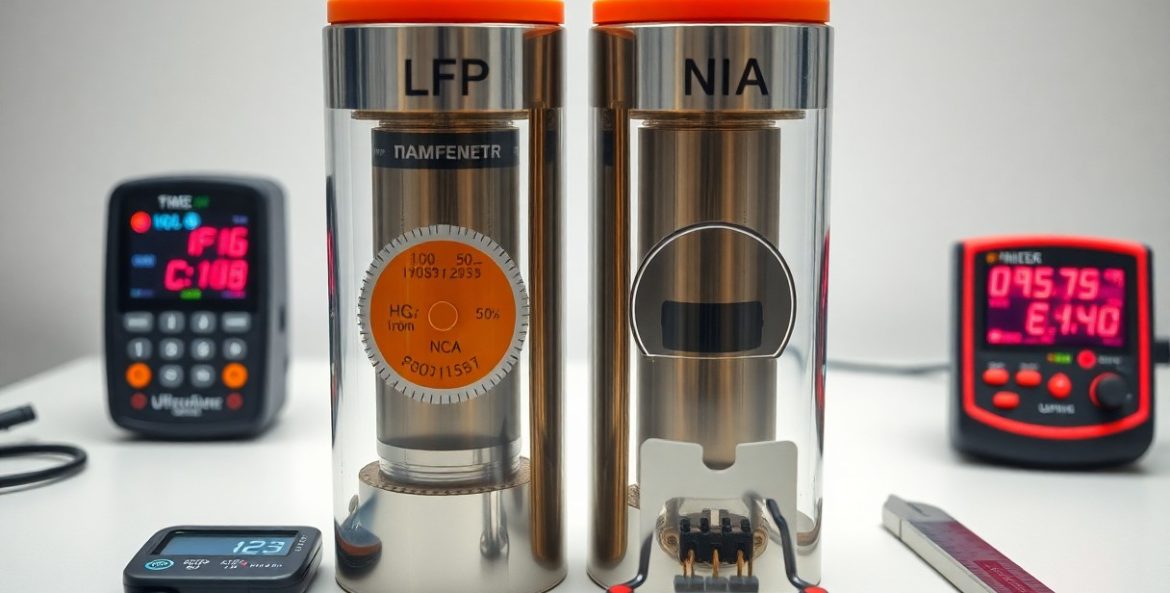
LFP cells offer safer chemistry and longer cycle life, while NCA delivers higher energy density but carries a greater thermal runaway risk-you need to weigh safety, range, cost, and longevity when choosing cells for your application.
Types of Battery Cells
You should be able to differentiate the two dominant families: LFP (lithium iron phosphate) and NCA (nickel cobalt aluminum). Practical metrics show LFP at roughly 90-160 Wh/kg with typical cycle lives of 2,000-4,000 cycles under conservative depth-of-discharge, while NCA often reaches 200-260 Wh/kg but commonly delivers 500-1,500 cycles depending on thermal management and cell formulation.
In deployments you’ll trade off energy density, cost, and risk: LFP reduces the chance of thermal runaway and avoids cobalt, lowering material cost, whereas NCA increases range-per-weight and is favored in long-range EVs when packaging and active cooling compensate for its sensitivity to abuse.
| Chemistry / Formulation | LFP: LiFePO4 – NCA: Ni-Co-Al (typical Ni:Co:Al ≈ 80:15:5) |
| Nominal Voltage | LFP: ~3.2-3.3 V – NCA: ~3.6-3.7 V |
| Energy Density (Wh/kg) | LFP: ~90-160 Wh/kg – NCA: ~200-260 Wh/kg |
| Cycle Life | LFP: ~2,000-4,000 cycles – NCA: ~500-1,500 cycles (depends on thermal control) |
| Safety / Thermal Stability | LFP: high thermal stability, low risk of thermal runaway – NCA: higher energy but greater sensitivity to overheat and abuse |
- LFP
- NCA
- Energy density
- Cycle life
- Thermal runaway
LFP Battery Cells
When you evaluate LFP cells, expect a stable chemistry with a nominal voltage around 3.2-3.3 V and a characteristic flat discharge curve that makes state-of-charge estimation less responsive but contributes to long calendar and cycle life; in field systems and grid storage units many manufacturers report >2,500 cycles at 80% DOD and calendar lives exceeding 10 years under proper management. Manufacturers such as BYD and multiple stationary storage vendors favor LFP because it eliminates cobalt, reducing material cost and supply-chain risk while offering strong high-temperature tolerance compared with high-nickel chemistries.
Because LFP is inherently more stable, you can design simpler passive safety layers, and some automotive programs (for example certain Tesla Model 3 Standard Range units in China) switched to LFP to cut cost and extend pack life. In practical charging scenarios, LFP accepts rapid charge at moderate SOC but shows a flatter voltage plateau that can limit apparent charge acceptance near full SOC unless the pack and BMS are optimized.
NCA Battery Cells
For NCA, you get higher specific energy-typically 200-260 Wh/kg-so if you prioritize vehicle range or energy-dense portable systems you’ll see the benefit in reduced pack mass or volume; major OEMs have deployed NCA in long-range EVs (historically in Tesla’s long-range packs) because the extra energy per cell lowers weight and improves packaging efficiency. That energy advantage comes with higher nickel and some cobalt content, which raises material cost and demands stricter thermal management and advanced BMS strategies to avoid accelerated degradation and safety events.
Operationally, NCA packs require active cooling and granular cell balancing to hit target cycle life, and they typically show faster capacity fade when exposed to sustained high-temperature operation or aggressive fast charging without appropriate conditioning; power-dense variants can still deliver high C-rate performance, but you must accept tighter pack-level controls and periodic diagnostics to maintain safe operation.
Manufacturing trends for NCA push nickel content higher (the common ~80:15:5 Ni:Co:Al ratio) to boost energy density, and you should expect trade-offs: higher nickel improves range but increases sensitivity to mechanical and thermal abuse, while electrolyte additives and tailored coatings can reclaim some stability-Perceiving which trade-offs between LFP‘s long life and safety versus NCA‘s energy advantage best match your application will guide your selection.
Performance Comparison
| LFP | NCA |
|---|---|
| Energy density: typically ~90-160 Wh/kg at the cell level; lower pack range for the same mass compared with NCA. | Energy density: typically ~200-260 Wh/kg; enables higher vehicle range or smaller pack mass. |
| Cycle life: commonly 2,000-5,000 cycles to ~80% capacity under moderate DoD and controlled temperature. | Cycle life: often 800-1,800 cycles to ~80% capacity, highly dependent on thermal management and depth of discharge. |
| Safety & thermal behavior: much higher thermal stability, lower risk of thermal runaway. | Safety & thermal behavior: higher energy density but greater thermal runaway risk if abused or poorly managed. |
| Typical use: stationary storage, budget EVs, applications where longevity and safety matter more than range. | Typical use: performance EVs and applications prioritizing maximum range and energy per mass. |
Energy Density
For practical sizing you’ll notice NCA cells deliver substantially more stored energy per kilogram: at the cell level you’re usually looking at ~200-260 Wh/kg versus LFP’s ~90-160 Wh/kg. In real-world terms, if your vehicle pack uses NCA at ~240 Wh/kg and you switch to LFP at ~140 Wh/kg, the cell mass needed to maintain the same range rises by roughly 70%, which translates to larger pack volume or reduced cargo and passenger capacity.
Manufacturers balance that trade-off: you can expect OEMs using LFP to mitigate the lower density with alternative strategies such as larger battery envelopes, lower vehicle weight targets, or accepting a shorter range in exchange for the benefits of longer life and improved safety. For instance, many mass-market EVs deploy LFP in standard-range trims where predictable cycle performance and cost are more valuable than maximum single-charge distance.
Cycle Life
When you compare longevity, LFP consistently outperforms NCA in cycle endurance: typical LFP chemistries reach 2,000-5,000 cycles to 80% state of health under moderate depth-of-discharge and controlled temperature, while NCA commonly ranges from 800-1,800 cycles under similar conditions. Field deployments show stationary battery systems using LFP rating warranties for >3,000 cycles, whereas automotive NCA packs rely heavily on sophisticated thermal and charge management to extend usable life.
Thermal behavior and depth-of-discharge govern those numbers: if your pack spends time above ~40°C or routinely cycles at >80% DoD, NCA degradation accelerates and you’ll see capacity fade faster than with LFP. Conversely, operating at shallower DoD (e.g., 20-60%) and keeping temperatures lower will materially increase cycle life for both chemistries, but the margin still favors LFP for high-cycle applications.
To give you a concrete planning example: cycling daily at an 80% DoD, an LFP pack rated at 3,000 cycles would provide roughly 8 years of service (3,000/365 ≈ 8.2 years) before reaching ~80% capacity, whereas an NCA pack rated at 1,000 cycles under the same profile would last about 2.7 years. That math illustrates why you’ll find LFP in grid storage and high-duty fleets where lifetime throughput matters more than peak range.
Factors Influencing Performance
Multiple variables change how your LFP and NCA cells behave in real-world use: cell chemistry, manufacturing quality, pack architecture, and the way you charge and store the battery all matter. You should pay attention to temperature, charge rate (C‑rate), state of charge (SOC), depth of discharge (DoD) and the presence of a capable BMS when comparing long‑term outcomes.
- Temperature – affects capacity, power and calendar life
- Charge rate – higher C‑rates accelerate degradation and risk
- State of charge – sustained high SOC speeds ageing, especially for NCA
- Cell design – electrode thickness, electrolyte formulation and separator quality
- Battery management – thermal control, SOC windows and cell balancing
Interplay between these factors determines whether you get the long cycle life and safety advantages of LFP or the higher energy available from NCA; practical examples include LFP packs in buses that regularly cycle >2,000 times with minimal degradation, versus performance EV packs using NCA that trade some cycle life for higher pack range. Any evaluation should weight your duty cycle, thermal constraints and charging profile when choosing between chemistries.
Temperature Effects
Cold conditions reduce available capacity and raise internal resistance: at −20°C you can expect a 20-40% drop in usable capacity and a sharp fall in power for both chemistries, but LFP generally tolerates repeated cold operation better because it is less prone to lithium plating under moderate charge rates. You should avoid charging NCA heavily below 0°C without active thermal management because plating risk and irreversible capacity loss increase dramatically.
Temperature effects – LFP vs NCA
| LFP | NCA |
|---|---|
| Low‑temp: 20-40% capacity drop at −20°C; better resistance to plating at 0-10°C | Low‑temp: similar capacity loss but higher plating risk when charging above ~0.5C at ≤0°C |
| High‑temp: faster calendar ageing above 40°C but more thermally stable | High‑temp: accelerated capacity fade and greater risk of thermal runaway if unmanaged |
| Operational window: 0-45°C recommended with active cooling for heavy loads | Operational window: 0-40°C preferred; aggressive cooling strongly advised for fast charging |
The Arrhenius rule of thumb applies: roughly every 10°C increase can double chemical ageing rates, so you should keep packs within their thermal design limits and favor mid‑range SOC when ambient temperatures are high to extend life.
Charging Rates
You can exploit the inherent robustness of LFP to achieve higher continuous C‑rates-many prismatic LFP cells handle sustained 1C and brief 2-3C pulses with acceptable fade-while NCA often requires tighter C‑rate limits to avoid accelerated capacity loss. For NCA packs, charging fast above 50-80% SOC or at elevated temperatures substantially increases the risk of lithium plating and impedance rise.
Practical guidance: if you regularly fast‑charge, design the pack and BMS to limit high‑SOC charging and maintain cell temperatures in the 15-35°C band; manufacturers commonly recommend avoiding routine top‑up charging above 80% SOC for NCA to preserve cycle life.
More detailed tests show that cells cycled with repeated 1C full‑charge cycles at room temperature can retain >80% capacity after >1,000 cycles for many LFP formats, whereas NCA cells pushed to 2C fast charging without strict thermal control may drop to 80% in 500-800 cycles depending on SOC policy and temperature management.
Pros and Cons of LFP Battery Cells
Pros and Cons
| Pros | Cons |
|---|---|
| Long cycle life – many LFP cells deliver >3000 cycles at ~80% DOD, making them ideal for heavy-cycle applications. | Lower energy density – typically ~90-160 Wh/kg at cell level, so packs are larger or heavier for the same range. |
| Superior thermal stability with a much lower risk of thermal runaway, improving safety for transport and stationary storage. | Reduced low-temperature performance – usable capacity and power can drop significantly below 0°C without heating. |
| Lower material cost due to abundant iron and phosphate, which lowers cell cost per kWh compared with Ni/Co chemistries. | Lower nominal voltage per cell compared with some NCA/NMC formulations, requiring a higher cell count and more complex BMS. |
| Better tolerance of full-depth discharges and long calendar life; you can expect less capacity fade in high-cycle fleet use. | Heavier pack mass per kWh – manufacturers often accept a weight penalty of roughly 10-20%+ for LFP packs to match NCA range. |
| No cobalt or nickel reduces supply-chain risk and ethical/environmental concerns in mining and sourcing. | Lower volumetric energy density can complicate packaging for space-constrained designs, affecting vehicle or device form factor. |
| Good high-rate charge acceptance and long calendar life make them a strong choice for fast-charge public fleet or stationary use. | Perceived consumer preference – you may see market resistance where buyers prioritize maximum single-charge range. |
Advantages
You’ll find LFP excels when longevity and safety matter more than absolute range: in real-world fleet trials LFP packs commonly exceed 3000 cycles with limited capacity loss, so total cost of ownership falls significantly for buses, delivery vans, and stationary storage. Manufacturers such as BYD and many Chinese EV lines deploy LFP at scale precisely because it lowers per-kWh material cost and reduces thermal risk during high-throughput charging and daily deep cycling.
Operationally, you benefit from simpler cooling strategies and fewer hazardous-material constraints during shipping and installation thanks to LFP’s chemistry. Field data shows fewer thermal incidents in LFP-based systems versus nickel-rich cells, and for grid storage you get predictable long-term performance – for example, multiple megawatt-hour installations report consistent capacity retention over 5-10 years under cyclic use.
Disadvantages
When you compare energy per kilogram, LFP’s ~90-160 Wh/kg leaves a tangible penalty: in passenger EVs that translates to shorter range or the need for a larger battery pack. OEMs targeting longer-range models often prefer NCA/NMC for higher specific energy, since matching range with LFP typically requires an increase in pack volume and mass of roughly 10-20% or more, depending on vehicle efficiency and packaging constraints.
You should also account for low-temperature and voltage-stack implications: LFP tends to lose power and usable capacity at subzero temperatures unless the pack includes preheating, and the lower nominal cell voltage forces higher series counts to reach pack voltage targets, increasing BMS complexity and assembly cost. Those trade-offs can drive design decisions away from LFP in compact, high-range consumer products.
Mitigation is possible: you can overcome many disadvantages through pack engineering – active thermal management, cell-format choices (pouch/prismatic), and software that optimizes charge windows. For fleets or fixed installations where space and weight are less constrained, these measures let you capitalize on LFP’s safety and cycle-life advantages while minimizing the range and cold-weather penalties.
Pros and Cons of NCA Battery Cells
| Pros | Cons |
|---|---|
| Very high energy density (typical cell-level ~200-260 Wh/kg), enabling longer driving range | Lower thermal stability; greater risk of thermal runaway compared with LFP |
| High specific energy reduces pack mass and volume for a given range | Contains significant nickel and cobalt, raising material cost and supply-chain risk |
| Good power capability for acceleration and performance applications (sustained discharge often ≥2-3C) | Shorter calendar and cycle life versus LFP under high SOC and temperature stress (typical field life ~500-1,500 cycles at ~80% DOD) |
| Proven in high-volume EV programs (e.g., legacy Tesla 18650/2170 packs), manufacturing scale lowers unit cost | Requires aggressive thermal management and sophisticated BMS, increasing system cost and complexity |
| Faster usable energy density gains from incremental chemistry improvements (high-Ni formulations) | Higher sensitivity to overcharge/overheat events; cell abuse more likely to cause smoke or fire |
| Enables lighter designs for aviation, performance EVs, and long-range drones | Environmental and ethical concerns around cobalt mining and refining |
| Often supports faster peak charging if thermal limits are respected | Degradation accelerates if you keep cells at very high SOC or elevated temperatures |
Advantages
Because NCA chemistry achieves one of the highest cell-level energy densities available commercially, you get clear benefits in pack-level range: a typical NCA cell at ~220 Wh/kg can translate to tens of kilometers more range versus an LFP pack of the same mass in an EV application. You’ll also see weight and volume savings in weight-sensitive applications-aircraft prototypes and performance EVs often choose NCA to hit range or payload targets where every kilogram counts.
In addition, NCA supports strong power delivery for high-acceleration use cases and can accept relatively high peak charge currents when cooled properly; this is why legacy Tesla packs used NCA with active liquid cooling and aggressive BMS strategies to balance fast charging and performance. You benefit from mature supply chains and large-scale manufacturing know-how, which has driven down cell-level cost per kWh over successive generations.
Disadvantages
NCA’s trade-offs become obvious when you push for longevity and safety: the chemistry is inherently less stable than LFP, so thermal runaway propensity and propagation are higher, and you must invest in robust thermal management and cell-level protections. You also face higher exposure to nickel and cobalt price volatility and the ethical/environmental issues tied to cobalt mining, which factor into total cost and corporate risk assessments.
Operationally, NCA cells exhibit faster capacity fade if you keep them at high state-of-charge or operate regularly at elevated temperatures; field reports and cycle tests typically show useful cycle life in the ~500-1,500 cycle range at ~80% DOD, depending on cell formulation and pack controls. That means you’ll often see manufacturers limit max SOC, slow charging above certain thresholds, or warranty differently compared with LFP packs.
For more context on failure modes, you should expect that NCA packs demand more conservative pack designs: extensive cell balancing, active liquid cooling, and multiple redundant safety cutoffs are common. In practice this raises pack BOM and integration costs and forces trade-offs between peak performance and long-term durability-an EV optimized for range via NCA will usually require tighter operational constraints to avoid accelerated aging or safety incidents.
Tips for Selecting Battery Cells
When you decide between LFP and NCA, prioritize the attributes that map directly to your use case: energy density (Wh/kg), cycle life (number of full cycles to a given capacity fade), safety (thermal stability and propensity for thermal runaway), and total system cost. Test candidate cells under the exact charge/discharge rates, temperatures, and depths of discharge you expect in the field; for example, compare an LFP cell rated ~100-160 Wh/kg and 2,000-6,000 cycles against an NCA cell rated ~200-260 Wh/kg with typically 1,000-3,000 cycles. Validate vendors with batch samples and independent lab cycle/abuse tests before committing to production.
- Energy density vs. mass/volume trade-off
- Cycle life at your intended depth of discharge (DoD)
- Safety under abuse, thermal runaway propensity, and thermal management needs
- Cost per kWh and cost per delivered kWh over lifetime
- Supply chain and raw material exposure (nickel/cobalt vs. iron/phosphate)
- Warranty terms, availability, and recycling/reuse pathways
Opt for LFP when longevity, low-cost materials, and passive safety reduce system-level overhead; choose NCA where you need the highest possible range or energy density per kilogram and can accommodate more aggressive thermal management. For procurement, structure contracts to include cell-level performance guarantees (e.g., capacity retention after 1,000 cycles) and penalty clauses if sample-to-production variance exceeds a small threshold.
Application Considerations
For stationary storage and fleet vehicles where weight is less critical, you should favor LFP because it delivers >2,000-4,000 cycles in many vendor datasheets and demonstrates better thermal stability across wide ambient ranges – utilities and commercial BESS projects commonly report LFP deployment because it reduces pack-level cooling and fire-suppression costs. In numbers, choosing LFP can lower pack-level BOM and thermal management expenses by roughly 10-20% compared with high-energy chemistries when scaled to multi-MWh installations.
If you design for long-range passenger EVs, you should evaluate how much range you need versus weight: a switch to NCA typically yields ~20-30% more energy per kilogram, enabling 50-150 km extra range depending on vehicle efficiency, but you must budget for more sophisticated cooling and reduced cycle life under frequent fast-charging. Also, verify cell C-rate specifications against your fast-charge profile – repeated 1C+ fast charging on high-energy cells will accelerate capacity fade and increase the risk of thermal events.
Cost Analysis
At the cell level, market pricing often places LFP below NCA on a $/kWh basis due to cheaper raw materials (iron and phosphate versus nickel and cobalt). Typical indicative cell costs as of recent procurement cycles are around ~$70-$110/kWh for LFP and ~$120-$180/kWh for NCA, though regional pricing and order volume shift those figures. You should also factor vendor premiums, testing, and certification costs into the upfront number.
When you model lifecycle cost, perform a cost-per-delivered-kWh comparison: for example, using conservative figures – LFP at $90/kWh with 3,000 usable cycles yields ~$0.03 per cycle per kWh of initial capacity, while NCA at $150/kWh with 1,500 cycles yields ~$0.10 per cycle per kWh. Include replacements, degradation allowance, and BOS differences (thermal management, BMS complexity); that simple example shows how higher initial cost plus fewer cycles can make NCA materially more expensive over a 10-year horizon for high-cycle applications.
More detailed analysis should include recycling value, warranty structure, and second-life potential – LFP‘s lower raw-material value reduces end-of-life scrap income but its higher remaining capacity after decommissioning often increases reuse value for stationary applications. Also, consider that robust thermal management can add ~10-15% to system cost for high-energy cells, so selecting LFP may reduce both upfront and operating expenses. After you weigh upfront cost, projected cycles, safety risk, and system-level expenditures, prioritize LFP for long-life, cost-sensitive deployments and NCA when maximizing range per kilogram is the overriding requirement.
To wrap up
Now you should understand that LFP cells favor safety, thermal stability, longer cycle life, and lower cost per cycle at the expense of lower energy density, while NCA cells offer higher energy density and range but require stricter thermal management, more complex battery management, and typically incur higher material and pack costs. You can expect LFP packs to tolerate deeper discharge and more aggressive charging with less degradation, whereas NCA packs deliver greater specific energy but need conservative operating windows to preserve longevity and safety.
When dicking out between them, align your choice to your use case: choose LFP for applications where durability, lower total cost of ownership, and safety matter most; choose NCA when maximizing range or minimizing pack volume is the priority and you can support enhanced cooling and management. Balance range, lifecycle, charging behavior, and operating temperature to ensure the cell chemistry matches your performance and lifecycle requirements.