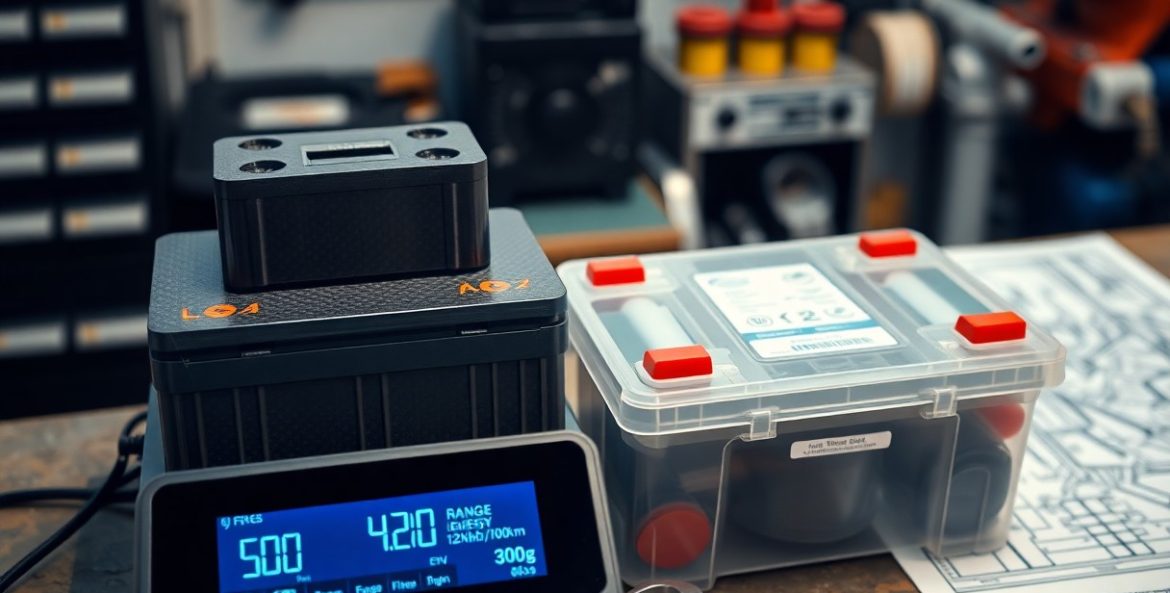
Many systems benefit when you reduce battery mass: by cutting weight you achieve longer operating range, lower energy consumption, and reduced mechanical strain, which together improve performance and lower lifecycle costs. You must also assess the increased safety risk if light-weighting compromises structural integrity or thermal management. Applying precise materials selection and design trade-offs ensures your system gains efficiency and reliability without introducing new hazards.
Types of Batteries
To assess trade-offs you should compare energy density, specific power and cycle life for each chemistry, since those parameters directly determine how much mass you can save without sacrificing performance.
| Chemistry | Typical metrics & applications |
|---|---|
| Lithium-ion (NMC/NCA/LFP) | 150-260 Wh/kg at cell level, 500-2,000 cycles; EVs, portable electronics, high-power systems |
| Lithium-polymer (LiPo) | Pouch-dominant form factor, slightly lower volumetric energy but better pack-level gravimetric efficiency; common in drones and mobile devices |
| Nickel-Metal Hydride (NiMH) | 60-120 Wh/kg, 300-1,000 cycles, high abuse tolerance; used in early hybrids and consumer products |
| Lead-acid | 30-50 Wh/kg, low cost, heavy; stationary backup and some starter applications |
- You prioritize energy density when mass reduction is the primary objective.
- You balance cycle life against upfront mass savings for long-lived systems.
- You assess safety and thermal behavior when trade-offs push you toward higher-density chemistries.
- You consider pack architecture and form factor because they often determine real-world gravimetric gains more than cell-level numbers.
Lithium-ion Batteries
You can rely on Lithium-ion formulations for the best mass-to-energy ratios: typical cell-level numbers range from 150-260 Wh/kg, with LFP variants nearer the lower end (90-160 Wh/kg) but offering higher thermal tolerance. Manufacturers like Tesla, Panasonic and CATL use NCA/NMC/LFP blends; in practice pack-level improvements reported across the industry have produced roughly 10-20% gains in gravimetric energy density over the last 5-7 years by combining higher-energy cathodes with thinner cell packaging.
You should focus on form factor and chemistry when reducing weight: switching from cylindrical to pouch cells, adopting tabless designs, or moving to higher-nickel cathodes can improve pack gravimetric efficiency by 5-15% depending on mechanical, cooling and safety requirements. Pay attention to thermal runaway risks and battery management trade-offs, because aggressive mass reduction often demands tighter thermal controls and advanced BMS strategies to keep your system safe and reliable.
Nickel-Metal Hydride Batteries
You will find Nickel-Metal Hydride useful where robustness and tolerance to abuse matter more than absolute gravimetric performance; typical energy densities sit around 60-120 Wh/kg and many hybrid vehicle packs historically used NiMH packs in the ~1-1.5 kWh range weighing on the order of 30-50 kg. Toyota’s early Prius models are a practical example: NiMH provided reliable performance and high cycle counts for regenerative-hybrid duty at the cost of additional mass.
You can expect NiMH to outperform lead-acid on energy density and temperature resilience while lagging behind modern Li-ion chemistries; typical self-discharge runs higher (~10-30% per month) and volumetric/gravimetric penalties mean you must plan for larger, heavier packs if you choose NiMH for safety or cost reasons. Cycle life is variable-often 300-1,000 cycles depending on depth-of-discharge and thermal environment-so your total system mass budget must include replacement and service considerations.
After comparing energy density, cycle life, safety profile and pack-level architecture you can select the chemistry that best meets your weight, performance and operational-safety targets.
Factors Influencing Battery Weight
Multiple variables determine battery weight and how it translates into system-level efficiency: cell chemistry drives energy density, cell format and module design set the proportion of active vs inactive material, and thermal or safety subsystems add lumped mass that doesn’t store energy. For instance, cell-level energy density commonly spans roughly 90-160 Wh/kg for LFP chemistries and about 200-260 Wh/kg for high-nickel NMC/NCA variants, so your chemistry choice alone can change pack mass per kWh by tens of kilograms.
- Material composition – cathode, anode, current collectors, separator, electrolyte
- Cell format – cylindrical, prismatic, pouch; cell size (e.g., 4680)
- Pack architecture – moduleization, mechanical reinforcement, structural integration
- Thermal management – air vs liquid cooling, integrated cooling plates
- Safety and BMS – fuses, sensors, enclosures and system-level redundancies
- System voltage and cabling – higher voltage reduces conductor mass
Trade-offs are measurable: switching to an 800 V architecture can let you reduce conductor cross-section by up to 50%, while adopting larger-format cells like the 46×80 mm family reduces tab and termination mass per kWh; these are engineering levers you use to shave tens of kilograms from the pack. Thou must balance those levers against cost, manufacturability and safety outcomes.
Material Composition
Choosing cathode and anode materials directly changes how much energy you get per kilogram: high-nickel NMC or NCA cathodes push cell-level energy density toward the 200-260 Wh/kg range, so your pack can be lighter for a given capacity, whereas LFP offers lower density (~90-160 Wh/kg) but brings benefits in cost and thermal stability. You also need to account for inert but heavy components – copper current collectors and thick metallic enclosures can add significant mass, and reductions in cobalt content lower both weight and supply-chain risk.
Secondary materials matter too: separators, electrolyte volume, and pouch or can thickness influence pack mass and safety. For example, swapping to thinner aluminum current collectors or adopting a lighter polymeric separator can shave several percent off cell mass, but you must evaluate the impact on conductivity and lifetime to avoid negative trade-offs.
Design and Engineering Choices
Cell format drives packaging efficiency: cylindrical cells typically have well-understood thermal pathways and high manufacturability but include more inactive packaging material per kWh than large prismatic or pouch cells; pouches can be optimized to reduce void space and enclosure mass, though they often require added structural support in the pack. When you select the 46×80 mm family, you get higher per-cell capacity and fewer interconnects, which reduces termination mass and simplifies cooling plate layouts.
Moduleization and whether the pack is structural have large downstream effects – integrating the pack as a load-bearing element can cut vehicle chassis mass by up to 10% in some designs, and liquid cooling systems, while adding roughly 10-30 kg depending on scale, enable higher continuous power without oversizing cells. You should quantify how each engineering choice moves the needle on mass versus performance and safety.
More specifically, optimizing busbar geometry, using high-voltage topologies to reduce conductor cross-section, and consolidating BMS functions onto fewer, lighter PCBs are practical tactics you can apply to reduce pack mass while preserving performance and meeting safety margins.
Tips for Reducing Battery Weight
Focus on targeted interventions that shave mass without degrading performance: prioritize cell chemistry and pack architecture first, then optimize enclosure and interconnects. You can achieve meaningful gains by combining material swaps with manufacturing changes – for example, a switch to a higher‑capacity anode blend plus a thinner current collector can yield a 5-15% pack mass reduction in many designs.
- battery weight
- energy density
- cell-to-pack
- silicon anode
- LFP
- structural battery pack
- laser welding
- pouch cells
Optimal Material Selection
When you evaluate electrode materials, consider specific capacity and volumetric density together: graphite has a practical capacity near ~350-372 mAh/g while silicon offers a theoretical ~3579 mAh/g, but in practice you should plan for a 10-30% net energy‑density improvement when using silicon blends because of expansion and cycle life tradeoffs. Choosing LFP over NMC may lower chemistry energy density by ~10-20% but can let you simplify thermal management and use lighter structural supports, which often compensates at the pack level.
- Quantify gravimetric vs volumetric gains for candidate electrodes (mAh/g and Wh/L).
- Select current collectors and foils optimized for thickness – moving from 20 µm to 10-12 µm copper where feasible saves several grams per kWh.
- Use lightweight casing alloys or composite housings to reduce enclosure mass without sacrificing stiffness.
Material Selection Comparison
| Material | Impact on Weight & Performance |
|---|---|
| Silicon‑graphite anode | Up to 10-30% energy density increase in practice; needs mitigation for expansion (prelithiation, buffer structures). |
| LFP cathode | ~10-20% lower cell energy vs NMC but allows lighter thermal systems and improved cycle life. |
| Thinner current collectors | Reducing foil thickness saves grams per cell; careful thermal/electrical design required to avoid heating issues. |
| Composite enclosures | Can reduce pack casing mass by 5-12% versus stamped steel while maintaining stiffness. |
Advanced Manufacturing Techniques
Adopt pack‑level innovations such as cell‑to‑pack (CTP) integration to eliminate module hardware: many OEM case studies report a ~10-15% reduction in module/pack structural mass and a corresponding improvement in volumetric energy density. You should also evaluate pouch or prismatic formats where the packaging mass per kWh is lower than cylindrical cells for your form factor.
Process changes like dry electrode coating and precision laser or ultrasonic welding let you reduce binder and adhesive mass while tightening tolerances – dry coating can increase electrode loading and reduce process solvent usage, and precision welding reduces bulky mechanical fasteners that add several hundred grams per pack in large systems.
- Implement cell‑to‑pack to remove module frames and simplify busbar architecture.
- Use laser/ultrasonic welding to replace heavy bolts and clamps in high‑current paths.
- Adopt dry coating or calendaring improvements to raise areal capacity and reduce stack height.
Manufacturing Techniques Comparison
| Technique | Typical Impact |
|---|---|
| Cell‑to‑pack (CTP) | Eliminates module hardware; ~10-15% pack mass savings reported in production programs. |
| Laser/ultrasonic welding | Reduces connector mass and improves joint density; lowers stray conductor length. |
| Dry electrode | Increases electrode loading by up to 10%, reduces solvent handling and coating thickness. |
| Structural pack integration | Combines casing and chassis roles to cut ancillary mass; used in automotive structural battery concepts. |
When you sequence manufacturing upgrades, start with low‑risk process controls (tighter calendering tolerances, optimized torque on fasteners) before moving to high‑impact changes like CTP or dry coating; pilot runs typically reveal whether the theoretical 5-15% mass savings are realizable for your product geometry and duty cycle.
Any changes you implement should be validated with a full system‑level mass, thermal, and safety analysis before production.
Step-by-Step Guide to Weight Reduction
Weight Reduction Roadmap
| Step | Action & Metrics |
|---|---|
| Baseline assessment | Weigh cells, modules, thermal hardware, enclosure and electronics separately; measure pack-level energy density (Wh/kg) and volumetric density (Wh/L). Use sample size n≥5 packs and target baseline KPIs (e.g., 180-260 Wh/kg for Li-ion cells) to quantify improvement potential. |
| Identify heavy components | Rank top mass contributors; cooling systems and enclosure commonly represent 15-30% of pack mass. Focus first on parts that are >5% of total mass. |
| Cell & architecture choices | Compare pouch, prismatic, and cylindrical options; pursue cell-to-pack or module-less designs to cut module hardware by ~10-15% and improve pack gravimetric energy density by ~5-10% in examples from recent OEM programs. |
| Material substitution | Use high-strength aluminum alloys, magnesium where appropriate (≈33% lighter than aluminum by density), or CFRP lids for targeted components; expect component-level weight drops of 20-40% with tradeoffs in cost and manufacturability. |
| Thermal & cooling optimization | Switch to microchannel cooling or PCM to reduce coolant volume and plumbing mass – typical coolant mass savings: 1-3 kg per EV pack. Validate heat transfer at 1C-3C charge/discharge rates. |
| Structural integration | Integrate the pack as a chassis member where possible; structural packs have delivered vehicle-level mass savings of 20-30 kg in production examples, but require rigorous crash and NVH validation. |
| Manufacturing & fasteners | Replace mechanical fasteners with structural adhesives and laser-welded joints to reduce hardware mass (fasteners often 2-5% of pack mass); validate repairability and service procedures. |
| Validation & pilot | Run a pilot lot (e.g., 50-200 packs), perform UN38.3, IEC/SAE abuse tests, vibration per ISO/IEC standards, and monitor warranty returns; set acceptance criteria such as ≤5% change in thermal margin and target 5-10% pack mass reduction. |
Assessing Current Battery Designs
You should disassemble a representative sample of packs and log mass at the subcomponent level – cell, module frame, busbars, cooling plates, enclosure, sensors and connectors – using scales with 0.1 g resolution for small parts and ±50 g for full modules. Quantify KPIs like pack Wh/kg, Wh/L and internal resistance; for example, if your baseline pack is 200 Wh/kg and the enclosure accounts for 18% of mass, removing 30% of enclosure mass would increase pack-level specific energy by roughly 5%.
Run thermal and mechanical simulations in parallel: finite element analysis for crash and stiffness, and CFD for cooling-path efficacy at expected power profiles (continuous power, 1C-3C peak). When you identify targets, validate that any removed material does not reduce thermal margins – hotspots exceeding 85°C under worst-case abuse can indicate unacceptable risk. Use historical case data: teams that replaced oversized busbar designs cut pack mass 4-8% while keeping thermal rise under 10°C at 2C discharge.
Implementing Lightweight Materials
You can prioritize material swaps with the highest mass-to-cost return: switch sectioned enclosure panels to high-strength aluminum 6000-series with optimized wall gauges to cut thickness by 20-30% without losing stiffness, or use magnesium for non-structural covers where corrosion is controlled. Carbon fiber reinforced polymer (CFRP) lids can drop lid mass by 20-40% versus aluminum in many programs, but expect material costs to increase by 2-4× and plan for different repair and recycling flows.
Design for hybrid multi-material assemblies: combine an aluminum base for crash energy absorption with a CFRP or glass-fiber reinforced polymer (GFRP) lid and structural adhesives to eliminate many mechanical fasteners – that approach often yields a net pack mass reduction of 5-15% in production validations. You must confirm flame retardancy and venting paths when introducing polymers; polymer housings can alter vent behavior and increase thermal propagation risk if not engineered with appropriate vent channels and thermal barriers.
Start implementation with targeted prototypes: perform crash, thermal abuse, salt spray and vibration testing on 10-20 prototype packs, and iterate material thickness and bonding methods using FEA and physical test correlation. Expect typical commercial programs to achieve material-driven mass reductions of 3-12% per iteration cycle; track cost per kilogram saved to prioritize which substitutions to scale. Work closely with suppliers (e.g., CFRP and specialty aluminum vendors) to validate long-lead raw-material availability and to define joining techniques compatible with production volumes.
Pros and Cons of Weight Reduction
| Pros | Cons |
|---|---|
| Improved range and endurance (lower mass reduces energy required per km or per hover). | Higher cell energy density can raise thermal runaway risk if not mitigated. |
| Better payload margin – you can carry more useful load for the same gross weight. | Cost increases from advanced chemistries or lightweight structural materials. |
| Reduced cycle energy loss during acceleration; drivetrain and brakes see lower peak loads. | Potential loss of mechanical robustness; thinner enclosures reduce crush and puncture tolerance. |
| Lower wear on mechanical components (tires, bearings), extending subsystem life. | More complex thermal management needed because less thermal mass can raise temperature transients. |
| Opportunities for smaller system packaging and lower BOM for ancillary systems. | Supply-chain pressure for high-energy cells (reliance on newer materials and limited suppliers). |
| Faster response for energy-limited applications (drones, portable equipment) allowing longer missions. | Diminishing returns: structural and safety hardware begin to dominate pack mass reductions. |
| Potential regulatory benefits in weight-constrained platforms (light aircraft, small robots). | Cycle-life trade-offs: some high-energy formulations degrade faster unless managed. |
| Lower transport costs and easier handling during manufacturing and maintenance. | Integration redesign effort (mechanical, electrical, certification) can add schedule risk. |
Benefits to System Efficiency
By increasing cell-level energy density from, for example, 200 Wh/kg to 250 Wh/kg, you can reduce pack mass by roughly 20% for the same usable capacity, which directly lowers the energy per distance or per hour your system consumes. In electrified vehicles that typically operate in mixed urban/highway cycles, a 10-15% reduction in battery mass commonly yields a 3-8% range improvement; in multirotor UAVs, similar mass savings often translate into 15-30% longer hover time because hover energy scales strongly with weight.
Reduced battery mass also eases demands on supporting systems: you’ll see lower peak currents during acceleration, smaller mechanical stress on mounts, and less heat generated in auxiliary subsystems. For system-level design, that means you can downrate some components (lighter suspension, smaller motors, or reduced cooling capacity), and these secondary reductions often compound efficiency gains – in certain vehicle architectures this can shift total system mass by another 5-10% beyond the cell-level savings.
Potential Downsides and Trade-offs
Pushing weight reduction often requires moving to higher-energy chemistries or thinner structural components, and those choices increase safety and lifecycle risks if you don’t change the pack architecture and controls. For instance, switching to cells at the higher end of energy density can increase cell cost by roughly 10-30% and may demand upgraded BMS hardware and software to manage tighter thermal margins; without those upgrades you could experience accelerated capacity fade or elevated failure rates.
Mechanical integrity is another common trade-off: as you strip enclosure and support structure mass, pack resistance to impact or penetration drops, creating a greater chance of catastrophic failure under crash or abuse scenarios. In practical terms, structural and safety hardware can constitute 10-25% of pack mass, so once cell mass is reduced substantially, these items become the limiting factor and you face diminishing returns unless you redesign the mechanical system.
Mitigation typically involves targeted investment: you should pair high-energy cells with enhanced thermal management (heat pipes, active cooling), add cell-level fusing and mechanical cradles, and run expanded accelerated life and abuse tests. Those fixes recover safety and longevity but they add cost and complexity, so you need to run a use-case-specific trade study – for short-duration UAV missions the increased cost might be justified, whereas for grid storage you’ll likely favor longevity over minimal mass.
Conclusion
So by reducing battery weight you lower the energy required to accelerate and maintain motion, which directly improves system efficiency and extends operational range. Lighter batteries reduce mechanical losses and inertia, improve regenerative energy capture, ease thermal management, and allow powertrain components to operate closer to their optimal efficiency points, so your whole system performs better with less energy input.
When you consider system-level design, shedding battery mass enables smaller motors, reduced cooling capacity, and lighter structural supports, which compound efficiency gains and can lower total cost of ownership. Implementing weight reduction thoughtfully-balancing energy density, safety, and lifecycle impacts-lets you maximize performance while meeting reliability and regulatory requirements.