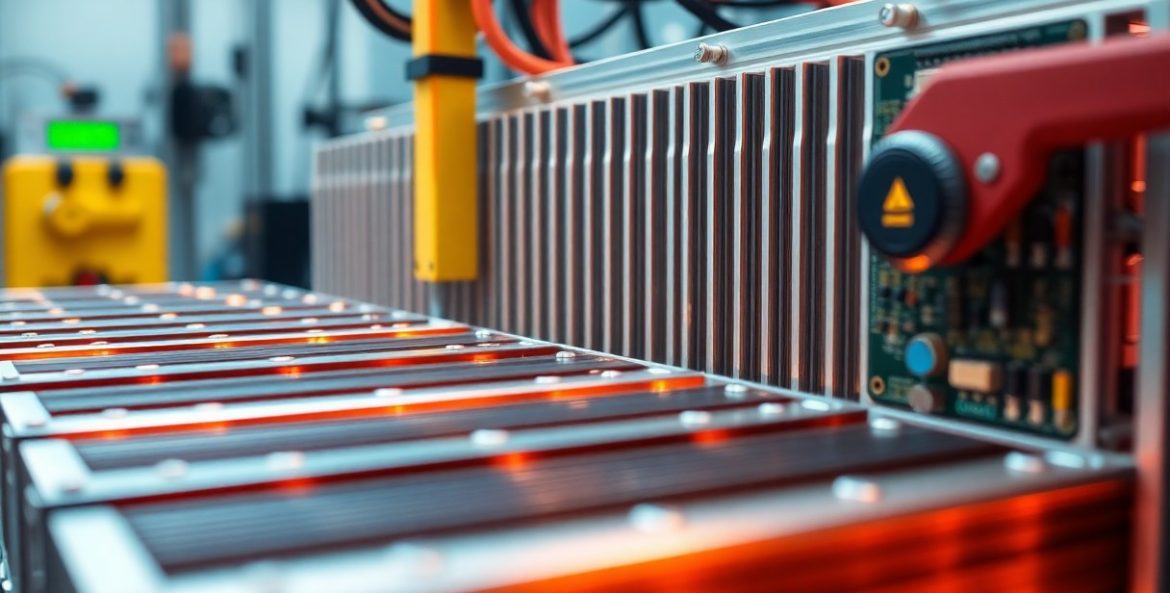
There’s no substitute for rigorous design when you engineer battery modules for longevity: you must prioritize robust thermal management, accurate cell balancing, and high-quality materials; mitigate thermal runaway and overcharge risks with redundant safety systems and conservative state-of-charge limits, implement predictive maintenance through data-driven monitoring, and design for serviceability so your modules remain safe and performant over years of cycling.
Types of Battery Modules
| Module Type | Key characteristics |
|---|---|
| Lithium-ion | High energy density (150-260 Wh/kg), requires active BMS and thermal management, common in EVs and grid-edge storage |
| Nickel-metal Hydride | Moderate energy density (60-120 Wh/kg), tolerant to overcharge, used in hybrids (e.g., Toyota Prius ~1.3 kWh), higher self-discharge |
| Lead-acid | Low energy density (30-50 Wh/kg), cost-effective for backup and starter applications, heavy and requires ventilation |
| Flow / Other | Scalable energy capacity, long calendar life, separate electrolyte tanks for long-duration storage but lower power density |
- Cell chemistry – governs energy density, voltage, and failure modes
- Cycle life – designed cycles before 80% capacity (e.g., LFP >2000 cycles, typical Li‑NMC 1000-1500)
- Thermal management – decisive for safety and aging, especially with high C‑rate cells
- BMS / cell balancing – extends module life by preventing cell over/under voltage
- Mechanical packaging – affects thermal paths and vibration resilience
Lithium-ion Batteries
You will encounter Lithium-ion modules as the default choice when you need high gravimetric and volumetric energy. Their energy density typically ranges from 150-260 Wh/kg, with NMC chemistries skewing higher for energy and LFP offering lower energy but far superior cycle life (>2000 cycles in manufacturer tests). For module engineering you must provision for active thermal management, redundant sensing, and precise cell balancing to avoid capacity drift across cells.
When you design for long term reliability, assume worst‑case abuse: high C‑rate charge/discharge, elevated ambient temperatures, and occasional cell mismatch. Failure modes include internal shorting and thermal runaway for some chemistries, so incorporate passive and active safety layers (fusing, current interrupt devices, and temperature cutouts). Field data from EV fleets show that packs with dedicated cooling and cell‑level balancing sustain >80% capacity after 8-10 years under typical duty cycles.
Nickel-metal Hydride Batteries
You should consider Nickel-metal Hydride when tolerance to overcharge and a stable thermal profile matter more than absolute energy density. Typical energy density sits around 60-120 Wh/kg, and cycle life commonly falls in the 500-1000 cycle range depending on depth of discharge and charge algorithm. Hybrids such as early Toyota Prius systems (~1.3 kWh) demonstrate NiMH’s robustness under frequent charge/discharge pulses and high cell count packaging.
Design implications for your modules include accommodating higher self-discharge (often 10-20% per month at ambient) and ensuring adequate ventilation for heat during rapid charge. You can simplify BMS requirements compared with lithium packs, but you still need accurate state-of-charge estimation and temperature compensation to prevent accelerated degradation during sustained high temperatures.
Operationally, you can extend NiMH life by limiting deep discharges and using temperature-controlled charge profiles; manufacturers report that maintaining charge cutoff at a modest overvoltage and avoiding prolonged float at high temperature can push cycle life toward the upper end of expected ranges.
Lead-acid Batteries
You will find Lead-acid modules where cost per kWh and proven performance for short-term high-current delivery dominate the spec sheet. Energy density typically ranges from 30-50 Wh/kg, making them heavy for mobile applications but economically attractive for stationary backup and automotive starter systems. Expect cycle life from a few hundred cycles (deep‑cycle variants) to over a thousand for well‑maintained flooded systems under shallow cycling.
From an engineering standpoint, you must address corrosion, sulfation risk with partial state‑of‑charge operation, and the hazards of sulfuric acid – ventilation and containment are mandatory. Valve-regulated AGM and gel variants reduce maintenance but still require design attention to cell balancing and temperature to avoid accelerated water loss and capacity fade.
When you specify lead‑acid for reliability, implement regular equalization charges in stationary systems, monitor specific gravity or voltage trends, and design enclosures that mitigate vibration and provide acid spill containment to preserve cycle life.
Perceiving the trade-offs between Lithium-ion, Nickel-metal Hydride, and Lead-acid allows you to align module architecture, thermal systems, and BMS strategies with your long‑term reliability targets.
Factors Influencing Reliability
Multiple, interacting variables drive how your modules age in the field; you must balance electrochemical limits, thermal management, mechanical design and system-level control to meet target lifetimes. When you design, focus on the dominant drivers for your use case-whether that’s daily deep cycling for grid storage or long calendar life for backup power-and quantify trade-offs with accelerated testing and field data.
- Temperature Effects
- Cycle Life
- Environmental Conditions
- State of Charge (SOC) Window
- Manufacturing Quality & Process Control
- Mechanical Stress and Vibration
- Battery Management System (BMS) Strategy
After you map these variables to your operational profile and failure modes, prioritize mitigations such as targeted thermal control, SOC window limits, enhanced sealing and tighter process controls to reduce the highest risks.
Temperature Effects
High temperatures accelerate chemical side reactions inside cells: you should assume reaction rates roughly double for every 10°C increase (Arrhenius behavior), which directly speeds capacity fade and electrolyte decomposition. Cells operating continuously above ~45-50°C will age far faster; by contrast, low temperatures raise internal resistance and create a lithium plating risk during charging below 0°C, which can produce permanent capacity loss and safety hazards if not managed through charge-temperature limits.
Thermal gradients inside a module create unequal aging-hot spots see faster SEI growth and greater resistance growth-so your thermal design must minimize ΔT between cells. Active liquid or forced-air cooling that keeps cell-to-cell temperature spread within ±2-5°C can significantly improve uniformity and extend module life; conversely, poor conduction paths or blocked channels can produce single-cell failure modes that cascade.
Temperature impact summary
| Condition | Effect on module |
|---|---|
| Elevated temperature (each +10°C) | Reaction rates ~2×; faster capacity loss and electrolyte breakdown; higher risk of thermal events at extreme temps |
| Low temperature (below 0°C) | Increased internal resistance; reduced usable capacity; charging can cause lithium plating |
| Thermal cycling | Mechanical stress on welds and tabs; SEI expansion/ contraction accelerates fade |
| Thermal gradients | Uneven aging; single-cell over-stress and premature module imbalance |
Cycle Life
Cycle life is governed by depth-of-discharge (DOD), charge/discharge rates (C-rate), and SOC window: deeper discharges and higher C-rates shorten life. For example, many NMC cells exhibit on the order of several hundred to a few thousand cycles depending on DOD-cycling at 100% DOD can produce ~500-1,000 cycles for some chemistries, while limiting DOD to ~80% commonly increases cycle count substantially; LFP cells frequently achieve >2,000-3,000 cycles under moderate DOD in lab tests.
Your BMS and system controls directly shape cycle durability: you should implement partial depth cycling, avoid prolonged time at high SOC, limit fast-charge episodes, and enable cell balancing to keep capacity fade uniform. Field data from EV fleets shows that reducing full-depth cycles and moderating peak charge power can extend pack life by a factor of two or more depending on duty.
More info: cycle degradation is often reported as a percentage of original capacity retained after X cycles (e.g., 80% capacity at 1,000 cycles). Testing under application-representative profiles (including rest periods, temperature profiles and charge rates) gives far more accurate lifetime projections than constant-current lab cycles; thus you should correlate accelerated test data with real-world telemetry to validate warranty claims.
Environmental Conditions
Humidity, salt exposure, dust ingress and corrosive atmospheres attack connectors, busbars and PCBs: your enclosure and material choices matter. Specify an appropriate ingress protection rating (IP65/IP67, etc.) and choose corrosion-resistant materials-stainless or plated conductors, conformally coated electronics-to prevent connector failure within months in marine or industrial environments.
Mechanical environment also matters: vibration and shock lead to weld fatigue, tab rupture and connector loosening. You should design for expected random vibration spectra (for example, 5-500 Hz harshness in automotive/industrial contexts) and validate with vibration testing plus shock and drop tests; elastomeric mounts and potting can mitigate many mechanical failure paths.
More info: combine environmental mitigation-IP-rated housings, desiccants or sealed cavities, conformal coatings and use of stainless or plated fasteners-with periodic inspection plans. Effective sealing and coatings can prevent corrosion and moisture-induced shorts, while mechanical isolation strategies preserve electrical joints and extend field reliability.
Tips for Enhancing Battery Life
You should prioritize managing temperature, state of charge (SoC), and depth of discharge (DoD) as the first line of defense against premature aging: keep cells in the ~15-30°C window for daily use, avoid repeated full-depth cycles, and target an operational SoC band of roughly 20-80% for long service life. Implement a BMS that enforces cell balancing, over/under-voltage cutoffs, and thermal derating; in field trials, systems that apply active balancing every 100-200 cycles show measurable capacity retention advantages after 2-3 years compared with passive-only solutions.
For charge/discharge rates, design for nominal C-rates near 0.5C and avoid sustained >1C charging except when necessary for short bursts-this reduces heat generation and internal resistance growth. When you quantify trade-offs, a battery cycled at 0.5C and held within the 20-80% SoC range typically achieves 1.5-2× the cycle life of a unit frequently pushed to 100% SoC at 1C; incorporate these targets into specifications and maintenance plans.
- BMS
- State of Charge
- Depth of Discharge
- Temperature management
- Charge rate (C-rate)
Optimal Charging Practices
You should adopt staged charging profiles: bulk charging up to ~80% at a controlled current, then taper to a lower current for the final 10-20% to limit electrode stress and heat. Practical implementations use a two-stage algorithm-constant-current until 80% SoC, then constant-voltage taper-reducing lithium plating risk and extending calendar life; for many Li-ion chemistries, that means limiting the constant-voltage hold to the minimum time necessary to achieve the required SoC.
When fast charging is unavoidable, you must compensate with stricter thermal controls and lower average DoD across the fleet: for example, permit 1C fast charges for emergency replenishment but enforce a rest-and-balance cycle within the next 10-20 cycles and keep operating temperatures below 40°C. Use charge scheduling to exploit off-peak periods and avoid topping to 100% unless the duty cycle requires it; this simple policy can reduce capacity fade rates by a noticeable percentage over multi-year deployments.
Regular Maintenance
You need a maintenance cadence that combines visual inspections, electrical tests, and mechanical checks: perform monthly visual and connector inspections, torque checks and busbar inspections every 3-6 months, and cell impedance or capacity tests every 6-12 months depending on duty cycle. If internal resistance climbs more than ~20% versus baseline or you see >5% mismatch in cell voltages after balancing, schedule targeted replacements or reconditioning to avoid cascade failures.
Safety-focused checks belong to your highest priorities: verify insulation resistance, confirm thermal sensor calibrations, and test the BMS trip thresholds at least annually; documented failures in these areas correlate strongly with incidents of thermal runaway in archived incident reports. Maintain spares and a documented replacement procedure so you can swap affected modules rapidly and keep the rest of the system within safe operating limits.
Implement a data-driven maintenance program that uses logged charge/discharge cycles, temperatures, and impedance trends to trigger interventions; predictive thresholds-such as a projected end-of-life within 6-12 months based on measured fade-let you plan replacements during scheduled downtime rather than in response to failures.
Storage Recommendations
You should store modules at a moderated SoC-typically around 40% SOC-and in a cool, dry environment between 10-20°C to minimize calendar aging; room-temperature storage at high SoC accelerates capacity loss, while sub-zero conditions risk electrolyte crystallization in some chemistries. When long-term storage is necessary, power the BMS in monitoring mode and schedule periodic top-ups to maintain the target SoC rather than leaving cells at full charge.
For logistics chains, label modules with SoC and storage date, rotate stock on a first-in, first-out basis, and avoid stacking that impedes airflow; in one industrial fleet case study, simple adherence to 40% SoC storage and quarterly checks reduced return-to-service failures by over 30% compared with unmanaged storage. If you must store for more than 12 months, plan intermediate functional tests (impedance and capacity) at 6-9 month intervals to detect early degradation.
Any prolonged storage at elevated temperatures or sustained high SoC will accelerate irreversible aging and increase the risk of dangerous events, so integrate environmental logging and automatic alerts into your warehouse management system.
Step-by-Step Guide to Engineering Reliable Modules
| Step | Action / Detail |
|---|---|
| Designing the Module | Define electrical architecture (example: 13s for 48V nominal or 16s for 60V nominal), specify cell balancing strategy, thermal path, mechanical tolerances (±0.1 mm for cell holders), and busbar sizing to handle continuous and peak currents (design for 1.5× expected peak). |
| Selecting Materials | Choose cell chemistry by lifecycle needs (LFP: 90-160 Wh/kg, >2000 cycles; NMC: 150-220 Wh/kg), select busbar materials (nickel-plated copper), TIMs (k = 1-5 W/m·K), flame-retardant housings (UL94 V-0), and connectors with low contact resistance (<0.5 mΩ). |
| Quality Control Testing | Implement incoming inspection (100% voltage/IR check), functional testing (BMS, balancing), environmental stress (thermal cycling −40→60 °C ×100 cycles), electrical safety (hi-pot at 1.5× operating voltage, controlled short-circuit), and sample cycle-life tests (e.g., 1000-2000 cycles at 0.5-1C to target DoD). |
Designing the Module
You should start by locking down the electrical topology and then validate thermal and mechanical constraints against that topology; for a 50-60 V pack many engineers use 16s or 13s cell strings and design busbars to carry at least 1.5× peak current with cross-sections sized to keep temperature rise under 20 °C at continuous load. Specify cell clamping tolerances (±0.1 mm) and torque values for fasteners-example: M6 terminations at 6-8 Nm depending on plating-and design clear thermal paths using copper spreaders or aluminum heat sinks to keep hottest cell ΔT below 10-15 °C under peak duty.
Next, integrate safety layers into the mechanical design: place pressure relief ventilation, isolation barriers, and foldback current paths so that a single cell fault cannot cascade; include 2-stage protection in the BMS (cell-level balancing and pack-level contactors) and plan space for fuses or PT/NTC sensors. When you prototype, instrument at least three modules with thermocouples and current clamps to validate predicted hotspots and iterate mounting geometry until thermal gradients and electrical contact resistances meet target specs.
Selecting Materials
You should favor materials that match your lifetime and safety profile: choose LFP when you need longevity and thermal stability-expect >2000 cycles at 80% DoD-or NMC when energy density (150-220 Wh/kg) is the priority. For conductors, use nickel-plated copper busbars or pure copper with protective plating to limit contact resistance; specify TIMs with thermal conductivity in the 1-5 W/m·K range for cell-to-cooler interfaces and housings rated UL94 V-0 to reduce flammability risk.
Also select electronic components with derating margins: MOSFETs and contactors should be rated for at least 1.5× continuous current and 2× transient, and sense resistors should have ppm-level temperature coefficients for accurate current measurement. Use gold- or silver-plated contacts where low resistance and corrosion resistance matter, and require material traceability from suppliers with ISO 9001 to support batch-level failure analysis.
When qualifying suppliers, insist on process capability metrics (Cpk), first-article inspection reports, and certificates of conformance; you can reduce field failures by disallowing materials with known decomposition below your maximum operating temperature and by requiring flame-retardant test reports for polymer parts.
Quality Control Testing
You should build a layered test plan: start with 100% incoming checks (cell voltage, internal resistance, visual) then run functional tests on every assembled module-BMS behavior, balancing action, insulation resistance, and wiring continuity-with acceptance gates tied to measured thresholds (for example, IR <5 mΩ for high-power cells or cell-to-cell voltage imbalance <10 mV after balancing). Include environmental stress tests such as thermal cycling (−40→60 °C, 100 cycles) and vibration per IEC profiles to expose mechanical or contact failures before production release.
Afterwards, perform electrical safety tests on every unit or on a statistically significant sample: hi-pot testing at 1.5× operating voltage for a defined dwell time, controlled external short-circuit to validate protection limits, and forced overcharge tests on sample cells under BMS supervision to ensure safe shutdown behavior. Maintain a zero-defect tolerance for safety-critical failures and log all test results to the serial-numbered build record for traceability.
For ongoing production control, implement a sampling plan (e.g., 1% destructive tear-down, 100% non-destructive functional testing) and a closed-loop defect feedback process: use root-cause analysis on any failure, update inspection criteria, and require corrective action reports from suppliers when material or process-related issues are found.
Pros and Cons of Different Battery Types
| Battery Type | Pros / Cons |
|---|---|
| Lithium‑ion (NMC / NCA) | Pros: High energy density (~150-260 Wh/kg), excellent power for automotive use; proven supply chain. Cons: Sensitive to high temperature and overcharge; requires active BMS and cell balancing; thermal runaway risk if abused. |
| LiFePO4 (LFP) | Pros: Very long cycle life (2,000-5,000 cycles), superior thermal and chemical stability, lower cost per cycle for stationary and low‑range EV uses. Cons: Lower energy density (~90-160 Wh/kg), larger module volume and weight for same capacity. |
| Lead‑acid (VRLA / Flooded) | Pros: Low upfront cost, mature recycling infrastructure, robust for short‑duration backup power. Cons: Very low energy density (~30-50 Wh/kg), poor deep‑cycle life (200-500 cycles), hydrogen evolution and sulfation risks if misused. |
| NiMH | Pros: Tolerant to abuse, reliable at moderate temperatures, proven in hybrid vehicles (e.g., earlier Toyota hybrids). Cons: Moderate energy density (~60-120 Wh/kg), higher self‑discharge than Li‑ion, heavier than modern Li‑ion cells for same capacity. |
| Solid‑state (emerging) | Pros: Potential for much higher energy density (>300 Wh/kg projected) and improved safety due to non‑flammable electrolytes. Cons: Manufacturing scale, interface stability, and cost remain limiting factors; commercial packs still limited and often experimental. |
Advantages
You can tune your module architecture around clear, measurable advantages: if you need maximum range or high power density, choosing conventional lithium‑ion chemistries (NMC/NCA) gives you 150-260 Wh/kg and proven performance for EVs and aerospace applications. Conversely, when lifecycle and safety matter more than volume, selecting LiFePO4 delivers 2,000-5,000 cycles and superior thermal stability, which directly reduces replacement frequency and long‑term system cost.
In practical deployments you’ll also benefit from mature ecosystems: lead‑acid remains cost‑effective for short‑term backup where weight isn’t a constraint, and NiMH has shown robustness in hybrid powertrains. Meanwhile, solid‑state promises game‑changing energy density and safety; pilot programs indicate potential for >300 Wh/kg, but you should weigh that against current availability and integration risk.
Disadvantages
Trade‑offs often bite you at the system level: higher energy density chemistries amplify thermal and abuse risks, so Li‑ion packs demand robust BMS, active cooling, and strict cell matching to avoid thermal runaway. If you operate cells at elevated state‑of‑charge and temperatures (for example, sustained exposure around 40 °C), you can see cycle life reduced by a large fraction versus room‑temperature baselines, increasing replacement and warranty costs.
Material and manufacturing limitations also constrain choices – lead‑acid’s low cycle life and sulfation issues (especially under partial‑state‑of‑charge duty) will force you into frequent maintenance, and emerging solid‑state technologies still present manufacturing scale and interface durability challenges that raise initial pack cost and integration complexity.
From a commercial perspective you must also consider lifecycle economics: pack price points in recent years have trended toward roughly $100-150/kWh for many automotive Li‑ion systems, but total cost of ownership can swing in favor of LFP or other long‑life chemistries when duty cycles exceed a few thousand cycles – a single wrong chemistry choice can markedly increase your operational expenses and safety mitigation burden.
Future Trends in Battery Technology
You will see the next wave of improvements driven less by incremental tweaks and more by wholesale changes to cell chemistry and architecture, where material innovation and packaging converge to boost longevity and pack-level reliability. Expect research and early commercialization to focus on combining lithium-metal or silicon-based anodes with solid or highly stabilized liquid electrolytes to push specific energy from today’s ~250 Wh/kg toward the 400-500 Wh/kg range while trying to preserve cycle life and safety.
As these technologies move from coin cells to pouch and cylindrical formats, your engineering work will shift toward managing mechanical stresses, thermal hotspots, and manufacturability-areas where small design choices change whether a high-energy cell becomes a reliable module or a thermal-risk asset. Higher energy density increases the severity of failure modes, so pack-level sensing, fault-tolerant BMS strategies, and scalable cell-level controls will become standard elements of long-term reliability engineering.
Innovations in Materials
You should watch how silicon anodes, despite a theoretical capacity near 3,500 mAh/g versus graphite’s 372 mAh/g, are being tamed with nanostructures, prelithiation, and advanced binders to limit the ~300% volumetric swelling that causes mechanical failure. At the same time, transition to higher-nickel NMC (e.g., NMC811) and cobalt-reduced chemistries is cutting cost and increasing energy density, but demands tighter control of cathode coatings and electrolyte additives to prevent oxygen release and surface degradation at elevated states of charge.
Solid electrolytes-sulfide, oxide and polymer types-are being engineered to form stable interfaces with lithium metal and silicon, offering the promise of dendrite suppression and improved safety; however, you’ll need to balance ionic conductivity (>1 mS/cm target for sulfides) against mechanical brittleness and processability in roll-to-roll manufacturing. Dendrite penetration and interface impedance remain primary failure drivers, so material-level fixes like thin ceramic interlayers, artificial SEI chemistries, and controlled stack pressure are active areas where you can directly influence module reliability.
Advancements in Energy Density
You’ll encounter multiple pathways to raise pack-level Wh/kg: stacking more active material, switching to lithium-metal anodes, or adopting high-voltage cathodes (>4.3 V) paired with stabilized electrolytes. Industry benchmarks aim for roughly a 50-100% increase in gravimetric energy over current commercial cells, but higher voltages and metal anodes amplify parasitic reactions and thermal runaway risk unless matched with tailored electrolyte formulations and robust thermal management.
For deeper context, lab demonstrations combining lithium-metal anodes with sulfide solid electrolytes have reported cell-level specific energies exceeding 400 Wh/kg at coin-cell scale, yet they typically struggle to meet the >1,000-cycle targets you’d expect for EV applications due to interfacial degradation and stack-level swelling. To translate these gains into reliable modules, you will need to address pouch-to-pack mechanical constraints, develop scalable stack pressures, and implement enhanced cell monitoring so that the theoretical energy-density improvements do not come at the expense of long-term safety and cycle life.
Conclusion
With this in mind, when you design and engineer battery modules for long-term reliability you should focus on selecting cells with appropriate chemistry and quality margins, implementing active thermal management, and building a resilient battery management system that handles balancing, fault detection, and graceful degradation. You should also ensure robust mechanical integration and manufacturability to prevent stress and connection failures, and include redundancy and protection features so individual faults do not compromise the entire system.
To sustain performance across the module lifetime you must invest in accelerated testing, field data collection, and predictive analytics so your maintenance and firmware strategies evolve with actual aging patterns. By combining conservative design margins, modular serviceability, controlled supply-chain practices, and continual diagnostic updates, you give your systems the best chance of meeting long-term reliability and safety targets.