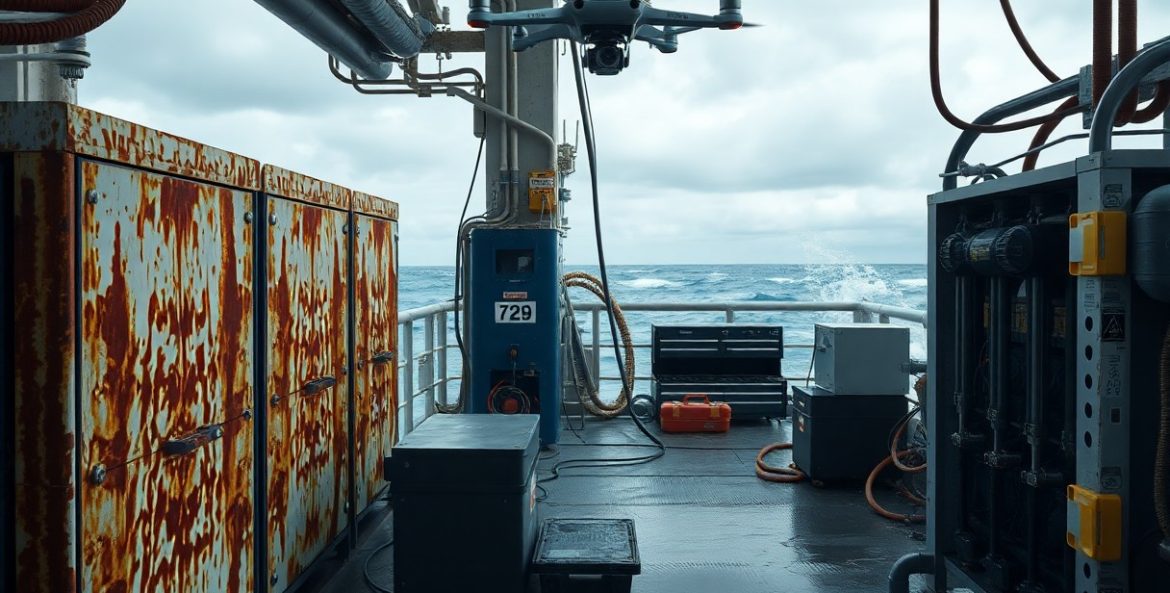
This guide helps you assess and manage energy storage in marine environments, focusing on corrosion, biofouling, and fire/thermal runaway risks that can rapidly degrade systems and threaten safety, while addressing limited maintenance access and harsh weather operational constraints; it highlights advances in ruggedized battery chemistries and flow/solid‑state systems that improve reliability and enable renewable integration, and guides you on inspection, sealing, and safety protocols to protect your assets and crew.
Types of Energy Storage Solutions
| Solution | Marine considerations |
|---|---|
| Mechanical (flywheel, CAES) | High power bursts, long cycle life; requires robust sealing, vibration control, and protection from saltwater corrosion. |
| Chemical (batteries, hydrogen) | High energy density options available; needs thermal management, gas handling, and mitigation for flammability and chemical leakage. |
| Electrical (supercapacitors, SMES) | Excellent power density and fast response; limited energy capacity, sensitive to temperature and electromagnetic interference in ship environments. |
| Hybrid / Integrated systems | Combine strengths (e.g., batteries + supercapacitors) to balance energy and power needs while minimizing single-point failures. |
Mechanical Storage
You can leverage flywheels for shipboard power smoothing and emergency ride-through: modern composite rotor systems deliver very high power for short durations and can achieve >100,000 cycles with minimal capacity fade. In practice, systems sized from tens of kW to several MW handle pulse loads on naval vessels and offshore platforms, but you must account for rotational failure risk and ensure containment and redundancy to avoid catastrophic energy release.
Compressed air solutions and subsea CAES concepts offer the potential for multi-MWh storage when integrated with seabed cavities or pressure-balanced tanks; however, you will face challenges sealing high-pressure systems against seawater ingress, managing thermodynamic losses, and protecting mechanical interfaces from biofouling and corrosion.
Chemical Storage
You will encounter the widest set of trade-offs with chemical storage: lithium-ion batteries give attractive gravimetric densities (commonly in the range of ~100-250 Wh/kg depending on chemistry) and are already used in ferries and offshore vessels for propulsion and hotel loads. Still, you need aggressive thermal management and IP-rated enclosures because thermal runaway and salt-driven connector corrosion are high-consequence hazards in marine settings.
Hydrogen and fuel-cell chains shift mass to storage and handling: hydrogen offers ~33 kWh/kg on a gravimetric basis but very low volumetric energy unless compressed or liquefied, forcing you to trade space, insulation, and safety systems aboard. Metal hydrides and chemical carriers can mitigate volumetric issues but introduce complexity, weight, and new maintenance regimes.
More specifically, when you evaluate battery chemistries choose LFP if safety and cycle life under warm, saline air matter most, or higher-energy NMC chemistries when range and compactness are prioritized; plan for corrosion-resistant busbars, secondary containment for electrolyte leaks, and gas detection systems to detect flammable or toxic releases.
Electrical Storage
You should consider supercapacitors and SMES for power-quality and high-rate discharge tasks: supercapacitors sustain millions of cycles with rapid response (milliseconds) and are ideal for load leveling and regenerative braking on electric ferries. However, their low energy density means they are rarely used alone for long-duration energy needs.
SMES offers near-instantaneous discharge and recharge with extremely high round-trip efficiency for short pulses, but cryogenic cooling and magnetic shielding are significant engineering burdens at sea; you must weigh electromagnetic compatibility with navigation and communications equipment when integrating SMES on vessels.
In many deployments you will pair electrical storage with batteries to provide both sustained energy and rapid power headroom, and ensure that control electronics implement state-of-charge and temperature protections to prevent accelerated degradation from frequent high-current cycling.
- Mechanical storage – best for high-power, short-duration demands; inspect seals and bearings often.
- Chemical storage – highest energy density options; enforce thermal and gas management protocols.
- Electrical storage – unmatched response time; plan for environmental control and EMI mitigation.
Any choice you make should prioritize system robustness, maintainability, and compliance with maritime safety standards.
Factors Affecting Energy Storage in Marine Environments
Multiple interacting variables shape how your storage systems perform offshore, and you must weigh them when specifying design margins. Environmental drivers like salinity, temperature cycling, and biofouling combine with engineering choices-materials, coatings, and thermal management-to determine lifetime performance and failure modes; for example, unprotected carbon steel can corrode at rates of 0.1-0.3 mm/year in seawater while pitting in austenitic stainless steels can appear within months in splash zones.
- Salinity / Chloride attack
- Temperature extremes
- Biofouling
- Material selection
- Protective coatings & cathodic protection
- CAPEX / OPEX impacts
Environmental Conditions
You should plan for standard marine salinity (~35 PSU) and airborne chlorides that accelerate pitting and crevice corrosion; pitting can rapidly compromise connectors and cell enclosures, especially where oxygenated splash zones alternate with submerged periods. Thermal behavior matters, too: lithium-ion chemistries perform best near 20-25°C and can lose roughly 20% of usable capacity at 0°C, while sustained operation above 40°C can halve cycle life over a few years unless active cooling and thermal management are provided.
Humidity, UV exposure, and biological growth further degrade external systems-biofouling can reduce heat-exchanger efficiency by 30-40% within months on poorly protected surfaces, raising internal temperatures and stress on battery management systems. You should therefore specify environmental testing (ASTM B117 salt spray, ISO 12944 C5-M equivalency) and install monitoring for chloride ingress and thermal hotspots to detect degradation early.
Material Durability
Material choices determine whether you face frequent replacements or long-term reliability: 316L stainless may be acceptable in sheltered onshore facilities but often suffers pitting offshore, whereas duplex stainless (e.g., 2205) or titanium offer markedly better resistance-duplex can provide 2-3× improved pitting resistance over 316 in chloride environments. Galvanic couples between dissimilar metals accelerate attack, so you must manage material pairings, use insulating barriers, or apply sacrificial anodes and impressed-current cathodic protection where appropriate.
Mechanical durability is equally important: wave-induced vibration and cyclic loading create fatigue risk for mounts, connectors, and piping. You should design for dynamic loads (fatigue cycles in the millions for long-lived platforms) and specify strain-relieved electrical connections and vibration-damping mounts to prevent microfracture propagation that leads to sudden failures.
More detailed assessment methods include salt-fog chamber testing, cyclic immersion protocols, and accelerated aging with UV and thermal cycling; performing EIS and periodic coupon testing on site gives you quantitative trends so you can schedule interventions before catastrophic leaks or shorts occur.
Cost Considerations
Expect a marine premium: hardening systems for offshore use commonly increases initial capital expenditure by 15-40% compared with equivalent onshore installations due to specialized enclosures, marine-grade materials, and certification costs. For example, enclosure and corrosion-mitigation measures on a 1 MWh system can add tens to hundreds of thousands of dollars depending on exposure class and access logistics.
Operational expenses escalate as well; vessel mobilization, offshore technician time, and expedited replacement parts can push OPEX much higher-typical offshore maintenance and inspection budgets for complex systems may run from $50,000 to $200,000 per year or more depending on accessibility and weather windows. You should model lifecycle cost (LCOS) with conservative failure-rate scenarios and include insurance loadings for marine risk environments.
More cost-effective long-term strategies often favor higher upfront investment in corrosion-resistant materials, robust thermal controls, and remote diagnostics because they reduce downtime and expensive mobilizations; for instance, replacing a stainless heat exchanger with a titanium unit may cost 3-5× more up front but can avoid repeated vessel charters and replacements over a 20+ year horizon, lowering total lifecycle cost by up to 25% in some project analyses.
The decisions you make now on materials, protective systems, and maintenance regimes will determine operational uptime, safety margins, and lifecycle cost.
Pros and Cons of Different Energy Storage Systems
Pros and Cons Overview
| Pumped hydro / Offshore pumped storage – Pros Very high energy capacity (multi-MWh to GWh), proven round-trip efficiency ~70-85%, long service life (decades), relatively low self-discharge. |
Pumped hydro / Offshore pumped storage – Cons Large footprint and civil works, limited applicability at sea except near shore or artificial basins, high capex, environmental permitting challenges. |
| Compressed Air Energy Storage (CAES) – Pros Scalable for long-duration storage, uses inexpensive working fluid (air), potential for low-cost long-term storage when heat recovery is integrated. |
CAES – Cons Round-trip efficiency typically 40-70% unless adiabatic designs capture heat; requires large pressure vessels or geological caverns and complex thermal management. |
| Flywheels / Mechanical rotors – Pros Very high power density, rapid response ( |
Flywheels – Cons Containment and bearing design needed for high RPMs, safety barriers add weight/volume, limited energy density so unsuitable for long duration discharge. |
| Gravity / Solid-mass (e.g., elevator/board systems) – Pros Long cycle life, low chemical risk, can be low-cost at scale, simple maintenance. |
Gravity / Solid-mass – Cons Low energy density, significant mechanical infrastructure required, still largely experimental for marine deployment. |
| Lithium‑ion batteries – Pros High energy density (typically ~100-265 Wh/kg), high round-trip efficiency (~85-95%), mature supply chain, modular and well-understood BMS. |
Lithium‑ion – Cons Sensitive to heat and salt; thermal runaway and fire risk at sea demands robust thermal management, fire suppression, and strict regulatory compliance. |
| Flow batteries (vanadium, etc.) – Pros Decoupled power/energy scaling, long calendar life, safer electrochemistry (lower flammability), good for multi-hour shore or offshore installations. |
Flow batteries – Cons Low energy density, pumps and plumbing add parasitic losses, electrolyte containment and potential leakage are concerns in marine environments. |
| Lead‑acid – Pros Low upfront cost, well-known behavior, tolerates wide temperature ranges in simpler systems. |
Lead‑acid – Cons Low cycle life and energy density, heavy (poor for vessel payload), contains lead and acid-environmental and handling hazards onboard. |
| Hydrogen (chemical storage) – Pros Very high gravimetric energy density, good for long-range or long-duration needs, can be produced renewably offshore. |
Hydrogen – Cons Low volumetric density (requires compression or cryo), complex storage and safety systems, fuel cells add cost and system integration complexity. |
| Supercapacitors – Pros Extremely high power density and cycle life (>1M cycles), ideal for rapid buffering and regenerative capture, high efficiency (~95-99%). |
Supercapacitors – Cons Very low energy density (single-digit Wh/kg), not suitable for sustained propulsion without hybridization with high-energy storage. |
Advantages of Mechanical Systems
You can leverage mechanical systems like flywheels and pumped hydro when you need high power, fast response, and long calendar life without chemical hazards. For instance, flywheel systems deliver bursts of megawatt-level power with round-trip efficiencies commonly above 85% and can endure well over 100,000 cycles, making them ideal for smoothing generator transients, frequency regulation, and regenerative braking on hybrid vessels.
In addition, mechanical approaches typically tolerate a wider temperature range and are less susceptible to salt-air degradation if you enclose moving parts properly; pumped hydro or gravity-based concepts provide multi‑MWh capacity for shore-adjacent facilities and avoid flammable electrolytes, which reduces onboard fire-suppression burdens and long-term environmental disposal issues.
Disadvantages of Chemical Systems
You must weigh chemical storage limitations carefully, especially in marine settings where space, ventilation, and exposure to salt spray all matter. Lithium‑ion batteries, while compact, require active cooling, robust BMS, and strict segregation because thermal runaway can lead to intense fires that are difficult to fight at sea; cycle life degrades quickly with high depth-of-discharge and elevated temperatures, often falling into the 1,000-6,000 cycle range depending on chemistry and duty profile.
Moreover, chemical systems introduce logistical and regulatory burdens: transporting damaged cells, recycling end‑of‑life packs, and complying with maritime hazardous-materials rules all add operational complexity and cost. Flow batteries mitigate flammability but bring plumbing and electrolyte containment challenges that are non-trivial in pitching, rolling, and corrosive environments.
To manage these disadvantages you’ll need layered mitigations: segregated battery rooms, inert-gas or Novec-type suppression tailored to crew safety, stringent thermal monitoring, and validated procedures for charging/discharging under marine temperature and humidity ranges-measures that materially increase system mass, volume, and cost.
Evaluation of Electrical Storage
You should evaluate electrical storage (batteries, supercapacitors, hybrid systems) against key metrics: energy density, power density, round‑trip efficiency, lifecycle (cycles and calendar life), cost ($/kWh), and environmental robustness. Lithium‑ion typically offers the best energy density for vessel propulsion and has pack costs in the general range of $100-200/kWh (system-level prices vary), whereas supercapacitors excel at high-power, high-cycle applications but provide only a few Wh/kg.
In practical marine deployments you’ll also factor in auxiliary systems: HVAC and thermal management can add 5-20% extra mass and volume, ingress protection and corrosion‑resistant enclosures are required for salt air, and BMS complexity increases with pack size. Real-world examples include battery ferries operating short crossings with multi‑MWh packs and hybrid tugs using supercapacitor + battery hybrids to handle peak loads while preserving battery life.
Ultimately, you’ll find that hybridizing technologies often gives the best outcome: pairing high-energy batteries for range with high-power mechanical or capacitive systems for peaks reduces battery stress, extends cycle life, and improves safety margins-an approach that balances system-level cost, weight, and operational resilience for marine conditions.
Tips for Implementing Energy Storage Solutions
When deploying systems offshore, adopt a phased rollout that begins with a pilot installation to validate assumptions about corrosion, load profiles and maintenance access; for example, run a 6-12 month pilot sized at 10-20% of planned capacity to capture real-world data. You should size battery banks with a safety margin – typically 20-30% above calculated peak demand – and require certifications (DNV, IEC 62619, UL 9540A) for modules and inverters before procurement. Integrate a telemetry-enabled BMS and specify IP66/NEMA 4X enclosures where salt spray and splashing are expected.
- Site assessment: collect 1-3 years of high-resolution metocean and humidity data before final design
- System selection: prefer LFP or flow batteries depending on cycle and duration needs
- Maintenance: plan monthly visual and quarterly electrical inspections, with annual load tests
- Budget for spares, sacrificial anode replacement and periodic firmware updates
Site Assessment
You need to quantify metocean conditions (wave height, peak period, wind gusts) and atmospheric parameters (median relative humidity, chloride deposition rate) at the intended location; design for the 99th percentile wave and wind statistics and gather at least 12 months of data if a longer archive is unavailable. Run a geotechnical survey for mooring and earth-return considerations and measure seabed resistivity and pH to size cathodic protection and grounding systems correctly.
Include on-site sensor deployments (wave buoy, anemometer, salt-fog samplers) during the pre-install phase and perform a focused corrosion risk assessment that flags hazards such as hydrogen sulfide or biological fouling. You should specify environmental monitoring for the first year after commissioning to validate enclosure ratings and ventilation strategies, and to refine maintenance intervals based on actual exposure.
System Selection
Choose battery chemistry to match duty cycle: LFP offers high cycle life (commonly 3,000-7,000 cycles at moderate DoD), strong thermal stability and wide adoption in maritime pilots; use flow batteries when you need long-duration discharge (tens to hundreds of hours) and independent power/energy scaling. Confirm that modules carry marine-grade coatings and that electrical components meet surge and vibration specs; require inverter and charger systems with proven transient ride-through and harmonic handling for generator-coupled platforms.
Specify redundancy (N+1 for critical power paths) and protective measures: overcurrent, ground-fault monitoring, and hydrogen detection where venting is possible. For autonomous buoys and remote platforms, size energy storage to provide at least 24-72 hours of autonomy depending on service interval – a 5-10 kWh LFP bank commonly supports multi-sensor buoys for 48-72 hours under modest loads (10-50 W average).
Balance CAPEX and lifecycle cost by comparing metrics such as cost-per-cycle and depth-of-discharge: many operators report lifecycle savings of 20-40% when replacing lead-acid with LFP for high-cycle marine applications, driven by lower replacement frequency and improved round-trip efficiency. Require IP66/NEMA 4X and relevant maritime certifications, and include a clear commissioning test protocol (insulation resistance, cell balance, thermal profiling) in procurement documents.
Maintenance Best Practices
Define a maintenance plan with concrete intervals: perform monthly visual inspections (seals, cable chafing, corrosion on terminals), quarterly electrical checks (cell voltages, string balancing, insulation resistance) and annual performance verification including capacity discharge tests. Keep a remote-monitoring dashboard that logs SOC, temperatures and alarm history so you can triage issues before on-site visits; remote diagnostics have been shown to reduce unplanned interventions by over 50% in comparable marine projects.
Prioritize preventive tasks that mitigate the most dangerous failure modes: check ventilation and gas detection where applicable to manage thermal runaway and hydrogen risk, inspect and replace sacrificial anodes on a 12-24 month cycle depending on measured corrosion rates, and torque electrical connections to manufacturer-specified values after 3-6 months of operation to prevent resistive heating. Maintain a trained crew rotation and a spares kit that includes cell modules, BMS units, fuses and gasket materials.
Document a condensed checklist for each visit: visual inspection, cable thermography, cell-string voltage spread, BMS firmware status and cathodic protection current/voltage readings; for remote sites, schedule at least one preventative visit per year even with robust telemetry to verify mechanical integrity and replace consumables.
Assume that you budget 10-15% of your system’s CAPEX annually for maintenance, spare parts and corrosion mitigation.
Step-by-Step Guide to Deploying Energy Storage
Deployment Checklist
| Phase | Key actions & specifics |
|---|---|
| Planning Phase | Collect 1-10 years of metocean and load data, perform geotechnical and cable route surveys, size system for required hours (e.g., 0.5-6 hr depending on role), assess grid connection and permitting timelines (often 6-18 months), specify standards such as IEC 62933 and battery safety standards (e.g., IEC 62619), and select chemistry based on cycle life and temperature tolerance. |
| Engineering & Permitting | Design foundations and lifting spread, choose enclosures meeting IP66 / NEMA 4X, specify cathodic protection and coatings (316 or duplex stainless, FRP where needed), and secure environmental and maritime permits. |
| Logistics & Lifting | Plan transport windows and vessel DP class, size cranes for unit weight (a 1 MWh containerized lithium system typically weighs 8-15 tonnes), prepare temporary berthing and storage areas with secondary containment. |
| Installation & Commissioning | Follow FAT/SAT, BMS calibration, insulation and polarity checks, run soak tests (48-72 hr), verify fire suppression (e.g., clean-agent systems) and interlocks, and perform performance acceptance cycling. |
| Monitoring & Optimization | Integrate SCADA/EMS, set SOC windows (commonly 10-90% for longevity), configure C-rate limits (typical continuous 0.5C, peak 1C), deploy predictive analytics and schedule inspections every 6 months. |
Planning Phase
You should base system sizing on measured load profiles and predicted renewable generation, sizing either for short-duration grid support (15-30 minutes) or energy-shifting (2-6 hours). Use at least 1-3 years of metocean data plus extreme-event analysis to set enclosure ratings, foundation loads, and mooring requirements; if you expect frequent salt spray and wave splash, specify duplex or 316 stainless steel and robust coatings.
Procurement timelines matter: allow 6-18 months for permitting and long-lead items such as bespoke inverters or marine-rated transformers. Factor in lifecycle modelling – design for ≥80% retained capacity at 10 years where possible, and select chemistries with the cycle life and temperature performance matching your operational profile.
Installation Process
Begin by staging modules onshore with full FAT records and then transport on vessels sized for the cargo; when planning lifts assume a conservative mass of 8-15 tonnes per MWh container and add dynamic factors for sea state. Secure a qualified marine lifting contractor, use certified spreader bars, and require torque-to-spec bolting and anti-corrosion locking hardware for all structural connections.
During shore-to-platform transfer ensure power and communications cables are sleeved with marine-rated glands and sacrificial anodes are installed on exposed metalwork; commissioning should include insulation resistance tests, polarity checks, BMS communications validation, and a minimum 48-72 hour soak and cycling to validate thermal management under realistic loads.
Logistics-side details that matter include establishing a dedicated laydown area with secondary containment, strictly enforced permit-to-work and hot-work procedures, and an on-site fire watch during energization; you must also integrate emergency shutdown and interlocks with the platform’s existing safety systems and document a rollback plan for firmware or control changes.
Monitoring and Optimization
You will want continuous telemetry into a central EMS with alarms for temperature excursions, unexpected impedance rises, and SOC drift; configure SOC operating windows (commonly 10-90%) and rate limits (typical continuous 0.5C, peak 1C) to balance performance and life. Apply trending analytics to flag capacity fade or cell voltage spread well before failures become critical.
Adaptive controls that ingest short-term wave and weather forecasts can reduce wear by pre-conditioning the BESS ahead of high-demand periods, and operators often target system availability of ≥98% through redundancy, automated fault handling, and prioritized maintenance windows scheduled from analytics rather than fixed intervals.
Cybersecurity and remote access governance are part of optimization: implement IEC 62443-aligned controls, role-based access, and secure update procedures so you can deploy firmware patches or configuration changes remotely while preserving a tested rollback path and avoiding inadvertent performance degradation during updates.
Future Trends in Marine Energy Storage
Emerging technologies and system architectures
Expect accelerated deployment of long-duration solutions such as redox flow batteries and hydrogen storage to shift how you balance seasonal and diurnal offshore supply: flow systems now routinely target 10-100+ hour discharge durations with cycle lives exceeding 10,000 cycles, making them suited for multi-day smoothing, while electrolyzer-to-hydrogen chains are being scoped for seasonal buffering despite lower round-trip efficiency (~25-40%) compared with lithium-ion (~85-95% round-trip). You should watch pilots pairing floating wind farms with on-site electrolyzers at the 1-10 MW scale in the North Sea and Gulf regions; these projects demonstrate practical trade-offs between storing high-density chemical energy for months and using batteries for minute-to-hour grid services. Hybrid architectures that combine short-term Li-ion for ramping and flow or hydrogen for duration are already proving more economical on life-cycle basis for offshore sites with high variability in generation.
Operations, materials and policy drivers
Digitalization will transform how you operate marine storage: advanced BMS, digital twins and machine-learning predictive maintenance are reducing unplanned downtime and O&M expense by measurable margins (typical pilot results show 10-30% lower maintenance costs), and you should factor those savings into total-cost-of-ownership models. Materials innovation and system design will also matter – expect wider adoption of corrosion-resistant alloys, improved coatings and encapsulation to extend asset life offshore, and the gradual introduction of solid-state and other advanced chemistries that significantly reduce the risk of thermal runaway. Finally, supply-chain and regulatory shifts around critical minerals, port infrastructure for hydrogen/ammonia bunkering, and stricter safety standards will determine project timelines, so you must integrate recycling/second-life strategies and contingency sourcing into your procurement and permitting plans.
Final Words
From above, you see that energy storage in marine environments combines aggressive corrosion, biofouling, pressure and temperature extremes, mechanical vibration, and safety and weight constraints that together threaten performance, lifetime, and operability. You must weigh trade-offs between energy density, robustness, maintenance access, and environmental impact while meeting tight regulatory and reliability demands.
To succeed, you should adopt corrosion-resistant materials and coatings, robust sealing and modular designs, active thermal management, and remote monitoring with redundancy to detect and mitigate failures early. You will also need standardized testing, lifecycle cost modeling, and cross-disciplinary collaboration so your systems remain safe, maintainable, and effective over operational lifetimes.