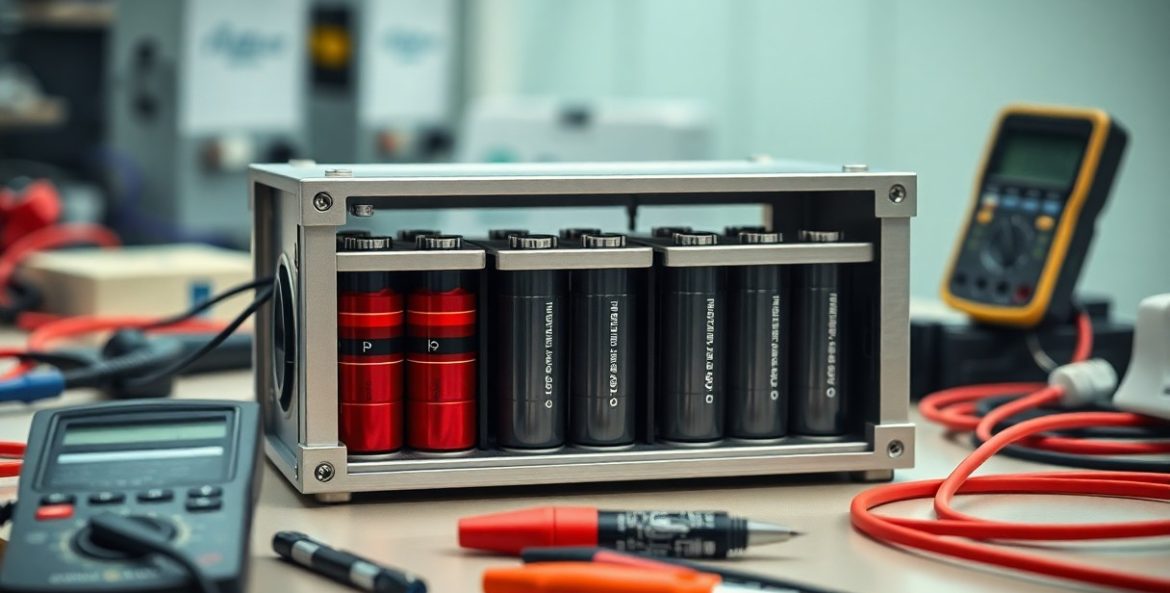
There’s a lot to plan when you build a custom battery pack: you must match voltage, current, and cell chemistry to your load while designing mechanical supports and thermal management. Focus on safe design and protection circuits, cell balancing and correct wiring, and robust enclosures and mounting to prevent vibration damage. Be aware of risk of fire and electric shock and mitigate with fuses, BMS, insulation, and cooling, which will deliver higher energy density and longer service life.
Types of Custom Batteries
When dicking out a chemistry for your custom pack, you must weigh trade-offs between energy density, cycle life, and system-level constraints such as weight and form factor. You will often trade lower mass and higher Wh/kg for increased safety management and more sophisticated BMS overhead; for example, Lithium‑ion gives 150-260 Wh/kg but demands active balancing and thermal mitigation.
Understanding real-world examples helps: e‑bikes and drones typically favor Lithium‑ion 18650/21700 cells for high discharge and energy, portable tool packs may use high-power formulations with 20-30C continuous discharge, while telecom UPS and solar storage sometimes choose Lead‑Acid or LiFePO4 for cost or cycle-life reasons.
| Chemistry | Key attributes |
|---|---|
| Lithium‑ion | High energy density (150-260 Wh/kg), nominal cell ~3.6-3.7 V, requires BMS and cell balancing, thermal runaway risk if abused |
| Nickel‑Metal Hydride (NiMH) | Moderate energy density (60-120 Wh/kg), nominal cell ~1.2 V, tolerant of overcharge but higher self-discharge (~20-30%/month) |
| Lead‑Acid | Low energy density (30-50 Wh/kg), nominal cell ~2.0 V, heavy, strong surge current capability, options: flooded, AGM, gel |
| LiFePO4 | Lower energy density than Li‑ion (90-120 Wh/kg) but very long cycle life (1,000-3,000 cycles) and superior thermal stability |
- Energy density vs weight and volume
- Cycle life and calendar aging expectations
- Safety considerations and required protections
- Cost per Wh and lifecycle cost
- Charging infrastructure and thermal management needs
Lithium‑ion Batteries
You can achieve compact, high-capacity packs with Lithium‑ion by using common cell formats like 18650 and 21700; cells typically deliver 2,500-5,000 mAh and continuous discharge ratings from 5C up to 30C depending on chemistry. When you design with Li‑ion, plan for a BMS that handles voltage balancing, over‑/under‑voltage protection, and temperature cutoffs – for instance, many e‑bike packs use a BMS that balances at ±10 mV and implements a temperature cutoff around 60°C.
If you deploy high‑power Li‑ion in confined enclosures, incorporate thermal runaway mitigation: use separators, fuses, pressure vents, and consider spacing that limits heat propagation. In proven designs, cell pairing and matching (within ±2% capacity) reduce imbalance; typical pack assemblies include passive or active balancing circuits and fusing per parallel group to limit fault current, and you should test with accelerated cycle and abuse tests (e.g., nail penetration or overcharge at 150% rated current) during development.
Nickel‑Metal Hydride Batteries
You will find NiMH appealing when you need robustness and simpler charge control: cells are nominally 1.2 V, can tolerate higher charge voltages, and are less prone to catastrophic thermal events than Li‑ion. Typical consumer NiMH cells (AA/SC) range from 1,900-2,500 mAh, while industrial cells scale higher; they exhibit self‑discharge around 20-30% per month unless low‑self‑discharge formulations (e.g., Eneloop) are used.
When you design packs from NiMH, implement charge termination by delta‑V and temperature detection – chargers commonly use ΔV ≈ −10 to −20 mV per cell and a +2-4°C temperature rise as termination criteria for fast charging at 0.5-1C. For multi‑cell assemblies, account for cell matching; mismatched internal resistance can cause uneven heating during high‑rate discharge and reduce runtime.
Consider that NiMH was the chemistry behind early hybrid vehicle packs (e.g., Toyota Prius used large NiMH modules), demonstrating their suitability for high‑cycle, high‑current applications, but you should budget for higher weight and greater self‑discharge compared with Lithium‑ion.
Lead‑Acid Batteries
If you prioritize low cost per installed Wh and high short‑term current capability, Lead‑Acid remains viable: automotive starter batteries and deep‑cycle AGM units are widely available and inexpensive. Expect energy densities around 30-50 Wh/kg; deep‑cycle flooded or AGM batteries can provide 200-1,000 cycles depending on depth of discharge (DoD), with typical design guidance limiting continuous DoD to 50% for long life.
You should design for proper charging regimes – float charging at ~2.25-2.30 V per cell for flooded and AGM, bulk charge up to ~2.40-2.45 V per cell, and include temperature compensation (≈ −3 to −5 mV/°C per cell). In high‑vibration or sealed installations, choose AGM or gel variants and incorporate venting/pressure relief in your enclosure design.
Lead‑Acid also presents safety and maintenance considerations: vented flooded cells can emit hydrogen gas during charging and require ventilation, while prolonged under‑charging leads to sulfation that drastically shortens service life; actively monitoring specific gravity (in flooded cells) or voltage under controlled conditions helps you schedule equalization and maintenance cycles. Recognizing the trade-offs between upfront cost, weight, and maintenance needs will guide your choice of lead‑acid for backup or starter applications.
Key Factors in Battery Design
You need to balance electrical and mechanical constraints: pack voltage defines cell series count, pack capacity (Ah / Wh) determines runtime and thermal load, and chosen chemistry drives temperature limits and energy density. For example, a 48V nominal system built from 3.6V nominal Li‑ion cells requires 13 cells in series (13S); sizing capacity to 20Ah yields a ~960Wh pack that must be assessed for peak current (C‑rate) and thermal dissipation. Mechanical form factor then forces tradeoffs between serviceability, vibration tolerance, and available space for cooling or insulation.
- Voltage – series count, cell balancing
- Capacity – Ah vs Wh, runtime targets
- Temperature tolerance – operating and charging windows
- Energy density – Wh/kg and Wh/L impacts weight
- BMS – protection, balancing, and current limits
Knowing how those items interact lets you set clear requirements that avoid safety failures and unexpected field returns.
Voltage and Capacity Requirements
You should pick pack voltage to match the load and inverter or motor controller specifications: common rails are 12V, 24V, 36V, 48V, and 400V+ for EVs. Series cell count is derived from single‑cell nominal voltage (e.g., 3.6-3.7V Li‑ion); therefore a 36V system usually uses 10S (10 × 3.6V ≈ 36V). Parallel strings raise pack capacity – a 10S × 4P configuration with 5Ah cells produces 20Ah at the nominal pack voltage, so calculate both Ah and total Wh (Wh = Vnom × Ah) when estimating energy and range.
You also must size for expected peak and continuous currents using C‑rate and duty cycle: a 20Ah pack delivering 200A impulsive current implies a 10C peak requirement, which affects cell choice and cooling. If you need 2 hours of runtime at a 200W load, design for ~400Wh plus a safety margin (a 48V × 8.5Ah ≈ 408Wh pack). Strongly factor in headroom for degradation – cells often lose 20-30% capacity over several years, so specify initial capacity accordingly.
Temperature Tolerance
Operating and charging windows vary by chemistry and dictate BMS cutoffs and thermal management. For typical Li‑ion (NMC/NCA) cells plan for safe discharge from about -20°C up to 60°C, but limit charging to roughly 0-45°C to avoid plating and accelerated ageing. LFP cells tolerate wider cycling temperatures and have better thermal stability, but they still degrade faster at sustained high temperatures; you should aim to keep pack ambient near 20-25°C for maximum cycle life.
Design choices such as passive convection, heatsinks, or active liquid cooling should reflect worst‑case thermal load (e.g., repeated 3-5C discharge pulses). Place temperature sensors on both cell groups and mounting surfaces so the BMS can derate or disconnect on sustained high temperatures; a single sensor in the wrong location may miss a hotspot that can lead to thermal runaway.
Temperature Ranges by Chemistry
| Parameter | Typical Range / Notes |
|---|---|
| Li‑ion (NMC) | Charge: 0-45°C; Discharge: -20-60°C; optimal storage ~15-25°C |
| LFP | Charge: 0-55°C; Discharge: -30-60°C; better cycle life at higher temps vs NMC |
| Lead‑acid | Charge: 0-40°C; Discharge: -20-50°C; heavy and low energy density |
Mitigations include active cooling for high‑power applications, cell spacing and thermal pads for even heat distribution, and software derating curves that reduce allowable current above specified thresholds; ensure the BMS enforces these limits because exceeding them increases the chance of irreversible damage.
Thermal Effects and Mitigations
| Condition | Effect / Mitigation |
|---|---|
| High temperature (>45-60°C) | Faster capacity fade, risk of thermal runaway – use active cooling, derate current, add venting |
| Low temperature (<0°C) | Reduced available capacity, risk of lithium plating during charge – restrict charging, use pre‑heat or insulation |
| Rapid cycling | Heat buildup – monitor cell temp and limit duty cycle or add heat sinks |
Size and Weight Considerations
You must translate required energy into realistic mass and volume using expected energy density: modern pouch/prismatic Li‑ion cells typically deliver ~200-260 Wh/kg at the cell level, but pack‑level figures commonly fall to ~150-200 Wh/kg after including structural, thermal, and electronics overhead. For instance, a 960Wh pack at 200 Wh/kg implies ~4.8 kg of cell mass and typically ~6-8 kg assembled; the same energy in lead‑acid would be ~20-30 kg, which directly affects mounting and handling design.
Factor in mechanical constraints: tight spaces often force higher aspect‑ratio cell arrangements that change cooling needs, and vibration or shock requirements may necessitate heavier enclosures and potting that reduce effective energy density. If weight affects performance (drones, portable tools, EV range), quantify a target Wh/kg early and iterate mechanical design to hit that metric while keeping structural integrity and service access.
Additional weight drivers include thermal management hardware (fans, pumps, radiators) and protection systems; when you need fast charging or high continuous power, expect cooling and busbars to add 10-30% to pack mass and volume, so budget that into your initial mechanical envelope and mounting strategy.
Step-by-Step Guide to Custom Battery Projects
| Step | Key actions / outputs |
| Define requirements | Specify voltage, capacity (Ah), energy (Wh), peak/continuous current, lifetime cycles, environmental range, mechanical envelope |
| Design layout | Determine series/parallel counts, busbar routing, cell orientation, thermal management and mechanical supports |
| Select components | Choose cell chemistry and form factor, BMS with rated current and balancing method, fuses, contactors, sensors and connectors |
| Build & integrate | Assemble packs with proper torque, insulation, cell matching, and mechanical restraints; implement BMS and wiring harnesses |
| Test & validate | Perform formation cycles, capacity & impedance tests, thermal imaging, abuse tests, and environmental qualification |
Defining Project Requirements
You should start by translating application needs into numeric targets: voltage (e.g., 48 V nominal), usable energy (e.g., 2.4 kWh), and expected runtime under typical loads (for example, 20 A continuous). Also define peak power demands – if your motor needs 300 A for acceleration, size the pack and wiring to handle that peak current without voltage sag or overheating. Include environmental bounds such as operating temperature range (commonly -20 °C to +60 °C for industrial systems) and vibration/shock specs if the pack mounts to moving equipment.
Account for lifecycle goals early: choose a target cycle life (for instance, 1,000 cycles to 80% capacity) and calendar life expectations, then back-calculate allowable depth of discharge, C-rates, and cell chemistry trade-offs. You must also specify safety and compliance endpoints – transport requirements (UN 38.3), and applicable safety standards (IEC 62133 for many cell chemistries) – so that your design and component selection meet regulatory constraints and your safety margins.
Designing the Battery Layout
Calculate series (S) and parallel (P) counts from voltage and capacity targets: for a 48 V system using 3.7 V nominal cells you typically use 13S (13 × 3.7 V ≈ 48.1 V), and to reach 100 Ah from 3.4 Ah cells you’d use 30P (30 × 3.4 Ah ≈ 102 Ah). Pay attention to current distribution – each parallel string carries a fraction of total current, so size busbars and fuses per string accordingly and design for a maximum continuous current equal to total pack current. Mechanical layout must secure cells against shock and vibration, provide insulation clearances, and route high-current conductors to minimize loops that create heating or EMI.
Thermal management belongs in the layout decisions: whether you choose passive conduction, forced air, or liquid cooling depends on energy density and power profile. For high-discharge applications (e.g., sustained >1C), include cooling channels and temperature sensors every few strings; placing a sensor every 8-12 cells is a common practice. Also design for serviceability – modular sub-packs and accessible fuses/contactors reduce repair time and improve safety when you need to replace individual modules.
More specifically, match cell form factor to desired cooling and packaging: pouch cells benefit from uniform compression and thermal pads, cylindrical cells (18650/21700) need spacers and welded busbars, and prismatic cells require robust mechanical clamps. For example, a 13S8P layout with 21700 cells may use welded nickel strips with 1-1.5 mm thickness to handle 200-300 A peaks while keeping voltage drop low; plan busbar cross-sections accordingly.
Selecting Components
You will select cell chemistry based on energy density, safety, and cycle life: LiFePO4 offers lower energy density (~90-110 Wh/kg) but better thermal stability and 2,000+ cycle life, while NMC/NCA provides 200-260 Wh/kg at higher energy but greater thermal management demands. Choose cells with C-rate ratings that meet your application – if your load requires 2C continuous at 100 Ah, pick cells and a BMS that can handle 200 A continuous without exceeding temperature limits. Also pick a BMS with appropriate features: current rating (continuous and peak), cell balancing method (passive vs active), SOC estimation algorithm, and communications (CAN/RS485) for system integration.
Protective components must be specified to match fault scenarios: use fuses sized slightly above expected continuous current but below the maximum safe short-circuit energy, and choose contactors rated for the peak fault current of your pack. Include temperature sensors at hot spots, and use connectors rated for the anticipated current and environmental ingress (IP rating). Highlight fuse sizing and BMS overcurrent protection as elements that directly prevent catastrophic failures.
More detail on supplier and component quality: source cells from manufacturers with traceable lot data and datasheets specifying internal resistance (mΩ), cycle life, and safety test history. Buy BMS units with verified firmware and documented test reports; during procurement, you should request cell sample test data (capacity, IR) and perform incoming QC on a sample basis.
Testing and Validation
You must run formation and capacity validation before fielding the pack: perform at least three formation cycles at a moderate rate (0.2-0.5C) to stabilize cell chemistry, then run full charge/discharge cycles at representative currents (for example 1C continuous and 2C pulse) to log capacity, voltage curves, and internal resistance. Use thermal imaging during these cycles to identify hotspots; any cell exceeding its safe operating temperature (often >60 °C for many Li-ion chemistries) needs a layout or cooling fix. Include functional BMS tests for balancing, over/under voltage, overcurrent, and temperature cutoffs under controlled fault injection.
Environmental and abuse testing should mimic your use-case: thermal soak across the full operating range, vibration per relevant standards, and short-duration overcurrent/overcharge abuse tests in a controlled lab. For lifetime projections, accelerated cycle testing at elevated temperature and a defined DOD profile (for example, 80% DOD at 25 °C and 0.5C for 500 cycles) gives you an expected end-of-life curve. Highlight that overcharge and short-circuit tests are the most dangerous and must be performed under proper safety protocols and containment.
More validation steps include firmware-in-loop testing for the BMS (simulate cell voltages and currents to verify alarms and contactor behavior), transport testing to UN 38.3 if the pack will ship, and documentation of test traces and failure modes; these records are required for certification and for post-deployment troubleshooting.
Tips for Successful Battery Projects
To shorten your development cycle and reduce failures, prioritize system-level tradeoffs early: decide target voltage and capacity with the BMS and mechanical team, define maximum continuous and peak C-rate (for example 1C continuous, 3C peak for many portable packs), and set thermal limits (design for an operating range of approximately -20°C to 60°C). Use the following checklist during concept and prototype stages to capture the highest-risk items quickly:
- BMS requirements: per-cell monitoring, over/under-voltage thresholds, and logging
- Thermal strategy: active vs. passive cooling, heat-sink placement, and transient heat maps
- Cell balancing: passive vs. active balancing and target state-of-charge (SOC) algorithm
- Mechanical constraints: vibration mounts, cell retention, and spacing for venting
- Compliance targets: IEC 62133, UN 38.3, and applicable UL standards
Plan for iterative testing: short-circuit, overcharge, and thermal-abuse tests during prototype builds will catch design gaps early and reduce costly late-stage changes. Integrate logging so you can correlate field behavior to simulation results and lab tests; data-driven adjustments to cell selection or thermal management often yield the largest reliability gains.
Prioritize Safety Standards
When you set safety requirements, map each design decision to a test or normative requirement – for example, define pack-level tests to demonstrate compliance with IEC 62133 and shipping certification under UN 38.3. Specify overcurrent protection to trigger at approximately 1.5-2× your maximum continuous current and include fuses or PTCs sized for expected fault energy; this prevents sustained thermal stress if the BMS fails to interrupt a fault.
Validate mechanical and thermal protections with measurable acceptance criteria: perform vibration at the frequencies your end use will see, nail/penetration or crush tests per the relevant standard, and run at least 100 charge/discharge cycles to verify capacity retention targets (for many chemistries a 10-20% capacity loss over 100 cycles indicates the need to reassess cell or charge strategy). Emphasize containment and venting features to mitigate thermal runaway propagation between cells.
Utilize Simulation Tools
You should model electrical behavior early using equivalent-circuit models in tools like LTspice or Simulink to predict voltage sag, SOC drift, and peak current heating under load profiles; simulate 1C, 2C and worst-case 3-5C pulses to size traces, connectors, and busbars. Include per-cell internal resistance (ESR) and open-circuit voltage curves so the simulation reflects real cell response across SOC and temperature.
Complement electrical models with thermal simulations in COMSOL or ANSYS to map hot spots and airflow paths; couple I2R losses from your electrical model into the thermal model to evaluate steady-state and transient temperature rises. Run worst-case scenarios such as simultaneous high-current discharge at elevated ambient temperature to ensure your design keeps cell temperatures within safe limits.
For deeper insight, run combined electro-thermal Monte Carlo analyses that account for manufacturing tolerances (ESR variation, weld quality) and perform abuse-case simulations (BMS failure, short-circuit) so you can quantify time-to-failure and design protective margins appropriately.
Collaborate with Experts
Bring in cell suppliers, BMS vendors, and thermal-mechanical engineers during concept review to align on performance targets and manufacturability; supplier input can reduce cycle formation variability and improve yield. Schedule a design-for-manufacture (DFM) review before the first prototype run – for example, a medical-device pack project avoided rework when the cell vendor advised a different tab-welding pattern that reduced heating during formation.
Engage accredited test labs and certification consultants early so test plans and documentation are correct on the first submission, which typically saves weeks and thousands of dollars. Use staged prototypes: one electrical-only test article, one thermal/mechanical prototype, then an integrated pack for certification; this staged approach isolates failure modes and keeps fixes targeted.
More practically, execute pilot production runs of 50-100 packs to validate assembly processes, firmware updates to the BMS, and quality-control checks; many teams find that a small pilot run exposes issues (connector torque variation, adhesive cure inconsistency) that are inexpensive to resolve before full-scale manufacturing.
Recognizing the interplay between rigorous safety standards, accurate simulation, and early collaboration with experts will let you deliver a reliable, scalable battery solution that meets performance and compliance goals.
Pros and Cons of Custom Battery Solutions
| Pros | Cons |
|---|---|
| Optimized energy density and form factor (e.g., pouch or prismatic layouts can yield 15-25% better volumetric utilization). | High upfront engineering and NRE costs – prototypes commonly range from $5,000 to $50,000 depending on pack complexity. |
| Weight savings tailored to application – drones and portable tools often see up to 30% reduction versus off‑the‑shelf packs. | Regulatory and certification expenses (UL 1973, IEC 62133, UN38.3) that can add $10k-$100k to program cost and months to schedule. |
| Ability to select chemistry and cell format for lifecycle needs (LiFePO4: >2,000 cycles; high‑energy NMC: higher gravimetric energy). | Thermal management and propagation risk increase when packing cells tightly – requires additional design for heat sinks, vents, or propagation barriers. |
| Custom BMS features (precise balancing, application‑specific charging profiles, CAN/SPI telemetry) improve performance and diagnostics. | Supply chain risk and cell obsolescence – qualification of a specific cell type can leave you exposed if manufacturers discontinue models. |
| Improved lifecycle cost at volume – pack-level cost per kWh can fall below $150/kWh with sufficient production volume and optimized BOM. | Longer development time and iteration cycles; design‑validation testing (abuse, vibration, EMI) often uncovers rework that delays launch. |
| Opportunity to embed safety features (fuses, PCB current-sense, venting) and mechanical protections specific to your use case. | Higher manufacturing QA/inspection burden – you must enforce cell sorting, weld quality, and process control to avoid field failures. |
| Competitive differentiation – you can enable unique product form factors, runtime targets, or fast‑charge profiles not available off the shelf. | Complex firmware and validation for BMS (state‑of‑charge, state‑of‑health algorithms) require specialist engineers and extensive test matrices. |
| Potential IP and proprietary advantage when you design unique pack layouts or thermal solutions. | Liability and warranty exposure if safety engineering is inadequate; thermal or cell failures can lead to property damage and recall costs. |
Advantages
You can extract more usable energy per liter and per kilogram by choosing cell format and chemistry that match your constraints – for instance, moving from cylindrical 18650s to pouch cells often gains you 15-25% in pack volumetric efficiency, which directly translates into longer runtime or a smaller enclosure. When you design the BMS specifically for your load profile, you can implement tailored charge algorithms (CC‑CV with temperature compensation, regenerative braking limits) and balancing strategies that extend usable cycle life; LiFePO4 packs routinely demonstrate >2,000 cycles to 80% capacity under conservative C‑rates.
At scale you also reduce unit cost: optimizing cell count, weld methods, and mechanical packaging often brings pack‑level costs down substantially – in practice many programs see pack costs drop below $150 per kWh once volumes justify tooling and automated assembly. Moreover, you gain the ability to add application‑specific safety and diagnostic features (on‑pack fuses, temperature sensors, CAN telemetry) that improve field serviceability and allow you to differentiate your product roadmap.
Disadvantages
Developing a custom battery pack imposes significant upfront expenses and scheduling risk: prototype iterations, environmental and abuse testing, and third‑party certification can add tens of thousands of dollars and multiple months to the program timeline. You must also manage thermal propagation risks when cells are densely packed; if you don’t design effective thermal barriers, vents, or active cooling, a single failing cell can lead to thermal runaway and rapid pack failure.
Supply chain fragility is another common downside – qualifying a specific cell format ties you to vendor roadmaps, and cell discontinuation or minimum order changes can force a costly requalification. Firmware complexity compounds this: implementing robust state‑of‑charge and state‑of‑health algorithms, plus fail‑safe behaviors for overcurrent, overvoltage, and temperature excursions, requires specialized validation to avoid latent failures that result in warranty claims.
To mitigate these disadvantages you should budget for extensive validation (nail‑penetration, thermal abuse, vibration, and cycle aging), plan for alternative cell sources, and include mechanical and electronic safety layers such as PTC/fuse protection, pressure relief vents, and redundant temperature sensing. In one reference project for an industrial handheld device, you reduced propagation risk by splitting the pack into two isolated modules with a mechanical flame barrier and implementing cell‑level fusing; that combination lowered the probability of a full‑pack event and simplified UL testing while adding only a modest weight penalty.
Common Challenges in Custom Battery Development
You will face a dense mix of trade-offs that show up as engineering, procurement, and compliance constraints all at once; for example, chasing a pack-level target of 200 Wh/kg often forces you to pick high-energy NMC cells (≈230-260 Wh/kg) and then accept shorter cycle life and higher thermal risk or add cooling that reduces net energy by 10-20%. You should expect qualification timelines to stretch: supplier qualification and incoming inspection alone typically add 6-12 weeks to a project, while safety testing and certification commonly add another 2-6 months and $10k-$100k in lab fees depending on scope.
Constraints in mechanical design and integration will bite you hard if not planned early; vibration tolerance (e.g., 5-10 g RMS in automotive applications), ingress protection (IP67 for outdoor kits), and serviceability drive cell layout and enclosure choices that reduce volumetric efficiency by 5-15%. When you balance these mechanical requirements with electrical needs like C‑rate, peak power, and SOC window, expect iterative redesigns-one real-world EV pack program I worked on required three pack redesigns after thermal simulations showed adjacent modules exceeded 120-140 °C during abuse scenarios.
Supply Chain Issues
You will confront raw-material volatility and constrained supplier capacity: typical minimum order quantities for pouch or prismatic cells run from 5,000 to 50,000 units, and lead times commonly sit at 12-20 weeks or longer for specialized chemistries. Strategic choices matter – choosing LFP eases cobalt and nickel dependence and can cut single-source risk because LFP cathode precursor supply is more diversified, while NMC/NCA choices expose you to nickel/cobalt market swings and longer qualification chains.
Counterfeit or substandard cells are an active threat; you must implement supplier audits, incoming QC (C‑rate, internal resistance, capacity spread), and traceability to avoid field failures that are dangerous and costly. Plan for buffer inventory and multiple qualified vendors: in one consumer-device program, qualifying a second cell supplier reduced production hold risk from 8 weeks to under 2 weeks despite a 12% premium on the spare supplier’s price.
Regulatory Compliance
You need to design to meet international safety and transport standards from the outset – for cells and packs that usually means passing UN 38.3 for transport, IEC 62133 (or equivalent) for portable battery safety, and region-specific approvals such as UL 2580/1642 depending on the application. Compliance testing includes abuse scenarios (short-circuit, overcharge, thermal stability, shock/vibration) and documentation like technical files, MSDS, and declarations of conformity; labs commonly require sample counts and multiple repeats, so factor that into schedule and budget.
Transportation rules add complexity: shipping large lithium-ion packs often triggers additional restrictions under IATA/DOT, and you may need special packaging, labeling, or a transport special permit for prototype shipments. If your product will enter regulated markets (EU, US, Japan), expect the certification pathway to add 2-6 months and to require iterative fixes after initial test failures.
For more depth, target test planning early: arrange pre-compliance testing (thermal run, abuse, altitude) which can reveal design flaws before full certification. Sample quantities vary by standard and test battery but budgeting for at least 10-30 cells/packs for initial lab iterations is prudent; failing a formal test can cost you $5k-$50k per retest plus schedule delays, so build contingency into your timeline.
Technical Limitations
You will run up against intrinsic cell-level limits: commercial NMC cells typically provide around 200-260 Wh/kg at the cell level, while LFP sits around 110-160 Wh/kg but offers >3,000 cycles in many formulations – that means your pack-level energy density will be significantly lower once BMS, thermal management, and mechanical structure are included. Thermal runaway risks manifest above roughly 150-200 °C depending on chemistry; design for effective heat removal because passive measures rarely suffice at high C‑rates.
Battery management system constraints often force compromises: balancing speed, measurement accuracy, and current-sensing bandwidth determine how aggressively you can use the cell SOC window. Active balancing adds cost and complexity but can increase usable pack capacity by several percent compared with passive methods, which is an important lever when you’re already constrained by cell energy density and volume.
Delving deeper, consider an example: to reach a 60 kWh pack at a realistic pack-level energy density of 150 Wh/kg you need cells providing ~200-250 Wh/kg; achieving that often requires selecting cells that sacrifice cycle life or adding active cooling that increases pack mass by 8-15% and system cost by ~10-20%. You should run iterative simulations (thermal, structural, and electrical) early-each iteration can change thermal margin by 5-10% and inform whether you need different cell chemistries, additional fusing, or redesigned busbars to meet your power and lifetime targets.
Final Words
Following this you should verify that your electrical design aligns with the application demands, including voltage, continuous and peak current capability, state-of-charge management, cell balancing, and protection strategies implemented in the BMS; rigorous testing of charge/discharge profiles, fault conditions, and EMC will confirm that your architecture performs safely under real-world loads. You must document performance margins, derating strategies, and maintenance intervals so your team and suppliers can reproduce the design and respond to anomalies without ambiguity.
Your mechanical choices-enclosure materials and geometry, mounting methods, connector types, vibration and shock resistance, and thermal paths-directly affect reliability and serviceability, so design for manufacturability, cooling, and ease of inspection from the outset. By iterating prototypes, validating thermal and mechanical models, and ensuring compliance with applicable safety and transport regulations, you minimize risk and deliver a battery system that meets performance, safety, and lifecycle expectations.