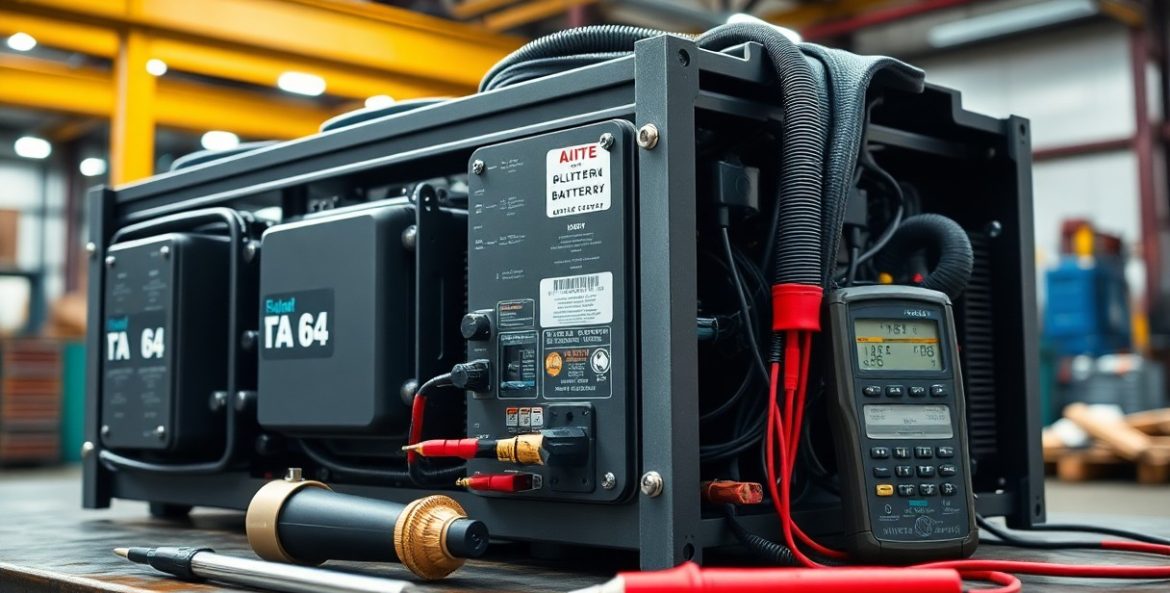
There’s no one-size-fits-all battery for heavy industry, so you need solutions that deliver high energy density and optimized runtime while meeting space and duty-cycle constraints; this guide shows how custom pack designs and system integration protect your assets, mitigate thermal runaway risks, and ensure industry-grade safety and long cycle life so you can deploy reliable power where failure isn’t an option.
Types of Custom Battery Solutions
- Lithium-Ion
- Lead-Acid
- Nickel-Cadmium
- Flow Batteries
- Supercapacitors
| Lithium-Ion | High energy density (≈150-260 Wh/kg), modular pack design, used in AGVs, drones, and fast-charge applications. |
| Lead-Acid | Low cost, good surge current capability, typical energy density 30-50 Wh/kg; common in UPS, starter, and stationary backup. |
| Nickel-Cadmium | Robust across wide temperatures (−40 to +60 °C), high cycle life and abuse tolerance; regulated disposal due to cadmium toxicity. |
| Flow Batteries | Scalable for long-duration storage, decoupled power and energy, ideal for microgrids and renewable smoothing; lower power density. |
| Supercapacitors | Exceptional power density and cycle life for pulse loads and regenerative braking; often paired with batteries in hybrid systems. |
Lithium-Ion Batteries
You can specify cell chemistry (LFP, NMC, NCA) to tune energy density, cycle life, and thermal tolerance – for example, LFP typically delivers 90-160 Wh/kg with >2000 cycles, while NMC offers 150-260 Wh/kg but requires stricter thermal management. In warehouse AGV deployments designers often choose pouch or 21700 cells with a Battery Management System (BMS) that enforces cell balancing, temperature cutoffs, and fast-charge profiles up to 2-3C to meet shift-change operational demands.
Thermal runaway remains the most dangerous risk, so you must integrate cell-level fusing, pack venting, and temperature sensors; manufacturers implementing field data from fleet pilots showed a >40% reduction in thermal incidents after adding redundant temperature sensing and firmware-based derating. Custom packs can include active cooling, IP-rated enclosures, and integrated CAN/Modbus communications for remote SOC and SOH telemetry.
Lead-Acid Batteries
If your priority is cost-per-kWh and high inrush current for motors, flooded, AGM, or gel lead-acid variants remain viable; flooded types deliver the best short-term economics but require maintenance (periodic water top-up) and proper ventilation. Typical lead-acid energy densities sit around 30-50 Wh/kg and cycle life ranges from ~200 for deep-cycle flooded to 600-1000 for premium AGM under shallow cycles.
Temperature sensitivity and sulfation are the main failure modes, so you should specify equalization charging schedules and consider built-in temperature compensation on chargers for installations in outdoor or unconditioned spaces. Examples include floor scrubbers and stationary UPS where predictable discharge profiles and rapid replacement logistics favor lead-acid over more complex chemistries.
For retrofits you can design custom tray sizes, integrated venting channels, and quick-disconnect terminals to simplify service and reduce downtime while ensuring adherence to local acid-handling and transport regulations. Knowing you must plan for safe handling, certified recycling, and periodic capacity testing to maintain fleet reliability.
Nickel-Cadmium Batteries
When you need a battery that tolerates extreme ambient temperatures and frequent deep discharge, nickel-cadmium (NiCd) packs deliver dependable performance; they operate effectively from −40 °C to +60 °C and handle high charge/discharge rates with minimal derating. Typical cycle life varies from ~1000 to 2000 cycles depending on depth-of-discharge and temperature, which is why NiCd is still chosen for critical railway signaling, aviation ground equipment, and some industrial emergency systems.
Cadmium content creates environmental and regulatory constraints, so you should incorporate documented end-of-life take-back and recycling into procurement contracts; however, NiCd’s resistance to overcharge and its ability to supply high surge currents make it a durable option where reliability under abuse is non-negotiable. In practice, system integrators often pair NiCd backups with smart chargers that include temperature compensation and periodic conditioning cycles to prevent capacity loss.
Knowing the environmental and disposal requirements, you must budget for certified recycling and compliance documentation as part of any NiCd deployment.
Key Factors to Consider
You should quantify the exact duty profile before selecting cells and package architecture: continuous load, peak power pulses, average energy throughput per day and expected cycle count per year. Specify charge and discharge C-rates (for example, 2-3C for high-acceleration motive applications or ≤0.5C for long-duration backup), desired Depth of Discharge (DoD) (typical design uses 70-80% usable DoD for balance of life and capacity) and target cycle life (LFP: ~2,000-5,000 cycles @80% DoD; NMC: ~1,000-2,000 cycles; lead‑acid: ~300-1,200 cycles). Factor in lifecycle cost: a higher upfront cost for cells with longer cycle life and lower degradation rate often yields lower total cost of ownership in high-cycle operations.
Safety, standards and integration constraints will shape enclosure, BMS and thermal strategies: require compliance with UL 1973, IEC 62619 and UN38.3 where applicable, and plan for thermal management that prevents thermal runaway (NMC chemistries have higher energy density but greater thermal risk than LFP). Specify environmental ratings (IP, salt-fog, vibration) up front and size for worst-case charging and ambient temperatures (packs often derate above 45 °C and need heating below 0 °C to accept charge).
- Cycle life
- Thermal management
- Cell chemistry
- Energy density
- C-rate
- IP rating
- UL/IEC/UN certifications
Application Requirements
If you’re designing for motive power versus stationary backup, the priorities shift: motive systems demand high peak power and robust mechanical packaging (example: an electric forklift commonly requires 2-3C discharge capability and fast recharge intervals), whereas telecom backup prioritizes float characteristics, calendar life and energy density. Calculate required pack size from load × runtime with margin – e.g., an 8‑hour, 10 kW backup requires 80 kWh usable, so specify ~100-110 kWh nominal capacity if you target 75-80% usable DoD and reserve a margin for degradation.
Also evaluate duty-cycle subtleties: frequent shallow cycles (50-100 cycles/day) favor chemistries with superior cycle life and fast charge acceptance, while infrequent deep cycles favor chemistries with high energy retention and simple thermal management. Integrate BMS controls that support your operational profile – state-of-charge algorithms, peak shaving limits, and cell balancing tuned to preserve life under the specific duty profile you define.
Environmental Considerations
You must design for the actual site conditions: ambient temperature range, humidity, dust, corrosive atmospheres and shock/vibration profiles. Specify operating windows (for example, -20 °C to 60 °C for many industrial packs, with optimal performance between 15-35 °C) and apply derating above 45 °C; below 0 °C you will typically need preheating or controlled charge protocols since charge acceptance drops significantly. For marine, offshore or washdown environments demand IP66 enclosures and corrosion-resistant materials; for explosive atmospheres require ATEX/IECEx rated designs and intrinsically safe electronics.
Mechanical stresses matter: vibration standards such as IEC 60068-2 or MIL‑STD‑810G should guide cell mounting and connector choices, because repeated shock accelerates intercell wear and can create internal shorts. Plan fire mitigation and detection where cells with higher thermal risk are used – install gas detection for lead‑acid installations (hydrogen) and consider automatic isolation, venting paths and external suppression systems for high-energy chemistries that present elevated fire/explosion hazards.
Thermal management strategy must match environmental extremes: for high-discharge applications in hot climates, active liquid cooling keeps cell-to-cell temperature gradients below the 10 °C threshold that accelerates capacity loss, while air cooling with directed ducts can be sufficient for lower C-rate systems in temperate environments.
Energy Density and Capacity
Choose chemistry by weight and volume constraints: LFP typically delivers ~90-160 Wh/kg with excellent cycle life and safety, NMC achieves ~150-250 Wh/kg with higher energy density but more rigorous thermal controls, and lead‑acid sits around 30-50 Wh/kg. When sizing, convert required usable energy to nominal pack capacity by dividing by system voltage and accounting for usable DoD – for example, 120 kWh usable at 51.2 V implies ~2,343 Ah usable; if you design for 80% usable DoD, specify ~2,929 Ah nominal.
Be aware that high energy density often means higher system-level cost for equivalent cycle life and more elaborate cooling and safety infrastructure; conversely, lower energy density chemistries can reduce integration complexity and long-term replacement costs in high-cycle environments. Also account for capacity fade forecasts (specify end-of-life at 70-80% of initial capacity) so you avoid undersizing replacement windows and spare inventory.
After you balance energy density, lifecycle predictions and environmental controls into a quantified spec, you can finalize cell chemistry, BMS requirements and enclosure standards that meet your performance targets.
Pros and Cons of Various Battery Types
| Pros | Cons |
|---|---|
| Lead‑acid: Very low upfront cost per kWh, high surge current suitable for starter/motive loads, widely recyclable and easily serviced in the field. | Heavy and low energy density (≈30-50 Wh/kg), limited cycle life (≈200-800 cycles) and prone to sulfation if left at partial state of charge. |
| Lithium‑ion (including LiFePO4): High energy density (≈150-250 Wh/kg for common Li‑ion; LiFePO4 ≈90-160 Wh/kg), high round‑trip efficiency (≈90-98%), and long cycle life (LiFePO4 often 2,000-5,000 cycles). | Higher upfront cost, requires robust BMS and thermal management; some chemistries carry thermal runaway risk if abused or improperly cooled. |
| Vanadium redox / flow batteries: Energy and power scale independently, extremely long cycle life (>10,000 cycles) and good deep‑discharge tolerance-ideal for long‑duration stationary storage. | Low energy density |
| Nickel‑metal hydride (NiMH): Robust for moderate‑duty cycles, safer thermal behavior than many Li‑ion cells and tolerant of partial states of charge. | Higher self‑discharge and lower energy density than Li‑ion, with moderate cycle life; often less cost‑effective for high‑energy, long‑duration industrial use. |
Advantages
You can match chemistry to duty: if your application demands high power for short bursts (e.g., heavy crane starts or backup generators) lead‑acid or certain Li‑ion blends deliver the required surge at lower cost, while LiFePO4 or flow batteries give you superior cycle life and deep‑discharge capability for daily cycling. In practice, switching a material‑handling fleet from flooded lead‑acid to LiFePO4 typically multiplies usable cycles from a few hundred to several thousand, cutting downtime and replacement intervals by a factor of 3-5.
Moreover, you gain operational efficiencies: modern Li‑ion systems often achieve >90% round‑trip efficiency and can fast‑charge within 1-2 hours, which reduces reserve sizing and floor space. When you need modular scalability, flow batteries let you increase energy (tank size) independently of power (stack size), enabling you to right‑size capital for applications like microgrids or renewable firming where multi‑hour discharge is required.
Disadvantages
Every chemistry forces tradeoffs: if you pick Li‑ion for its energy density and cycle life, your system must include a reliable BMS, cell balancing, and active cooling to prevent failures-omitting these raises the risk of thermal events. Conversely, choosing lead‑acid to save on CAPEX imposes a heavier weight penalty, larger cabinets, and more frequent replacements; in high‑use forklifts that can translate to more than 2× the lifecycle logistics cost compared with LiFePO4.
Flow batteries mitigate cycle degradation but demand more space and operational oversight: pumps, electrolyte management and freeze protection add recurring maintenance and can increase OPEX relative to compact Li‑ion racks. NiMH and older chemistries still used in specialized equipment suffer from higher self‑discharge and may force you to design more aggressive charge schedules or risk capacity loss during long idle periods.
To manage these drawbacks you should enforce engineering controls and procedures: specify temperature limits, BMS alarm thresholds, preventive maintenance intervals and spare strategies up front. For example, setting Li‑ion packs to operate between 10-40 °C and limiting charge voltage reduces degradation rates significantly, while scheduled equalization and water checks extend lead‑acid life-these practical mitigations often determine whether a chosen chemistry succeeds in your facility.
Tips for Selecting the Right Battery
When narrowing options for industrial deployments, focus on measurable performance parameters so you can match a battery to the load profile rather than its marketing. Quantify the required capacity in kWh, the expected peak power (kW) and continuous draw, and the intended depth of discharge (DoD); for example, a 50 kWh bank delivering 25 kW continuous with 3:1 motor inrush requires very different chemistry than a 50 kWh backup that only supplies 2 kW. Factor in environmental constraints such as ambient temperature range (operate ideally in the 20-25°C window) and site-level requirements like ventilation or explosion-proof enclosures, because thermal management failures and poor ventilation are among the most dangerous failure modes.
- Match energy density to space: LFP offers moderate energy density but high cycle life; lead‑acid takes more room per kWh.
- Specify C‑rate and peak power: motors and drives often need 3-6× surge capability; choose cells/modules rated for those pulses.
- Design for cycle life and DoD: LFP commonly delivers 2,000-5,000 cycles at 80% DoD; lead‑acid typically 300-1,200 cycles.
- Include safety and BMS features: active cell balancing, thermal cutoff, and overcurrent protection reduce risk and downtime.
Thou ensure procurement specs list these metrics explicitly and require factory test data and site acceptance tests to validate claimed performance.
Assessing Power Needs
Start by breaking the load into steady-state and transient components so you can size both energy (kWh) and power (kW). For instance, a hydraulic pump that runs five minutes every hour at 30 kW continuous but has a 90 kW startup surge will need a battery system sized for the energy (≈2.5 kWh per cycle) plus a BMS and cell chemistry capable of handling short bursts at ≥3C; specifying only average power will under‑engineer the system. Use load logging for at least one representative week to capture duty cycles, temperature variation, and rare high‑demand events.
Then translate those measurements into system architecture choices: choose series/parallel arrangements to hit the required voltage and capacity, and decide whether to use a hybrid design (battery + supercapacitor or ultracap bank) where frequent high inrush current or regenerative braking is present. If you need 48 V at 400 A continuous, you’re specifying a 19.2 kW system and should confirm cells/modules are rated for the corresponding continuous current and peak current with headroom for age‑related degradation; specify a minimum safety margin of 10-20% above measured peaks.
Evaluating Longevity and Maintenance
Compare chemistry lifecycle expectations against your maintenance window and total cost of ownership: Lithium‑iron‑phosphate (LFP) commonly offers 2,000-5,000 cycles at 80% DoD and stable calendar life, whereas flooded lead‑acid typically provides 300-1,200 cycles and requires periodic watering and equalization. You should model lifecycle using your actual DoD profile-operating at 50% DoD can roughly double cycle life compared with deep cycles-then convert cycles to years given expected daily duty cycles to forecast replacement schedules.
Account for environmental effects and maintenance labor: elevated ambient temperatures accelerate degradation-battery life can be substantially reduced for each 10°C above the optimal window-so you must budget for HVAC or enclosure cooling if the site runs hot. Also build service tasks into your maintenance plan: flooded lead‑acid requires electrolyte checks and watering every 30-90 days, VRLA/AGM may need periodic terminal inspection, and lithium systems require BMS firmware checks, occasional cell balancing validation, and annual electrical inspections.
From a risk perspective, prioritize features that reduce unplanned downtime: choose systems with integrated remote monitoring, SOC trend logs, and predictive alerts to catch thermal anomalies or rapid capacity loss early; include thermal runaway mitigation elements and clear service intervals in the contract so you can minimize both safety incidents and lifecycle costs.
Step-by-Step Guide to Custom Battery Design
Design Steps & Key Deliverables
| Step | Key Actions & Metrics |
|---|---|
| Initial Consultation | Gather load profile (kW/kWh), duty cycle (peak C-rate), temperature range, space/weight limits, certification targets (UL, IEC, UN38.3), budget and expected lifecycle (cycles @ %DoD). |
| Design & Prototyping | Select chemistry (e.g., NMC 200-260 Wh/kg vs LFP 90-160 Wh/kg), cell format, BMS topology, thermal management (air/liquid), mechanical pack layout; produce 1st prototype in 6-12 weeks. |
| Testing & Validation | Electrical (cycle, C-rate, efficiency), environmental (-30°C to +60°C), safety (overcharge/short/abuse per IEC/UL), mechanical (vibration/shock); QA sample size ≥10 packs or 10% production. |
Initial Consultation
Start by defining the real-world duty cycle: hours of operation per day, expected peak and continuous power (for example, a 50 kWh AGV pack requiring 100 kW peak and 25 kW continuous), target cycle life (e.g., 3,000 cycles at 80% DoD) and ambient temperature extremes. Specify form-factor constraints-available volume and mounting-and any weight ceilings, because these directly determine whether you choose high-energy NMC or more robust LFP chemistry.
Also provide system-level integration needs: communication protocols (CAN, Modbus TCP), redundancy requirements, serviceability (replaceable modules vs sealed packs) and regulatory targets (IEC 62619, UL 1973, UN38.3). If you want lower total cost of ownership, note that optimizing cell selection and thermal design can reduce maintenance and replacement costs by 15-30%, while ignoring thermal paths increases risk of thermal runaway during high-rate discharges.
Design and Prototyping
When opting for cells, weigh energy density against lifecycle and thermal tolerance: NMC typically offers 200-260 Wh/kg and higher energy density, while LFP delivers 90-160 Wh/kg with >3,000-5,000 cycles and superior thermal stability. Define module topology to meet your required C-rate-if you need sustained 2C discharge with 4C peaks, specify cells and busbars sized accordingly and design cooling (forced air or liquid) to keep hottest-cell delta under 10°C in worst-case duty.
BMS architecture must include cell-level monitoring, passive or active balancing (passive ~200-500 mA typical; active recommended when cell mismatch drives premature degradation), current sensing, state estimation (Coulomb counting + Kalman filter) and safety interlocks (fuses, pre-charge, contactors). Prototype fabrication often uses CNC-machined busbars, 3D-printed enclosures for fit checks and off-the-shelf BMS devkits; expect a prototype build window of roughly 6-12 weeks and a budget range of $10k-$50k depending on complexity.
Iterate firmware rapidly: run worst-case simulations (short-circuit, high-temperature soak) and adjust balancing thresholds and thermal paths; first-prototype changes commonly reduce peak cell temp by 6-10°C and lower internal resistance variance to under 5% across cells.
Testing and Validation
Build a testing matrix covering electrical (cycle life at target DoD, capacity retention, self-discharge), environmental (thermal shock, humidity), safety (overcharge, external short, nail and crush equivalents per standards) and mechanical (vibration per IEC 60068, shock). For example, validate capacity retention to <80% after 3,000 cycles at 1C for LFP designs, and perform soak tests across -20°C to +55°C if the pack will operate outdoors.
Define pass/fail criteria up front: round-trip DC efficiency targets (often >90-95%), maximum cell variance (<5%), internal resistance rise limits (<20% over target lifecycle) and safety thresholds (no thermal runaway under abuse tests). Use thermal imaging during high-rate discharge to identify hotspots and ensure no single cell exceeds safe temperature margins.
Include accelerated-aging and statistical sampling in production validation-test at least 10% of initial production or a minimum sample of 10 packs-and perform NDT checks (X-ray/CT for welds) and full factory acceptance tests for CAN sequences and fault injection; certification cycles typically add an extra 4-12 weeks before commercial release.
Common Applications in Industry
Heavy Machinery
For on-site heavy machinery such as electric excavators, wheel loaders, and haul trucks you typically specify battery systems that deliver very high peak currents and sustained power over long duty cycles – think peak discharge currents in the 500-1,500 A range for 48-800 V architectures depending on vehicle class. OEMs including Caterpillar and Komatsu are field-testing electrified drivetrains, and you’ll see pack energy capacities from a few hundred kilowatt-hours for forklifts up to multiple megawatt-hours for mining trucks, with power electronics sized for frequent regenerative braking and rapid torque demands.
Your designs must prioritize ruggedization and system-level control: IP67 enclosures, CAN/ISO 11898 communication with the vehicle ECU, and fast-acting BMS that can isolate cells within milliseconds are common requirements. You should also engineer for safety under abuse – short-circuit currents can exceed thousands of amps and lead to thermal runaway if not mitigated by cell chemistry selection, current-limiting contactors, and redundant temperature monitoring.
Renewable Energy Systems
When integrating batteries with solar farms, wind parks, or microgrids you deal with different priorities: you’re optimizing energy throughput, cycle life, and system-level economics for applications like time-shifting, peak shaving, and frequency regulation. Typical deployments range from 250 kWh containerized units up to multi‑MWh, grid-scale BESS, with round‑trip efficiencies commonly between 85% and 95% depending on inverter topology and battery chemistry.
You should choose chemistry and thermal management based on operating profile: LFP (LiFePO4) offers long calendar and cycle life and better thermal stability, while NMC provides higher energy density where footprint is limited. Also account for active cooling/heating, smoke and gas detection, and industry-standard fire suppression strategies (inert gas or water-mist systems) because thermal events in large-scale stacks pose elevated fire and escalation risks without proper mitigation.
Operationally, plan for warranty and lifecycle economics up front – many commercial BESS contracts expect 10‑year warranties and 60-80% retained capacity at end of warranty, and you can design to support value stacking (energy arbitrage + ancillary services) to improve ROI. In practical terms, LFP cells commonly achieve 3,000-5,000 cycles at ~80% depth of discharge, grid inverters provide response times in the milliseconds for frequency support, and containerized systems are often sited with separate fire zones and remote telemetry so you can monitor degradation and safety in real time.
Final Words
Hence you should expect a custom battery solution to align with your operational profile, environmental constraints, and duty cycles; through tailored cell chemistry, form factor, thermal management, and an integrated BMS, you gain reliable power delivery and extended service life in high-vibration, extreme-temperature, or high-cycle environments.
By partnering with an experienced provider you secure rigorous testing, certification, maintenance planning, and upgrade pathways so your deployment minimizes downtime, meets safety and regulatory demands, and delivers measurable total cost of ownership improvements as your needs scale.