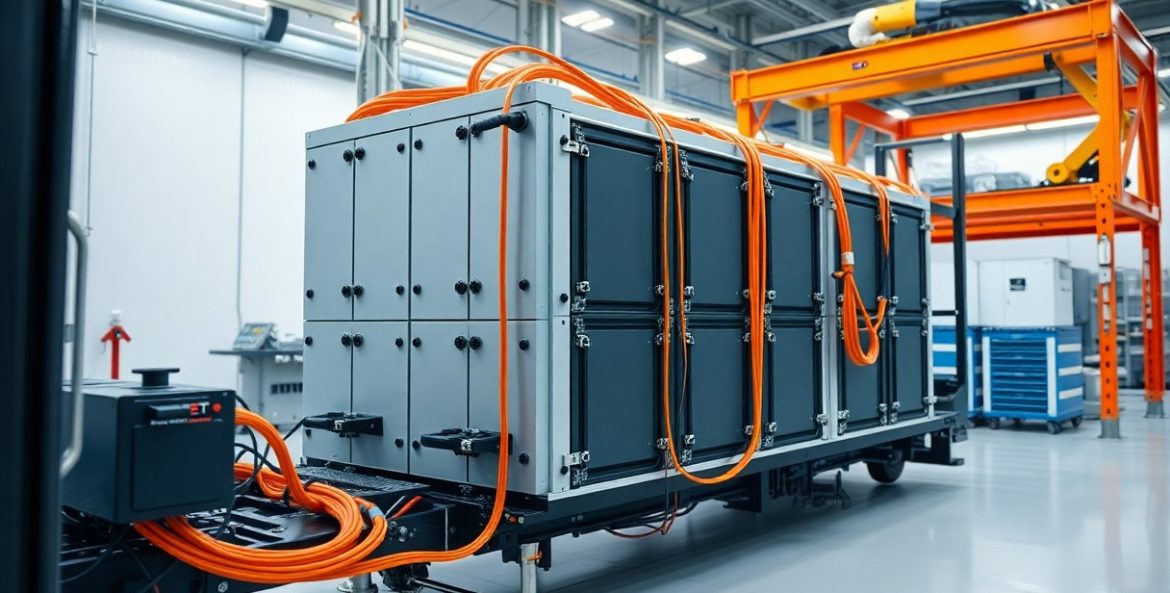
Many engineers like you face the challenge of integrating battery systems into electric transportation platforms: you must balance energy density and modular design, mitigate thermal runaway and electrical hazards, and maximize range, lifetime, and reliability through disciplined system architecture, BMS strategy, mechanical packaging, and comprehensive validation testing.
Types of Battery Systems
| System | Key characteristics |
| Lithium-ion | High energy density (≈150-260 Wh/kg for NMC/NCA; LFP ≈90-160 Wh/kg), widespread EV adoption, requires robust BMS and thermal management. |
| Solid-state | Potentially >300 Wh/kg, reduced flammability, challenges in scalable manufacturing and electrolyte interfaces (companies: Toyota, QuantumScape). |
| Flow batteries | Scalable energy capacity, suited for stationary storage, low power density makes them uncommon for mobile platforms. |
| Lead-acid / Supercapacitors | Low cost or high-power density respectively; lead-acid has low cycle life, supercapacitors support rapid charge/discharge but limited energy. |
Lithium-ion Batteries
You rely on Lithium-ion chemistries for most electric vehicles because they deliver the best mix of energy density and manufacturability; for example, NMC/NCA pack-level densities commonly deliver 200-260 Wh/kg enabling ranges over 400 km in mainstream EVs. Cell selection-NMC for high specific energy, LFP for longer cycle life and thermal resilience-affects pack architecture, where you must trade off weight and volumetric efficiency against lifecycle cost and safety margin.
Thermal management and a sophisticated BMS are indispensable since uneven cell aging or abuse can trigger thermal runaway events; practical mitigations you should implement include cell balancing, active liquid cooling for high-power platforms, and module-level fault containment. Field data shows LFP cells can exceed 3,000 cycles at moderate DoD while NMC/NCA typically deliver 1,000-2,500 cycles depending on depth of discharge and temperature profiles, so you must design pack service intervals and warranty models around the chosen chemistry.
Solid-state Batteries
Manufacturers pursuing Solid-state designs aim to replace the flammable organic electrolyte with a ceramic or polymer solid electrolyte to raise pack-level energy density toward the 300-500 Wh/kg range and to lower the incidence of thermal runaway. Pilot cells have demonstrated improved safety margins and the potential for thinner cell stacks, but you should expect current prototypes to be limited to a few hundred to a few thousand cycles depending on the interface stability and dendrite management strategy.
Production hurdles remain significant: scalable thin-film solid electrolyte deposition, consistent stack pressure management, and reliable cell-to-pack integration are engineering bottlenecks that firms such as Toyota and QuantumScape are addressing through iterative pilot lines. While you can anticipate performance leapfrogging in certain use cases-especially where energy density directly reduces vehicle mass-cost reduction and cycle life parity with advanced liquid-electrolyte cells will define the timing of broader adoption.
Adopting solid-state technology for your platform requires validating material compatibility, module mechanical design to maintain electrolyte contact, and revised safety testing protocols that account for different failure modes than liquid systems.
- BMS sophistication: cell balancing, SOC/SOH algorithms, and fast fault detection
- Thermal management: liquid cooling, phase-change materials, and module-level vents
- Energy density vs lifecycle: NMC/NCA for range, LFP for longevity
- Supply chain: critical minerals (Ni, Co, Li) and emerging solid-electrolyte materials
Recognizing the trade-offs among energy density, safety, cost, and manufacturability will determine which battery system best supports your electric transportation platform.
Factors Influencing Battery System Integration
Packaging, electrical architecture, thermal strategies and software integration define how effectively you can execute Battery System Integration at vehicle level. Mechanical constraints like available floorpan volume and mounting points dictate pack shape and module layout, while electrical choices – nominal pack voltage, topology and connector standards – determine compatibility with inverters and chargers. Pay attention to thermal interface requirements: many passenger EV packs target steady-state coolant temperatures of 25-35°C for optimal longevity, and improper thermal design raises the risk of thermal runaway.
- Energy density vs power density trade-offs
- Thermal management approach (liquid, air, refrigerant)
- Pack voltage architecture (400V vs 800V)
- Mechanical packaging and crashworthiness
- Communication and safety standards (CAN, Automotive Ethernet, ISO 26262, UN R100)
Electrical and regulatory constraints often force design choices: for urban buses you may design packs of 200-600 kWh with heavy emphasis on durability and IP67/69K ingress protection, whereas passenger cars typically balance 50-100 kWh energy with weight targets of 200-500 kg. You should quantify lifecycle targets up front (for example, >1,500 useful cycles or a calendar life of 8-10 years) since cell chemistry and BMS strategy directly influence cost-of-ownership and warranty exposure.
Performance Metrics
You measure integration success using a handful of performance metrics that tie pack design to vehicle-level outcomes: gravimetric and volumetric energy density (Wh/kg, Wh/L), peak and sustained power (kW per pack and kW/kg), round-trip efficiency (%), and usable State-of-Charge window that defines range. Typical modern automotive cells deliver ~200-260 Wh/kg at the cell level with pack-level values nearer 140-200 Wh/kg; if you need fast charging, an 800V architecture can enable >300 kW peak charging rates that reduce 10-80% times to 15-25 minutes on compatible chargers.
Degradation metrics also matter: you should track capacity fade per 1,000 cycles and power fade across life; many lithium chemistries will show ~10-20% capacity loss after 1,000 cycles under aggressive cycling, but you can extend life by limiting Depth-of-Discharge (DoD) and controlling cell temperature. Testing protocols you run – standardized 0.5C/1C cycle tests, calendar aging at 45°C, and abuse tests per UL/UNECE – must be mapped to warranty targets, because a mismatch between claimed range and real-world degradation rapidly becomes an operational and safety cost.
Compatibility with Transportation Platforms
You must align pack electrical architecture to vehicle systems: passenger cars commonly use 350-800 V packs depending on powertrain goals, while heavy trucks and buses may prioritize modular high-capacity modules that scale to multi-megawatt-hours. Mechanical integration touches crash structures and COG targets; for example, mounting the battery low and central can lower roll-over risk but forces tighter cooling channels and service access planning. Certification pathways differ by platform – automotive OEMs expect compliance with ISO 26262 for functional safety and UN R100 for electrical safety – and you must design BMS interfaces (CAN FD, Automotive Ethernet) that integrate with vehicle controllers.
Thermal and serviceability considerations are platform-dependent: in buses you might implement distributed module cooling with redundant pumps to tolerate in-service failures, while in performance cars a centralized chilled loop with 2-4 bar coolant pressure optimizes heat rejection during track use. You should validate structural crash behavior via sled tests and simulation; a typical passenger EV pack design target is to limit intrusion to under 50 mm at 56 km/h frontal impact conditions to preserve cell integrity and prevent electrical shorting.
Further integration choices include module modularity for swapping or repair, ingress and EMI shielding to meet vehicle OEM standards, and specific charging ecosystem constraints – for instance, if you target fleets that use depot fast-charging, design for repeated 1C-2C charges without accelerated degradation. Thou ensure that your mechanical, electrical and thermal interfaces are defined in vehicle-level interface control documents so that you and vehicle engineers avoid costly rework during prototype and crash validation.
Step-by-Step Integration Process
Integration Step Summary
| Step | Key activities & deliverables |
|---|---|
| Planning & Design | Define energy (kWh) and power (kW) targets, choose cell chemistry (e.g., NMC ~200-260 Wh/kg vs LFP ~90-160 Wh/kg), select pack voltage (400V vs 800V), initial BMS architecture (central vs distributed), preliminary thermal strategy (liquid vs air), mechanical envelope and crash constraints. |
| Electrical Integration | Cell string configuration, fusing, pre-charge, contactors, HV harness sizing (calculate currents: I = P/V), isolation monitoring, CAN/CIP interfaces, HV connector and shielding specs. |
| Thermal & Mechanical | Thermal model validation (CFD), cooling plate/channel design, target cell delta-T (<5-10°C under peak), mounting, IP rating, vibration and crash fixtures. |
| BMS & Software | State estimation algorithms (SOC/SOH via extended Kalman filter), cell balancing strategy (passive vs active), sampling rates, fault management per ISO 26262, HIL test plan. |
| Validation & Testing | Cell/module/pack cycling (1C-2C), thermal cycling (-40°C to +80°C), EMC, isolation and dielectric tests, propagation and abuse tests, road-load simulation, accelerated aging. |
| Certification & Production | UN 38.3 transport compliance, product safety reports, supplier control plans, pilot builds, manufacturing test fixtures and end-of-line software flashing. |
Planning and Design
Define your vehicle-level requirements first: target range (km), continuous and peak power (kW), and usable pack energy (kWh) after reserve. For example, a 300 km light-duty EV often requires ~60-75 kWh usable; selecting a 400V architecture for that pack means designing for peak currents on the order of hundreds of amps (I = P/V, so 150 kW peak implies ~375 A at 400V). Choose cell chemistry with those targets in mind – NMC offers higher energy density (~200-260 Wh/kg) useful where weight is limited, while LFP gives longer cycle life (often 2-3× cycles) and higher abuse tolerance, which may reduce cooling and safety margins.
Balance electrical and mechanical constraints by mapping module size, interconnect resistance, and thermal impedance early. Specify BMS functions up front: sample rates (e.g., 10-100 ms per string), balancing current (0.5-5 A passive or up to 10 A active), SOH estimation methods, and diagnostic coverage aligned with ISO 26262 functional safety requirements. Also set thermal targets – keep cells in the 15-35°C window for optimal longevity, and design for maximum cell delta-T <10°C under peak discharge to avoid localized aging.
Testing and Optimization
Start testing at the cell and module level, then escalate to pack and vehicle. Run standard cycle tests (e.g., 1C continuous for calendar and cycle life: 1000-3000 cycles depending on chemistry) and abuse tests (overcharge, short-circuit, nail penetration) to quantify risks like thermal runaway. Perform module thermal mapping with joule heating profiles and use road-load simulation to reproduce real duty cycles; this identifies hotspots and informs coolant flow rates or air channel placement. Include EMC and isolation testing per regulatory norms and plan HIL tests for BMS logic before hardware-in-loop integration.
Optimize through parameter tuning and targeted experiments: limit SOC window (for example, operating between 10-90% SOC can extend cycle life by roughly 2× versus full 0-100% cycles), adjust regen limits to protect cells during heavy recuperation, and implement active balancing if passive balance time exceeds acceptable maintenance intervals. Use data-driven analytics from cycling tests (log at 1 Hz or faster during dynamic events) to refine charge algorithms (multi-stage CC/CV or pulse-charge profiles) and thermal control setpoints to improve both performance and life.
For deeper verification, accelerate aging with elevated temperature testing (Arrhenius rule of thumb: every 10°C increase roughly doubles reaction rates) to compress multi-year degradation into months, but validate that accelerated modes represent field failure modes. Deploy statistical test plans: sample at least 10-30 packs for pilot runs to capture manufacturing variability, and apply root-cause analysis on outliers; in one fleet case study, this approach revealed a solder joint design that increased module resistance by 15% under vibration, which was fixed before mass production.
Tips for Successful Integration
Focus on practical trade-offs: for example, choosing cell chemistry that balances energy density and cycle life (NMC at roughly 150-250 Wh/kg vs LFP at 90-160 Wh/kg) will directly affect vehicle range and warranty exposure. In many platforms you’ll limit continuous discharge to 0.5-1C for longevity, but design for peak pulses of 2-3C with appropriate thermal margin; bus and truck systems commonly exceed 300 kWh and require robust liquid cooling and redundancy in power electronics. Integrate the BMS early so state-of-charge (SOC) and state-of-health (SOH) algorithms are validated with the actual cell batch, and plan for field diagnostics to capture >95% of anomaly events for root-cause analysis.
- Prioritize modular design: standardize 20-50 kWh modules to simplify repairs and staging.
- Validate thermal design: aim for <5°C temperature spread across modules under peak load.
- Design wiring and connectors for >150% of peak current to avoid heating risks.
- Automate factory calibration of cell-to-pack balancing currents (typical passive balancing 50-200 mA; active balancing 1-5 A).
- Require over-the-air firmware rollback and signed updates for the BMS.
Recognizing that integration is a systems exercise will push you to enforce cross-discipline sign-offs – electrical, mechanical, thermal and software – and to run combined-environment tests (vibration + thermal + humidity + electrical abuse) that mimic the most extreme in-service conditions.
Choosing the Right Components
You should pick cells and balance-of-pack hardware based on mission profile: light passenger EVs often target 30-75 kWh with higher energy density chemistries, whereas delivery vans and buses favor higher cycle life and abuse tolerance – for instance, specifying LFP for vehicles needing >5,000 cycles at 80% DOD. Select contactors and precharge circuits rated for at least 1.5× maximum pack voltage and peak current; many automotive packs use contactors sized for 800-1,200 A continuous with inrush handling above 2,000 A. Match cell mechanical format to cooling strategy: prismatic or pouch cells for dense liquid-cooled stacks, cylindrical for air-cooled or high-rate designs.
When choosing the BMS, require features such as per-cell voltage and temperature monitoring, active balancing option, secure communication (CAN-FD or Ethernet) and diagnostic logging at ≥10 Hz for transient capture. For example, a medium-duty truck that uses 400 V architecture typically benefits from a distributed BMS topology with module-level controllers to reduce harnessing weight and to localize a fault; you’ll save tens of kilograms and simplify thermal routing while improving fault isolation.
Ensuring Safety and Compliance
Implement layered safety controls: cell-level fuses or current interrupt devices, module-level temperature sensing every 1-4 cells, and pack-level contactor isolation with monitored precharge. Follow standards such as ISO 26262 for functional safety, UN 38.3 for transport, and UL 2580 or UN R100 for pack certification as applicable. Perform abuse testing that includes external short, overcharge, nail penetration and mechanical crush on representative cells and modules; many OEM programs require propagation-resistance validation where a single-cell thermal runaway must not exceed a defined energy transfer threshold to adjacent modules.
Carry out rigorous verification: run 1,000-cycle calendar+cycle profiles at elevated temperature (e.g., 45°C) to quantify capacity fade and impedance growth, and validate SOC/SOH algorithms against coulomb-counting and periodic reference measurements. Also embed secure update mechanisms and fail-safe state machines so that in the event of a sensor failure the system transitions to a safe, limited-power mode rather than full shutdown; this design pattern has reduced field-inservice incidents in multiple fleet deployments.
Pros and Cons of Various Battery Systems
Pros and Cons by Battery System
| Li‑ion (NMC / NCA) – Pros: Very high energy density (≈150-260 Wh/kg), excellent for long-range EVs; high specific power enabling sustained highway speeds; widespread manufacturing scale cuts pack costs to roughly $100-150/kWh for recent automotive packs. | Li‑ion (NMC / NCA) – Cons: Contains nickel/cobalt dependency and higher thermal runaway risk, requiring sophisticated BMS and cooling; cycle life typically ~1,000-3,000 cycles depending on depth of discharge. |
| LFP – Pros: Outstanding calendar and cycle life (often 2,000-6,000 cycles), inherently safer chemistry with lower thermal runaway propensity; lower raw-material cost and better tolerance to full‑state‑of‑charge storage. | LFP – Cons: Lower volumetric energy density (≈90-160 Wh/kg) which increases pack size/weight for given range; lower low‑temperature power without active heating. |
| Solid‑state (emerging) – Pros: Potential +20-50% energy density vs liquid electrolytes and marked safety improvement by eliminating flammable liquid electrolyte; attractive for aerospace and premium EV segments. | Solid‑state – Cons: Manufacturing scale and interface stability remain major hurdles; commercialization timelines uncertain and cost premiums expected initially. |
| Lithium‑sulfur – Pros: Theoretical very high specific energy (potentially >400 Wh/kg) with low-cost sulfur; promising for weight‑sensitive platforms like drones. | Lithium‑sulfur – Cons: Rapid capacity fade and shuttle effects currently limit cycle life; few productionized solutions for heavy-duty transport yet. |
| Sodium‑ion – Pros: Uses abundant raw materials lowering raw‑material risk and cost; recent prototypes achieve ~150 Wh/kg at cell level and are attractive for cold‑climate grid‑adjacent applications. | Sodium‑ion – Cons: Lower energy density vs leading Li‑ion chemistries and limited temperature performance compared with optimized Li‑ion packs. |
| Lead‑acid – Pros: Very low upfront cost per kWh and well‑understood recycling infrastructure; robust for low‑speed, low‑range utility vehicles and backup systems. | Lead‑acid – Cons: Very low energy density (~30-50 Wh/kg) and short cycle life (<500 cycles in deep discharge), making them impractical for modern EV range requirements. |
| Flow batteries – Pros: Extremely long cycle life and decoupled power/energy scaling; good for heavy vehicles with stationary charging profiles or grid‑linked fleets. | Flow batteries – Cons: Low energy density and system complexity (pumps, tanks) make them unsuitable for space‑constrained mobile platforms. |
| NiMH – Pros: Mature technology with decent tolerance to abuse and moderate cost; used historically in hybrids for robustness. | NiMH – Cons: Lower energy density than Li‑ion and higher self‑discharge; largely superseded in EVs by Li‑ion solutions. |
| Ultracapacitors – Pros: Extremely high power density and very long cycle life (>1,000,000 cycles), ideal for regenerative braking and peak shaving. | Ultracapacitors – Cons: Very low energy density, so they must be paired with batteries for range‑bearing functionality. |
Advantages
When you evaluate battery systems for your platform, the primary advantages you can leverage are clear: higher energy density chemistries like NMC/NCA let you achieve longer ranges (100-400+ miles for modern EV packs) without excessive mass, while LFP gives you exceptional lifecycle and cost stability that suits high‑usage fleets where replacement cadence matters. You can optimize for power density with tailored cell formats-prismatic cells for high volumetric packing or pouch cells for flexible packaging-so your mechanical design aligns with the battery’s electrical performance.
You should also factor in system‑level benefits: a robust BMS and active thermal management can unlock faster DC fast‑charging (for example, enabling 10-80% charge in 15-30 minutes on high‑power NMC packs), and modular pack architectures let you scale energy capacity without redesigning the entire vehicle. Manufacturers such as BYD demonstrate how choosing LFP and designing packs with thermal buffers yields fleets that sustain 1,500-3,000 cycles in real‑world bus operations, reducing total cost of ownership.
Disadvantages
You must weigh several disadvantages that directly affect system safety, cost, and operations: high‑energy chemistries frequently require complex cooling and advanced BMS to mitigate thermal runaway and degradation, which increases upfront engineering and validation time. You will also face supply‑chain exposure-materials like cobalt and nickel drive price volatility and ethical sourcing concerns that can constrain procurement for large fleets.
You will encounter trade‑offs between energy density and durability; for instance, choosing LFP improves cycle life but increases pack mass and volume, impacting vehicle packaging and aerodynamic efficiency. Additionally, emerging technologies such as solid‑state or lithium‑sulfur may promise step‑changes in energy but currently introduce schedule and integration risk because manufacturing processes and long‑term field data are limited.
Beyond immediate technical trade‑offs, you should plan for lifecycle and regulatory impacts: recycling rates and available infrastructure vary by chemistry (automotive Li‑ion recycling is scaling but still often incomplete), and end‑of‑life management can drive compliance costs. You will benefit from designing packs for disassembly, using standardized modules, and engaging with certified recyclers to reduce residual risk and capture value from recovered materials.
Future Trends in Battery System Integration
Emerging Technologies
Solid-state electrolyte cells are advancing from pilot lines toward limited vehicle programs, and you should expect cells moving from ~250 Wh/kg today toward the 350-400 Wh/kg range within the next 5-7 years for high-performance platforms; companies such as QuantumScape and Solid Power are already demonstrating prototype modules and automotive partners are planning integration trials. At the same time, silicon-dominant anodes and controlled lithium-metal architectures promise >20-50% pack-level energy gains, but they bring increased dendrite and cycle-life risks that require integrated cell chemistry controls and more sophisticated BMS algorithms.
Adoption of cell-to-pack (CTP) designs, direct liquid cooling, and AI-driven cell balancing is accelerating system-level efficiency and cost reduction: CTP can cut module overhead 5-10% and improve volumetric energy density by similar margins. Wireless charging pilots and high-power modular chargers (200-600 kW) are changing thermal and electrical design constraints, so you’ll need to validate cooling loops and contact resistance under 350 kW+ charge profiles to avoid thermal stress and accelerated degradation.
Predictions for Electric Transportation
Battery pack costs are projected by industry estimates to breach the <$100/kWh threshold for mainstream automotive packs in the mid-2020s, shifting total-cost-of-ownership in favor of EVs across many segments; for heavy-duty applications you should anticipate packs of 500-2,000 kWh becoming common by 2030, enabling 300-800 km ranges depending on vehicle class. Integration will increasingly prioritize scalability and standardized interfaces so fleets can swap modules, reuse cells in second-life stationary storage, and streamline recycling pathways.
Software-defined battery management will become a primary differentiator: over-the-air BMS updates, predictive degradation models, and digital twins let you optimize charging curves per vehicle and per cell chemistry, improving usable range by several percent and extending warrantyable life. Regulatory moves such as the EU’s battery transparency initiatives and national reuse/recycling mandates will force traceability and design-for-disassembly, so plan procurement and packaging choices around end-of-life flows now.
Operationally, you should design with realistic aging margins (plan for 15-30% capacity fade over 8 years depending on duty cycle), validate systems for frequent fast-charging cycles, and contract for recycling/second-life services early in procurement. Most importantly, ensure your BMS, thermal management, and mechanical containment are qualified to handle high-energy packs and 1C-3C charge regimes, because thermal runaway risk increases with higher charge rates and larger pack energies and becomes the dominant safety constraint as you scale.
Summing up
As a reminder, integrating battery systems into electric transportation platforms requires a system-level approach: you must align battery chemistry, pack architecture, thermal management, BMS, mechanical packaging, and vehicle controls to meet performance, safety, and cost targets. Your design choices should enable modularity for scalability, thermal strategies that preserve energy and lifetime, and BMS functions that provide accurate state estimation, cell balancing, and fault detection.
You should validate integration through simulation and hardware-in-the-loop testing, define clear interfaces with charging infrastructure, and plan for manufacturing, maintenance, and end-of-life processes to control total cost of ownership and comply with regulations. By coordinating multidisciplinary teams and iterating rapidly on prototypes, you reduce technical risk and accelerate deployment of reliable, efficient electric platforms.