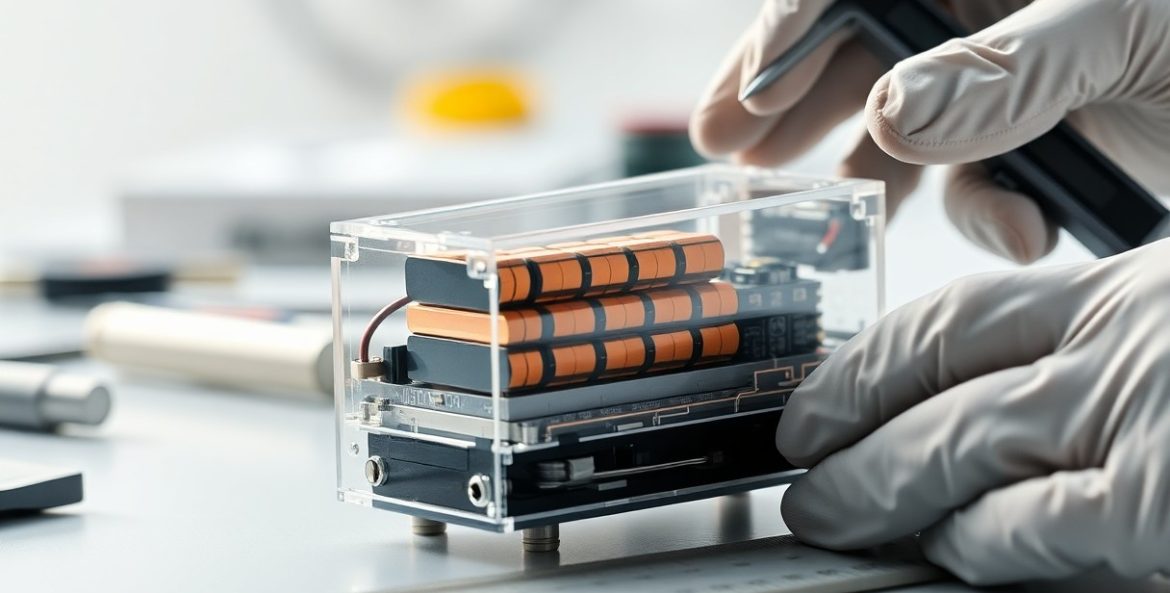
Most high energy density batteries let you pack more power into less volume, enabling smaller system footprints and extended run time without sacrificing performance; however, the same chemistry raises thermal runaway risk, so your designs must prioritize robust battery management, cell-level safety, and cooling to balance size, weight, and reliability while meeting regulatory and lifecycle demands.
Types of High Energy Density Batteries
- lithium-ion
- solid-state
- lithium-metal
- lithium-sulfur
- energy density
| Lithium‑ion (NMC / NCA) | Typical cell energy density ~150-260 Wh/kg; widely used in EVs and portable electronics; established manufacturing and BMS ecosystems. |
| LFP (LiFePO4) | Lower energy density (~90-160 Wh/kg) but >3000 cycle life and better thermal stability; common in grid and cost‑sensitive EVs. |
| Lithium‑sulfur | Potential for >400 Wh/kg at cell level, but presently limited by rapid capacity fade and electrolyte shuttle issues. |
| Solid‑state | Targets >300 Wh/kg with improved safety from non‑flammable electrolytes; significant scale‑up and interface challenges remain. |
| Lithium‑metal | Offers highest theoretical specific energy but faces dendrite growth and cycle life limits unless paired with robust electrolyte solutions. |
Lithium-ion Batteries
You rely on lithium‑ion chemistries because they balance high energy density with mature supply chains and predictable manufacturing yield. For example, NMC/NCA cells delivered to EV makers routinely hit ~200-260 Wh/kg at the cell level, enabling compact pack designs that reduce vehicle volume and weight; you can quantify tradeoffs by comparing pack-level Wh/kg and usable capacity after thermal management losses.
System designers must account for safety risks from flammable organic electrolytes and thermal runaway propensity: active battery management, cell balancing, and robust cooling typically extend usable life to 1,000-2,000 cycles for high‑energy variants, while LFP alternatives push cycle life to several thousand at lower energy density. You should plan for BMS algorithms and mechanical containment to mitigate those risks when you compress energy into tighter form factors.
Solid-State Batteries
Solid‑state designs replace liquid electrolytes with ceramics or sulfide glasses, so you see reduced flammability and the potential to stack thinner cells for higher volumetric energy-manufacturers target >300 Wh/kg and, in optimistic roadmaps, 400-500 Wh/kg at the cell level. If you pursue solid‑state, expect gains in packaging density and simplified thermal management because the cells tolerate higher abuse before thermal events.
Practical limitations remain: interface resistance between solid electrolyte and electrodes, pressure/stacking requirements, and scalable manufacturing are common hurdles that affect cycle life and rate capability. You will want to evaluate prototype data for capacity retention (many early cells show significant fade over a few hundred cycles) and validate formation and assembly steps that differ from conventional roll‑to‑roll wet processes.
More specifically, you should verify electrolyte type and stack architecture-oxides often give stability but require higher sintering temperatures, sulfides enable lower resistance but need protective coatings; manufacturing yield and cell‑to‑cell variability will determine whether you can realistically shrink your system without sacrificing longevity.
Thou must weigh energy density, safety, cost, and lifecycle performance to choose the chemistry that best fits your compact system design.
Factors Influencing Battery Design
You need to weigh multiple, often competing, parameters when you optimize a pack for a compact system: energy density, power density, thermal management, cycle life, safety, cost, and form factor. Each factor drives different choices in cell chemistry, cell format, and pack architecture; for example, prioritizing high energy density typically pushes you toward NMC/NCA cells, while prioritizing safety or long life points you to LFP or conservative electrode loading.
- Energy density – cell-level ranges ~150-300 Wh/kg; pack-level typically 150-200 Wh/kg.
- Power density – affects discharge capability and thermal load during high-current events.
- Thermal management – determines cooling architecture, enclosure size, and safety margins.
- Cycle life and calendar life – trade with usable capacity and chemistry choice.
- Form factor – pouch, prismatic, cylindrical and structural cells change packaging volume and mechanical integration.
You must evaluate system-level consequences: higher cell-level Wh/kg can shrink enclosure volume but increases the need for robust thermal controls and safety systems because of elevated risk of thermal runaway under abuse or high-rate cycling. After optimizing these inputs you can translate chemistry and cell choices into pack-level trade studies that quantify mass, volume, cost, and risk.
Energy Density
You should distinguish between gravimetric and volumetric measures: gravimetric energy density (Wh/kg) determines how light the system can be, while volumetric (Wh/L) governs how small the package can be. Commercial Li‑ion cells commonly deliver about 150-300 Wh/kg at the cell level and roughly 200-700 Wh/L in volumetric terms; high-energy NMC/NCA cells sit at the upper end, while LFP is lower but offers better thermal stability.
You will face clear trade-offs when pursuing higher energy: pushing electrode loading and using high‑nickel cathodes raises specific energy but typically reduces cycle life and increases sensitivity to elevated temperatures. In practice, lab-scale solid‑state concepts have demonstrated >400 Wh/kg, yet you should factor manufacturing readiness and safety – for instance, many automotive packs are designed around 150-200 Wh/kg pack-level targets to balance energy and durability.
Size and Weight Considerations
You should target the most constraining metric for your product: handheld devices often optimize volumetric energy density to preserve slim profiles, while aerial platforms prioritize gravimetric energy density to maximize endurance. As an example, a smartphone battery of ~12 Wh typically occupies a few cubic centimeters and a 1 mm reduction in pack thickness can free up space for sensors or cooling components; multirotor drones commonly aim for >200 Wh/kg cell-level to hit the 30-60 minute flight window with modest payloads.
You will also manage structural and thermal trade-offs: lighter packs reduce chassis mass but can force more rigid mounting points and different crash/containment strategies in automotive or aerospace designs. For small electric vehicles, improving pack-level specific energy by 10% can translate into meaningful range or payload gains; in aircraft-level applications, even single-digit percentage mass reductions have pronounced effects on fuel/energy budgets and certification paths.
More detailed implementation choices matter: selecting pouch cells may maximize volumetric packing efficiency, cylindrical cells can simplify thermal paths and manufacturing, and prismatic cells can make tight enclosures easier to engineer; adopting a structural battery approach can reduce overall system volume but increases repair complexity and thermal coupling with the airframe. After evaluating these trade-offs you can prioritize the optimal balance between energy density, form factor, and system-level safety for your application.
Pros and Cons of High Energy Density Batteries
Pros and Cons Overview
| Pros | Cons |
|---|---|
| Higher runtime per charge – you can often get 30-60% more energy for the same volume compared with older chemistries. | Increased safety hazard – a single cell failure can release more energy and greater fire risk than lower‑energy cells. |
| Smaller, lighter packs – moving from ~150 Wh/kg to ~250 Wh/kg cell-level energy density can cut pack mass and volume significantly, enabling compact mechanical design. | Higher upfront cost – cell costs for high‑energy NMC/NCA variants typically remain 20-40% higher than LFP equivalents per Wh. |
| Enables novel form factors – you can implement slimmer devices, longer‑range EVs, or longer‑endurance drones without larger housings. | Tighter thermal management – you need more robust cooling, increasing system complexity and BOM cost. |
| Fewer parallel strings/modules for a given capacity – simplifies mechanical layout and may reduce wiring and connectors. | Potential for faster calendar and cycle degradation if stressed (fast charging, high SOC, high temperature). |
| Weight-sensitive applications benefit directly – aerospace, portable medical devices, and handheld tools gain proportional performance. | Supply risk – dependence on nickel, cobalt, and specialized materials raises exposure to price and sourcing volatility. |
| Can reduce secondary system mass (smaller chassis, structural supports), improving overall system efficiency. | Recycling and end‑of‑life handling are more complex and costly for high‑nickel chemistries. |
| Enables higher system energy density without increasing footprint – useful where board space or envelope is fixed. | Regulatory and transport constraints can be stricter for high‑energy cells, affecting logistics and certification timelines. |
| Commercial examples: flagship EV packs and premium drones leverage these cells to gain range and endurance advantages. | May require higher‑performance BMS and cell balancing hardware, increasing design and validation effort. |
Advantages
You gain substantially higher energy per unit volume and mass, which directly translates into either longer runtime or a smaller enclosure for the same runtime. For example, upgrading from a 150 Wh/kg pack to a 250 Wh/kg cell-level chemistry can reduce pack mass by roughly one‑third for the same stored energy, letting you shrink housings, trim structural members, or allocate that mass budget to sensors or payloads instead of batteries.
Designers also benefit from reduced subsystem counts: with higher energy cells you often need fewer parallel strings and fewer modules, which lowers wiring complexity and connector count and can simplify thermal paths. In practice, this has enabled consumer devices and drones to add 20-50% more operational time without changing the external form factor, and EV manufacturers to extend vehicle range while keeping cabin and crumple‑zone constraints unchanged.
Disadvantages
Higher energy density increases the severity of failure modes: when a cell goes into thermal runaway, the amount of energy released is larger and propagation to neighboring cells is more likely unless you implement rigorous mitigation. You should plan for active cooling, cell‑level fusing, and mechanical barriers; cell temperatures above roughly 150°C commonly precede violent thermal events, so thermal design margins matter.
Cost and lifetime trade‑offs are also real: premium high‑energy NMC/NCA cells can cost 20-40% more per Wh than LFP, and some high‑energy formulations show faster capacity fade under repeated fast‑charge cycles-expect typical cycle life ranges of ~800-1,500 cycles versus 2,000+ cycles for conservative LFP variants, depending on depth of discharge and temperature.
To mitigate these drawbacks you will need to invest in a higher‑spec BMS, thermal management system, and qualification testing (UN38.3, IEC62133, and pack‑level abuse tests). Selecting the right chemistry for the application-trading some energy density for improved cycle life or safety (for example, LFP or modified NMC blends) -is often the most effective path to balance compact design with operational reliability and regulatory compliance.
Tips for Implementing High Energy Density Batteries
When integrating high energy density batteries into a compact product, prioritize pack-level architecture and thermal paths before finalizing the mechanical layout. You should select cell form factors and chemistries that match your target energy density (for example, NMC cells typically deliver ~200-260 Wh/kg while LFP is in the ~140-170 Wh/kg range) and then design the enclosure, interconnects and cooling to handle the worst-case power profile rather than average use.
- Cell selection: choose pouch, prismatic or cylindrical based on volumetric efficiency, mechanical stability and thermal coupling.
- Pack topology: minimize series-parallel complexity where possible to reduce balancing overhead and failure modes.
- BMS: implement cell-level monitoring, active balancing and conservative cutoff thresholds to protect your pack.
- Thermal management: use heat spreaders, phase-change materials or liquid cooling for high continuous C-rates.
- Testing: run UN 38.3, IEC 62133 and pack-level abuse tests (UL 9540A for energy storage) during validation.
For compact systems you should target a balanced set of trade-offs: tolerating a slightly lower usable SoC window (for instance, operating between 20-80% SoC) can increase cycle life and reduce peak thermal loads, and limiting continuous discharge to about 1C will simplify cooling needs in many designs. Be aware that pushing pack energy density above ~250 Wh/kg raises the risk of thermal runaway propagation and forces you to add physical separation, propagation barriers or active cooling to meet safety standards.
Design Considerations
When you design the pack, account for mechanical compression, vibration and tolerance stack-up: pouch cells can save volume but require rigid frames and controlled compression to prevent swelling and internal shorts, while cylindrical cells (e.g., 2170) often simplify thermal pathways and incorporate predictable mechanical behavior. You should size busbars and interconnects to carry peak currents with at least 20-30% margin to avoid resistive heating under worst-case transient loads.
Also plan your series/parallel configuration so the BMS can practically balance cells; for example, very large parallel strings reduce balancing effort but increase single-point failure risk and make cell-level diagnostics harder. Implement advanced state-of-charge estimation (Kalman filter or coulomb-counting with periodic reference corrections) and tune your CC/CV charging profile to the cell chemistry-many NMC packs perform best with 0.5-1C charge rates and slightly reduced end-of-charge voltages for longevity.
Safety Measures
You must layer protection: cell-level safety features (pressure relief vents, current interrupt devices), pack-level fuses or pyro-fuses, and an intelligent BMS that enforces temperature, current and voltage limits. Deploy distributed temperature sensing (one sensor per few cells or thermal couple strips) and design thermal runaway mitigation (metallic heat spreaders, fire-retardant potting or mechanical propagation barriers) so that a single-cell failure cannot cascade through the pack.
In practice, conservative electrical limits reduce incidents: cap charge to 80-90% of manufacturer max voltage when long life or safety is prioritized, keep continuous discharge below 1-2C depending on chemistry, and define immediate cutoffs for temperatures above ~60-70°C and thermal-runaway thresholds that often begin around ~150°C for many Li-ion chemistries. Historical failures such as the 2016 Note7 recall demonstrate how manufacturing defects or poor mechanical design can produce internal shorts and thermal events, so implement incoming lot testing and destructive sample analysis as part of qualification.
Expand your validation beyond laboratory cycling: run abuse tests (overcharge, nail penetration, external fire) on representative modules, instrument packs with telemetry for field diagnostics, and include periodic end-of-line electrical and X‑ray inspections to detect assembly faults; implement automated firmware watchdogs and graceful derating strategies so you can isolate and derate a failing string without shutting the entire product down. Assume that you will also run full-pack UL 9540A and UN 38.3 test sequences during validation.
Step-by-Step Guide to Battery Selection
Selection Checklist
| Step | What to measure / decide (examples) |
| Define load profile | Continuous power (W), peak power, duty cycle – e.g., 10 W continuous, 50 W peak for 2 min every hour |
| Calculate energy need | Wh required (runtime × average power). Example: 8 hr × 10 W = 80 Wh |
| Translate to pack size | Ah at nominal voltage and expected pack energy density. At 3.7 V, 80 Wh ≈ 21.6 Ah |
| C-rate & peak current | Peak current = peak power / pack voltage. Example: 444 W at 14.8 V → 30 A → if pack is 5 Ah that is 6C |
| Form factor | Cell type trade-offs: 21700 (high energy, ~250 Wh/kg), pouch (space-efficient), prismatic (mechanically compact) |
| Chemistry & lifecycle | NMC/NCA (≈200-260 Wh/kg), LFP (≈110-160 Wh/kg, but better thermal stability, 2000-5000 cycles) |
| Thermal & safety limits | Operating range, required thermal management, standards: UN 38.3, IEC 62133, and thermal runaway mitigation |
| Certification & transport | Packing, cell marking, and supplier test reports for regulatory compliance |
| Cost & supplier | Unit cell cost, availability, MOQ, long-term supply risk |
Assessing Needs
Start by mapping your real-world use cases: quantify average and peak power, expected runtime, and environmental extremes. For example, if your handheld instrument needs 5 W average and 20 W peak for short bursts, that translates to a 40 Wh daily draw (8 hours × 5 W) plus headroom for peaks; at 3.7 V nominal that is about 10.8 Ah. You should model worst-case scenarios – cold starts at −10 °C or a maintenance window requiring rapid recharge – because both will greatly change required cell sizing and thermal design.
Next, convert those requirements into pack-level constraints: allowable mass, volume, and placement inside the enclosure. If you target a mass budget of 0.5 kg for the battery and use cells at ~250 Wh/kg, that gives ~125 Wh of usable energy before accounting for BMS and packaging losses (~10-20%). Also calculate required C-rate: a 20 W peak at 7.4 V requires ~2.7 A, so with a 2 Ah pack that’s ~1.35C – if your device sees higher pulses, pick cells rated for the needed pulse C and include margin.
Choosing the Right Battery
Compare chemistries by matching their strengths to your priorities: choose NMC/NCA when you need maximum gravimetric energy (typical real-world cells ≈ 200-260 Wh/kg), choose LFP when you prioritize cycle life and safety (LFP often provides 2000-5000 cycles and far lower thermal runaway risk). Also weigh form factor: cylindrical 21700 cells give robust mechanical tolerance and are common in high-energy packs (Tesla 2170 ≈ 250 Wh/kg), while pouch cells let you maximize volumetric fit in thin enclosures but require careful mechanical support and swelling management.
Ensure the BMS and pack topology match the cell choice: implement cell balancing, overcurrent protection sized for peak pulses, and temperature sensing colocated with highest-heat zones. For instance, if you expect continuous 1C charging and 3C discharge pulses, select cells tested for those rates and specify an internal fuse or PCB fuse that blows below the cell’s maximum short-circuit current. Finally, require supplier test data for cycle life, impedance, high/low temperature performance, and UN 38.3/IEC 62133 compliance before approving cell vendors.
Dig deeper into aging and derating strategies: plan for end-of-life capacity loss (typical Li-ion cells lose 20-30% capacity after 1000 cycles under aggressive conditions) and design your state-of-charge window to extend life (keeping cells between ~20-80% SOC can double effective cycle life). You should also prototype with at least three different cell vendors/formats under your exact thermal and load profile to validate real-pack performance and confirm that your chosen chemistry meets size and safety targets in practice.
Future Trends in Battery Technology
Innovations on the Horizon
You will see solid-state architectures moving from lab to pilot lines, with companies like QuantumScape and Solid Power targeting cells that can surpass 400 Wh/kg energy density-roughly a 30-60% increase over many current commercial cells-while reducing flammability by replacing liquid electrolytes. At the same time, silicon-dominant anodes are being integrated into mainstream packs: silicon’s theoretical capacity is roughly 3,600 mAh/g vs graphite’s 372 mAh/g, and practical implementations by firms such as Sila Nanotechnologies and Amprius are already delivering 20-40% pack-level energy gains in early products through stabilized silicon composites.
Innovations in electrolyte chemistry (high-concentration, fluorinated additives), nano-structured electrodes, and AI-driven materials discovery are accelerating cycle-life and fast-charge performance; pilot results show some chemistries retaining >80% capacity after several hundred cycles even at high C-rates. Be aware that while solid electrolytes cut thermal runaway risk, lithium-metal dendrite formation remains a major safety challenge, so you should factor in advanced separator and stack designs when planning compact systems that rely on these next-gen cells.
Market Predictions
Battery pack costs have fallen dramatically-from roughly <$1,200/kWh a decade ago to around $132/kWh in 2021-and multiple analysts expect prices to approach or drop below $100/kWh later this decade, which will directly lower the cost-per-watt-hour of compact systems you design. Manufacturing capacity is scaling fast: several forecasts place global lithium-ion production capability in the 2-3 TWh (2,000-3,000 GWh) range by 2030, driven largely by EV demand, grid storage, and consumer electronics, which will expand your supplier options but also tighten raw material spot markets for lithium, nickel, and cobalt.
Regional policy and OEM strategy will shape which chemistries dominate your product choices: for example, China-led adoption of LFP (iron-phosphate) cells prioritized cost and cycle life for mass-market EVs, while Western OEMs are pushing high-nickel NMC and low-cobalt blends for energy density. You should expect a phased rollout of solid-state and lithium-sulfur into premium EVs and aerospace first, transitioning to broader markets only as cycle life and manufacturing yields improve.
More specifically, if you plan product roadmaps you need to model multiple scenarios: energy density improvements of 20-50% could shrink pack volume by similar margins for the same range, while a sub-$100/kWh price horizon will enable more aggressive cost targets for compact devices. Also factor in supply-chain volatility-spot lithium prices can swing >50% year-to-year-and evolving regulations on recycling and materials sourcing that will affect total cost of ownership and design decisions.
Summing up
To wrap up, high energy density batteries let you shrink the power source without sacrificing run time, enabling more compact, lightweight enclosures, denser component placement, and slimmer product profiles. By increasing energy per unit volume and mass, they free up space for sensors, processors, or payloads and reduce mechanical support and packaging requirements.
You must balance those gains with targeted design measures: robust battery management, thermal control, and mechanical protection are needed to manage higher energy concentration, but when engineered correctly they let you deliver higher performance, longer endurance, and sleeker form factors while meeting safety and reliability goals.