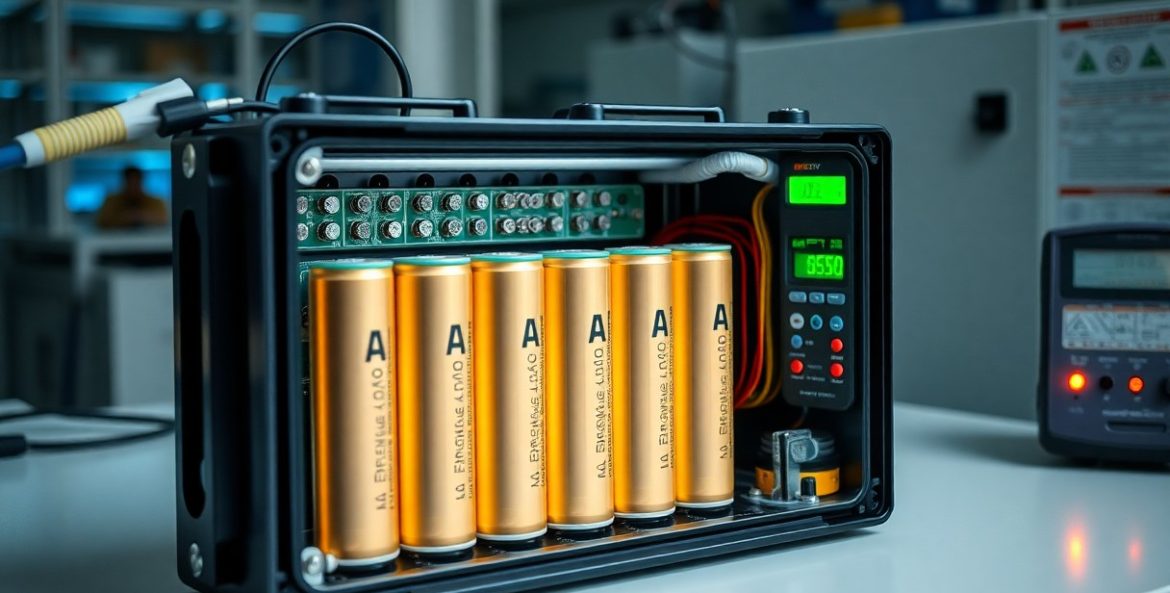
You must prioritize safety engineering in lithium battery systems because it shields you, your users, and your assets from thermal runaway, fire, and explosion, while enabling reliability, longer service life, and optimal performance. Through rigorous cell selection, robust battery management systems, mechanical protection, and standards-based testing, you mitigate failure modes, ensure regulatory compliance, and reduce operational and reputational risk.
Types of Lithium Battery Systems
| Cell Chemistry | Lithium‑Ion (NMC, NCA, LFP) vs Lithium Polymer (pouch, gel) |
| Energy Density | Typically 150-260 Wh/kg for common Li‑ion cells; pouch variants overlap but depend on design |
| Form Factor | Prismatic, cylindrical, and pouch – pouch (LiPo) offers flexibility and weight savings |
| Safety Characteristics | Thermal runaway risk varies: LFP shows better thermal stability, NMC/NCA have higher energy but greater hazard if abused |
| Typical Applications | Consumer electronics, EVs, grid storage, drones – selection trades off energy density, cost, and safety |
- Lithium‑Ion (widespread in EVs and consumer gear; multiple cathode chemistries)
- Lithium Polymer (pouch cells favored in UAVs, wearables for low mass and thin profiles)
- LFP (a Li‑ion subtype with lower energy but enhanced thermal tolerance and cycle life)
Lithium-Ion Batteries
You should account for the diversity within Lithium‑Ion systems: cathodes like NMC (nickel‑manganese‑cobalt) offer high specific energy used in many EV packs (~200-260 Wh/kg at cell level), while LFP (lithium iron phosphate) delivers ~90-160 Wh/kg but markedly better thermal stability and cycle life. In practice, manufacturers pair chemistry choice with pack architecture and a comprehensive BMS to manage cell balancing, temperature monitoring, and overcurrent protection to prevent thermal runaway.
For safety engineering you must design for failure modes seen in field cases: mechanical abuse, overcharge, and internal shorts. For example, high‑profile incidents (e.g., consumer device thermal incidents) illustrate how inadequate cell selection and poor pack ventilation can escalate; OEMs mitigated similar risks by switching to LFP in grid/storage contexts and implementing active cooling plus redundant cell monitoring in EV packs. Certification routes (IEC 62133, UN 38.3, ISO 26262 for functional safety in automotive contexts) are integral to validating those mitigations.
Lithium Polymer Batteries
Pouch‑type Lithium Polymer cells give weighter and form‑factor advantages – you see them in drones, smartphones, and thin laptops because they allow tight packaging and lower mass per watt. However, the soft pouch means reduced mechanical protection: you must plan for pouch swelling and potential seal failure under abuse, and incorporate mechanical supports, rigid framing, or vent paths within your enclosure design to manage gas release and prevent puncture‑induced internal shorts.
Thermal behavior for LiPo cells mirrors Li‑ion chemistry but with distinct failure signatures: pouch swelling can precede venting, and a puncture can trigger rapid failure without the rigid containment of cylindrical cells. You should enforce test protocols like nail penetration, external short, and overcharge at the cell and pack level, and implement cell‑level fuses or current interrupters where weight allows to limit propagation.
More specifically, when you select Lithium Polymer cells for UAVs or portable medical devices, design choices matter: adding a thin metal chassis can reduce puncture risk, redundant temperature sensors near high‑C cells improve detection, and using LFP pouch variants can lower fire risk at the expense of run time; quantify that tradeoff with cycle and abuse testing aligned to your use case. Assume that your design integrates chemistry choice, mechanical protection, robust BMS features, and appropriate certification testing to mitigate thermal runaway and cell propagation risks.
Factors Influencing Safety in Lithium Battery Systems
Multiple interacting factors determine how you manage risk in a lithium battery system: cell chemistry (for example, NMC and NCA typically provide ~200-260 Wh/kg while LFP sits around 90-160 Wh/kg), pack architecture, and the controls you deploy all change the failure modes and mitigation options. Manufacturing quality and assembly tolerances are often the difference between a benign aging cell and one that develops an internal short under mechanical stress; field incidents such as the 2016 smartphone thermal runaways and the 2013 Boeing 787 battery event illustrate how small defects or inadequate control logic can cascade into pack-level thermal runaway.
- Cell chemistry and energy density
- Manufacturing quality and separator integrity
- Thermal management and cooling architecture
- State of charge (SOC) management and charge protocol
- BMS functions: cell balancing, over/under-voltage, temperature sensing
- Mechanical design: crush, vibration, and crash resistance
- Environmental stresses: temperature, humidity, altitude
- Aging and cycling effects-capacity fade, impedance rise
- Regulatory and test standards: UN38.3, IEC 62133
When you design or specify systems, quantify how each factor scales: for instance, increasing pack energy from 10 kWh to 100 kWh multiplies the available energy by ten and changes propagation dynamics – module-to-module propagation tests often show that once a cell goes into thermal runaway (typically initiated above ~150-250°C), adjacent cells can follow within seconds to minutes unless you provide thermal barriers or venting channels that divert heat and gases such as HF and carbon monoxide.
Design Considerations
You must architect the pack so that mechanical, electrical, and thermal protections work together: cell spacing, thermal barriers, and current interrupt devices reduce propagation likelihood while a properly implemented BMS enforces voltage cutoffs (typical charge cutoff ~4.2 V per cell, discharge cutoff ~2.5-3.0 V) and limits charge current to avoid lithium plating at low temperatures. Meeting transport and safety standards like UN38.3 and IEC 62133 requires performing altitude, thermal, vibration, shock, external short, and impact tests to validate that your mechanical design does not create burrs or separator damage that could lead to an internal short.
Thermal management choices are another determinative trade-off: air cooling can be acceptable for low‑power, low‑energy packs, but once continuous power exceeds a few tens of kilowatts many OEMs switch to liquid cooling to maintain cell temperatures in the 15-35°C window and limit aging. You should also evaluate balancing strategies-passive balancing is simple and cheap, while active balancing reduces SOC-related risk for large packs where cell mismatch can otherwise concentrate stress on a subset of cells.
Environmental Impact
Ambient conditions directly change both short-term safety and long-term degradation; for example, chemical reaction rates approximately double for every 10°C rise in temperature, so storing or operating cells above ~45-60°C accelerates SEI growth and gas production and increases the probability of thermal runaway. Conversely, charging below 0°C greatly raises the risk of lithium plating, particularly at high C-rates, so your charge protocols should include temperature-dependent current limits and use cell heaters or preconditioning where necessary.
Corrosive atmospheres, high humidity, and salt spray can degrade electrical connections and sensor reliability, while sustained vibration or repeated mechanical shocks can abrade separators or loosen welds-both conditions that increase the chance of an internal short during service. You need to consider altitude effects too: pressure differentials can affect venting behavior, which is why transport tests include pressure cycling to simulate aircraft cargo hold conditions.
Mitigations you can apply include thermal insulation, dedicated venting paths, fire-resistant separators, and system-level sensor redundancy (for example, cell-level temperature sensors combined with pack-wide gas detection). Any safety assessment must include abuse testing at cell, module, and pack scales with realistic scenarios (nail penetration, overcharge, external fire, crush, and crash tests) and verification of post-failure containment and mitigation strategies.
Pros and Cons of Lithium Battery Systems
| Pros | Cons |
| High energy density – 150-260 Wh/kg typical for Li‑ion | Thermal runaway risk – can ignite and propagate between cells |
| High round‑trip efficiency – often >90% at cell level | Cell chemistry sensitivity – overcharge/overheat can trigger failure |
| High power capability – suitable for EV acceleration and grid response | Degradation over cycles – capacity fade typically 500-2,000 cycles depending on chemistry |
| Fast charge potential – 0-80% in tens of minutes with proper thermal control | Cost and resource constraints – critical materials like nickel, cobalt, lithium |
| Modular scalability – packs from cells to MWh systems | Pack complexity – BMS, cooling, mechanical containment add cost and design burden |
| Wide range of chemistries – NMC, NCA, LFP let you trade energy, life, safety | Toxic off‑gassing – HF and other gases can form during decomposition |
| Rapid cost decline historically – pack prices fell from >$1,000/kWh (2010) to ~\$130-150/kWh (2020-22) | Recycling and end‑of‑life handling remain immature in many regions |
| Proven in many sectors – EVs, grid storage, consumer electronics | Regulatory and certification complexity – transport and installation rules vary by jurisdiction |
Advantages
You can leverage high energy density to reduce system mass and footprint: typical lithium‑ion cells deliver about 150-260 Wh/kg, which enables longer EV range or denser stationary storage than lead‑acid or NiMH alternatives. In practice, that means a passenger EV pack can exceed 300-400 km of range with pack gravimetric energy densities achievable today, and grid‑scale systems can achieve compact MWh installations where floor space is at a premium.
Your systems also benefit from strong power performance and efficiency. Cells commonly show >90% round‑trip efficiency and high C‑rate capability, allowing rapid discharge for acceleration or frequency response. Moreover, by choosing chemistries like LFP you can push cycle life beyond 2,000 cycles, while NMC/NCA offer higher energy at the expense of shorter cycle life – letting you balance cost, life, and performance to suit the application.
Disadvantages
You must contend with significant safety hazards if you under‑engineer protection: internal shorts, mechanical abuse, overcharge, or thermal hotspots can initiate thermal runaway, starting around elevated temperatures (cell venting often begins >150°C) and producing flames and toxic gases. Real world incidents such as the 2016 Samsung Galaxy Note7 battery fires and the 2013 Boeing 787 battery failures illustrate how a single cell defect or design oversight can escalate to system‑level failure and lasting reputational damage.
Your design complexity increases because mitigating those hazards requires robust battery management systems, cell balancing, containment, thermal management, and mechanical protection. For example, automotive packs use coolant loops, inter‑module fire barriers, and fast‑acting contactors; stationary BESS often employ inert gas enclosures or compartmentalization. Each mitigation adds cost, weight, and points of failure that you must validate through testing and certification.
Beyond safety, you face lifecycle and supply challenges: cell chemistries differ widely – LFP trades lower energy density for better thermal stability and >2,000 cycles, while NMC/NCA give higher energy but greater sensitivity to abuse and cost exposure to nickel/cobalt markets. You should plan for end‑of‑life recycling streams, supply chain volatility, and regulatory constraints on transport and storage to avoid operational and financial surprises.
Tips for Ensuring Battery Safety
When you design and operate lithium systems, quantify protective limits and verify them with tests: set charge cutoffs at 4.1-4.2 V per cell, discharge cutoffs near 2.7-3.0 V, and aim to keep continuous cell-case temperatures below 45 °C during normal duty. Combine a robust BMS with cell-level balancing (typical balancing currents 50-300 mA) and redundancy in sensing so that a single sensor failure cannot allow an overcharge or thermal runaway event to progress.
Implement staged verification: perform IEC 62133 and UN 38.3 transport tests, execute abuse tests (overcharge, forced-discharge, short-circuit, nail penetration) on representative batches, and apply continuous field telemetry for temperature, voltage, and current so you can correlate anomalies to manufacturing lots or environmental conditions.
- BMS and protection: use per-cell voltage monitoring, over/under voltage cutoffs, passive and active balancing, and fail-safe hardware relays that disconnect at fault.
- Thermal management: maintain cell temps 45 °C in operation, use PCM or liquid cooling where power density exceeds 200 W/L, and include thermal barriers to stop propagation between cells.
- Cell selection & QA: pick chemistries suited to your load (LFP for safety, NMC/NCA for energy density), require batch traceability, and insist on vendor test reports and incoming-sample destructive analysis.
- Mechanical design: provide crush resistance, vent paths, and isolate high-voltage connections to prevent arcing; plan for expanding cells and include vent routing away from electronics.
- Operational limits: specify charge/discharge C‑rates, storage SOC (30-50% for long-term), and temperature windows for charge and discharge.
- Testing & certification: document IEC 62133, UL 1973/2580 where applicable, and maintain records for each production lot.
Best Practices
You should establish a layered protection strategy: hardware limits (contactors and fuses), firmware logic (multi-sensor validation and state estimation), and operational policies (maximum C-rate, environmental envelopes). For example, set the BMS to require agreement from two independent temperature sensors before enabling full charge and throttle peak power above a safe temperature delta; this reduces false positives and prevents unsafe charging if a single sensor drifts.
In manufacturing and field service, enforce tight cell matching (capacity variance <2% across a pack), perform sample-based destructive electrical and X‑ray inspection, and run accelerated cycle tests (500-1,000 cycles at expected C‑rate) to detect early-life failures. You should also maintain firmware revision control and over-the-air rollback capability so a patch that tightens thresholds can be deployed quickly after an incident.
Common Pitfalls to Avoid
Relying on a single line of defense is a frequent error: if you trust only the BMS software without hardware interlocks, a firmware bug or electromagnetic interference can leave the pack exposed to overcharge or high-current faults. Overlooking manufacturing variability-using cells from mixed lots or skipping incoming QC-can produce internal short risks like those that contributed to high-profile incidents (e.g., consumer device fires linked to defective cell welds and the 2013 aircraft battery events where internal shorts led to thermal runaway).
Under-specifying cooling for worst-case duty cycles is another common mistake; you can design for nominal conditions yet see rapid temperature spikes during sustained high currents or in hot ambient environments, which increases the chance of thermal propagation. Similarly, inadequate venting or cramped enclosures that trap hot gases enable fire spread and prevent safe pressure relief.
Any comprehensive mitigation plan pairs FMEA-based hazard analysis, traceable BOM controls, periodic requalification testing, and a clear end-of-life and recycling pathway to limit exposure from aging cells.
Step-by-Step Guidelines for Safety Assessments
Safety Assessment Checklist
| Step | Action / Key Details |
|---|---|
| Initial Assessment | Visual inspection, SOC and SOH measurement, cycle count review, datasheet verification (cell chemistry, max charge voltage, recommended temp). Flag cell swelling, electrolyte leakage, or >50% impedance rise for immediate quarantine. |
| Hazard Analysis | Perform FMEA/Fault Tree using failure rates, worst‑case currents, and thermal runaway propagation likelihood; quantify risk (e.g., probability × consequence) and set mitigation priority. |
| Cell & Pack Testing | Run EIS, capacity vs C‑rate, pulse current tests, and DSC on suspect cells; follow IEC/UL test vectors and UN38.3 for transport where applicable. |
| BMS & Electrical Protection | Verify voltage cutoffs per chemistry (e.g., NMC ~4.2V/cell, LFP ~3.65V/cell), overcurrent limits (continuous = pack C‑rate, peak 2-3×C for short bursts), and fail‑safe watchdogs. |
| Thermal Management | Check coolant flow, thermal gradients (<5°C across modules target), heater/insulation strategies for cold conditions, and vent paths for gases. |
| Manufacturing & QA | Confirm weld/connection quality, torque within spec, 100% electrical checks, and a sample destructive test program (e.g., 1% of lots) to detect latent defects. |
| Field Monitoring & SOPs | Define telemetry rates (e.g., 1 Hz for transient EV data, 1/min for stationary), maintenance interval (inspection every 3 months), and incident response procedures with fire suppression readiness. |
Initial Assessment
Start with a hands‑on triage: inspect every pack for mechanical deformation, cell swelling, electrolyte stains, and loose busbars, then record pack SOC, terminal voltage, and individual cell voltages. You should compare measured open‑circuit voltages and capacity against the manufacturer datasheet – for example, if a nominal 3.7 V cell shows >100 mV dispersion between parallel cells or capacity loss >10% relative to nameplate, escalate to module isolation.
Then run targeted diagnostics: use EIS to detect impedance increases (an impedance rise of >50% over baseline typically indicates internal damage), and perform a low‑rate charge/discharge cycle to confirm usable capacity. When suspect thermal instability exists, employ DSC or accelerated abuse tests on a sample cell; historical incidents like Samsung Galaxy Note7 failures underscore how manufacturing defects that first present as minor internal shorts can rapidly evolve into thermal runaway if undetected.
Implementation of Safety Protocols
Configure your BMS to enforce chemistry‑specific thresholds: set charge termination at the cell recommended max (for NMC ≈ 4.2 V/cell, for LFP ≈ 3.65 V/cell), implement cell balancing with a margin to avoid overcharge, and program overcurrent cutouts tied to the pack’s rated C‑rate (for example, limit continuous current to 1C and allow a 2-3C peak for <30 seconds depending on thermal capacity). You must include hardware layers - fuses, contactors, and fast disconnects - so that software faults cannot alone cause sustained overcurrent or thermal escalation.
Complement electrical controls with thermal and mechanical mitigations: design active cooling to keep module-to-module temperature delta under 5°C during peak loads, provide directed venting paths and thermal barriers to slow propagation, and integrate fire suppression or inerting in enclosures where packs are densely stacked. During assembly, enforce weldness and torque specs, perform 100% electrical verification, and retain destructive test sampling (e.g., 1% of units) to catch latent manufacturing defects that could lead to high‑energy failures like those seen in early aviation battery incidents.
Operationally, implement clear maintenance and incident procedures: require inspections every 3 months, run EIS annually or after any thermal event, log telemetry anomalies (flag SOC drift >5% or module temp excursions >10°C from baseline), and train technicians on safe isolation and PPE. You should also maintain a replacement policy (e.g., retire modules that fall below 80% capacity or exceed specified cycle counts) and keep an incident report library to refine failure modes and update protections over time.
Summing up
Summing up, safety engineering in lithium battery systems protects you and your assets by preventing thermal runaway, mitigating fire and explosion hazards, and ensuring reliable performance across charge and discharge cycles. It guides cell selection, mechanical integration, thermal management, battery management systems, and fail‑safe controls so your products meet technical, regulatory, and operational requirements.
When you embed rigorous safety engineering from design through operation, you reduce lifecycle cost, minimize downtime and warranty exposure, and preserve stakeholder trust. Investing in thorough testing, real‑time monitoring, and clear operational procedures gives you predictable behavior under fault conditions and the confidence to scale battery applications safely.