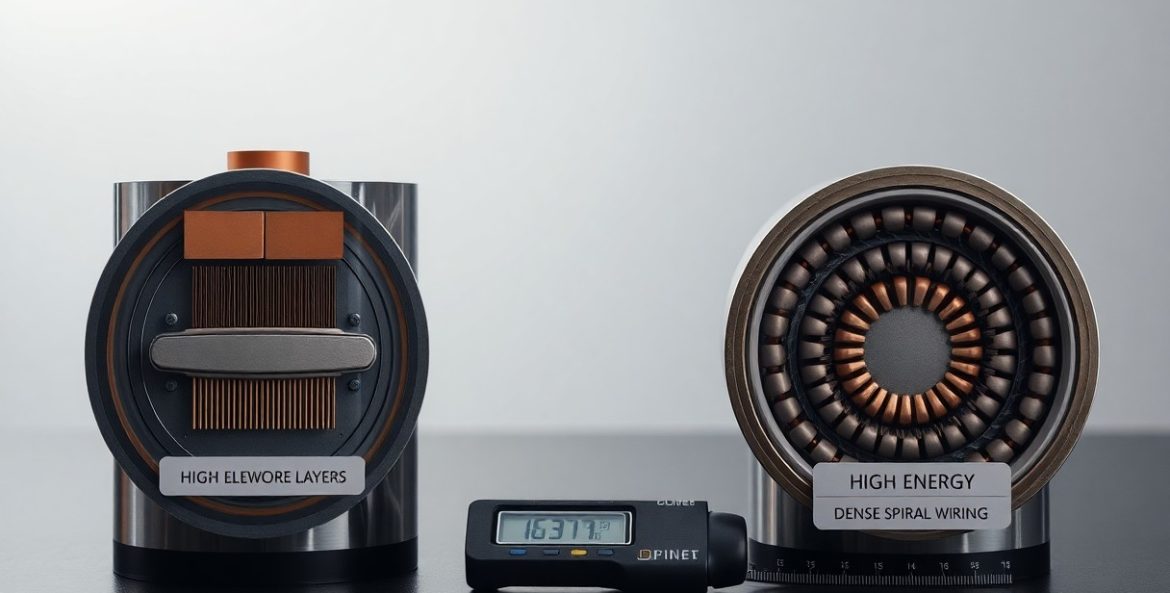
You must understand how cell chemistry and internal resistance determine if a cell favors fast discharge (high power) or longer run-time (high energy), so you can size your pack and manage charging and cooling while avoiding the increased thermal runaway risk that comes from misuse or mismatched duty cycles.
Types of Battery Cells
When you choose between cell formats and chemistries, you balance power density, energy density, form factor and thermal behavior. Manufacturers tune electrode thickness, electrolyte formulation and tab placement so some battery cells are optimized for very low internal resistance and high transient current (favoring high power), while others push capacity per cell and pack-level Wh/kg (favoring high energy).
In practice, you’ll see trade-offs quantified: high power cells often specify continuous discharge capability of >5C and pulse currents above 10-20C with internal resistance in the single-digit milliohm range, whereas high energy cells commonly deliver 200-260 Wh/kg commercially with continuous discharge rates closer to 0.5-2C and higher internal resistance. Expect thermal management and cell geometry to drive which format is chosen for handheld tools, EV traction, or stationary storage.
- Cylindrical – robust mechanical structure, common in high-power applications.
- Pouch – high volumetric efficiency, used where space and weight matter for high energy.
- Prismatic – good packaging efficiency for modules and packs, common in automotive cells.
- LiFePO4 (chemistry) – lower energy density but excellent cycle life and safety for high-cycle use.
- NMC/NCA (chemistries) – used where higher energy per cell is required despite tighter thermal constraints.
| Cylindrical (e.g., 18650/21700) | Durable, good thermal conduction, often tuned for high power (5-20+A continuous; low mΩ IR). |
| Pouch | High packing efficiency, used for high energy packs; requires robust mechanical support and thermal design. |
| Prismatic | Space-efficient modules for automotive/ESS; intermediate balance of power and energy with heavier cooling needs. |
| LiFePO4 | Lower energy (90-140 Wh/kg), exceptional cycle life (>2000 cycles) and thermal stability-favored for long-life and safe systems. |
| NMC / NCA | Higher energy (200-260 Wh/kg commercial), used in EVs and phones where pack energy and range are prioritized. |
High Power Battery Cells
If your application demands rapid delivery of current for acceleration or repeated high-current pulses, you select high power cells engineered for low internal resistance and high C-rates. Typical designs reduce electrode thickness, increase conductive additives, and use tighter tab connections to keep DC resistance below 10 mΩ; that enables continuous discharge ratings commonly in the 5-30C range and pulse capabilities that can exceed pack-level peaks by 2-3× for short durations.
Practical examples include power tools and electric powertrains that require hundreds to thousands of amps at pack level; you’ll often see packs built from cylindrical 21700 or reinforced prismatic cells because they tolerate mechanical stress and dissipate heat predictably. Pay attention to heat generation-at 10C discharge a 3Ah cell produces several watts internally, so active cooling, conservative SOC windows and a BMS with current limiting are mandatory to avoid accelerated degradation or thermal events.
High Energy Battery Cells
When run-time or driving range is the priority, high energy cells increase electrode loading and optimize chemistry for higher specific capacity-commercial cells now typically reach around 200-260 Wh/kg, with cutting-edge developments pushing toward 300 Wh/kg in specialty cells. That yields single-cell capacities of 3-5 Ah in common formats (e.g., 21700, 4680 variants) and enables packs from tens to hundreds of kWh for EVs and grid storage without making the pack impractically large.
However, the trade-off you manage is that these cells tolerate lower continuous C-rates (often 0.5-2C) and present higher internal resistance than their power-focused counterparts, which increases heat during sustained high loads. Systems using these cells must rely on conservative charge/discharge profiles, precise BMS controls, and robust thermal pathways; otherwise the increased stored energy elevates the risk profile during abuse or failure.
For more depth, examine how cell stacking and electrode coatings alter performance: higher-loading cathodes can boost mAh per cell by 20-40% but also steeply increase diffusion limitations and local overpotential, so cell makers often accept slower charge speeds (for example, limiting fast-charge to <1C to avoid lithium plating) to preserve cycle life and safety.
Thou must ensure your selected cell type matches your peak-current, energy, thermal-management and safety priorities before committing to pack-level architecture.
Pros and Cons of High Power and High Energy Cells
| Pros | Cons |
|---|---|
| High continuous and pulse currents: many high‑power cells support >10C continuous and pulses up to 50C, enabling strong acceleration and power tool performance. | Lower gravimetric energy: high‑power chemistries typically trade energy density for power, often 100-160 Wh/kg versus ~200-260 Wh/kg for high‑energy cells. |
| Faster charge acceptance: some power cells accept charge rates of 2C-10C, reducing recharge time for duty‑cycle applications. | Higher heat generation at high current, requiring active cooling; pack complexity and cost rise with thermal management needs. |
| Lower internal resistance improves efficiency under load, reducing I2R losses during high‑power events. | High‑energy cells can experience large voltage sag and reduced usable capacity at high C rates (often losing >20% usable capacity at >2C). |
| Power cells often deliver long calendar/cycle life in high‑cycle applications-certain LFP power designs exceed 3,000 cycles. | High‑energy cathodes (e.g., high‑Ni NMC/NCA) increase material cost, complexity, and supply risk (nickel/cobalt dependence). |
| Better for regenerative braking and peak power buffering in EVs and hybrid systems. | Higher stored energy per cell in high‑energy designs increases severity risk in thermal events; a single failure can propagate without mitigation. |
| Design flexibility: you can use power cells to shorten pack size for high‑power duty or combine with energy cells in hybrid packs. | System-level tradeoffs: using high‑power cells to increase runtime means adding more cells, increasing pack weight and volume. |
| Predictable performance under high drain-useful for aerospace, robotics, and motorsport where sustained power matters. | High charge/discharge rates accelerate degradation; cycling at high C can reduce cycle life by 30-50% depending on chemistry and temperature. |
| Some power chemistries tolerate abuse and high temperatures better, simplifying thermal safety margins in short‑duration use. | High‑energy cells require more conservative charge protocols and BMS complexity to protect cell life and prevent overheating. |
Advantages
You gain immediate benefits from choosing the right cell type for your application: if you need bursts of power for acceleration, welding, or traction motors, high‑power cells deliver with 10C-50C capability and lower internal resistance, so your system sees less voltage sag and higher instantaneous efficiency. In contrast, if you prioritize range or runtime, high‑energy cells-typical NMC/NCA formulations-offer ~200-260 Wh/kg at the cell level, allowing fewer cells for the same energy and simplifying pack architecture.
Practical examples make the trade clear: motorsports and power tools often use cells optimized for pulse power and fast charge acceptance (2C-10C), while long‑range EVs and portable electronics favor energy‑dense cells to maximize range or run‑time per charge. You can also combine both: hybrid packs use power cells for peaks and high‑energy cells for sustained energy, improving overall system efficiency and reducing peak cooling requirements.
Disadvantages
When you push current, thermal management becomes a limiting factor-high‑power cells produce significant heat and demand active cooling or conservative duty cycles; without it, you risk accelerated aging or, in worst cases, thermal runaway. High‑energy cells are not immune: their larger stored energy means a single failure can release more energy, so you must design robust BMS, fusing, and cell containment to mitigate propagation.
Cycle life and usable capacity degrade under high C operation: many high‑energy cells are specified for 0.5-1C continuous use, and operating above that can cut usable capacity and cycle life substantially-often reducing cycles by 30-50% depending on temperature and SOC window. Additionally, high‑energy chemistries tend to rely on more nickel or cobalt, which increases material cost and supply volatility for production scaling.
From a system perspective, you’ll face tradeoffs in weight, volume, cost, and safety when choosing between power and energy cells; specifying the correct cell requires quantifying peak power, average energy demand, cooling budget, and lifecycle targets so you can balance the risks of heat, degradation, and event severity against performance and cost goals.
Factors to Consider
You need to weigh metrics that directly affect system performance and lifecycle: energy density (cells optimized for range typically hit 200-300 Wh/kg), power density (high‑power cells routinely sustain >10C continuous and handle >20C pulses), and cycle life (LFP chemistry can exceed 3,000 cycles while some high‑energy NMC cells are often in the 1,000-2,000 cycle range). Pay attention to how thermal management requirements change with your choice – a high‑power pack will demand heavier cooling and faster fault detection, and high‑energy packs will push you to optimize pack mass and insulation. System constraints such as packaging, serviceability, and certification (UN38.3, IEC 62660, etc.) also influence the right cell choice for your application.
- Power density – how much instantaneous power a cell can source or sink (examples: >3,000 W/kg for many high‑power cells).
- Energy density – usable Wh/kg and Wh/L that define range and runtime; typical modern high‑energy cells: 200-300 Wh/kg.
- Cycle life – expected cycles at a given depth of discharge; affects total ownership cost and replacement intervals.
- Thermal management – cooling mass, sensors, and BMS complexity; inadequate cooling raises the risk of overheating and accelerated ageing.
- Charge acceptance / regenerative braking – how fast a cell will safely absorb charge during pulses without excessive temperature rise.
- Cost per kWh – cell and pack cost differences that shift the balance between upfront expense and lifecycle cost.
- Safety and certification – abuse tolerance, separator stability, and homologation impacts for commercial deployment.
Knowing how those trade‑offs affect your system‑level mass, cost, thermal budget and safety envelope will let you pick the chemistry and cell profile that match the operational demands of your product.
Application Requirements
If you design for electric vehicles, you’ll prioritize energy density for range but still need bursts of power density for acceleration; a typical passenger EV motor might require 100-300 kW peak, so you either choose cells that balance both or mix cell types and power electronics to meet peak loads without over‑specifying the entire pack. For tools and e‑bikes, the need for repeated high currents (500-2,000 W peaks) pushes you toward cells that sustain >5-10C continuous discharge and tolerate frequent shallow cycles-those needs also influence mechanical packaging and connector sizing.
When regenerative braking or rapid charge acceptance is part of the duty cycle, you must select cells with high short‑term charge acceptance (e.g., 1-3C for brief pulses) and pair them with a BMS that limits thermal excursions; for stationary storage where weight is less important, you can prioritize cost per kWh and cycle life (LFP is often a better fit). Aligning your cell choice with realistic duty cycles, ambient temperatures, and maintenance intervals prevents overspecification or premature failure.
Cost and Efficiency
Your procurement decision should separate upfront cost per kWh and lifecycle economics. Pack‑level prices across automotive deployments have fallen toward $100/kWh in recent years, but cell costs vary by chemistry and format; high‑power cells commonly cost more per kWh because they trade energy for materials and internal construction that improve rate capability. Efficiency at low rates for lithium chemistries typically exceeds 90-95% round‑trip, but at high C‑rates internal resistance causes I2R losses that can drop efficiency into the 80-90% range depending on cell design and thermal control.
Your choice also changes replacement cadence and effective cost per delivered kWh: for example, a pack costing $100/kWh with cells rated for 3,000 cycles implies a raw cost of roughly $0.033 per kWh‑cycle (ignoring BOS and O&M), whereas a $100/kWh pack with only 1,000 cycles yields ~$0.10 per kWh‑cycle. Those numbers make you evaluate whether a higher upfront cost for long‑life chemistry (like LFP) reduces total ownership cost compared with higher energy chemistries that need earlier replacement.
More information: fast charging and frequent high‑rate operation accelerate calendar and cycle ageing-charging at >1C regularly can materially shorten usable life, and running cells above ~45°C dramatically increases capacity fade; plan for additional cooling capacity and conservative C‑rate windows in your BMS to protect both efficiency and long‑term value.
Tips for Choosing the Right Battery Cell
Match the cell selection to the actual use profile: if you need long runtimes prioritize cells with high energy density (measured in Wh/kg or Wh/L), and if you need repeated high bursts pick cells with low internal resistance and high power density. Quantify your target in real numbers – for example, a commuter e‑bike typically needs 400-700 Wh of storage, while a power tool pack might require 1,000-2,000 W continuous output – then translate that into pack voltage, capacity, and per‑cell current so you can compare candidate cells objectively. Strong thermal control and proper BMS settings are non‑negotiable because high currents amplify heat generation (I²R), and thermal runaway risk increases quickly when cell temperature exceeds safe limits.
- Energy density – Wh/kg or Wh/L, affects range and pack size
- Power density – W/kg or C‑rate, affects acceleration and burst capability
- Internal resistance – determines heat build‑up at high current
- Cycle life – number of useful cycles at your operating depth of discharge
- Thermal management – cooling needs, temperature window, and derating
- Safety – cell chemistry, abuse tolerance, and BMS requirements
- Cost – $/kWh and $/A for total system economics
Use those metrics to run simple calculations: estimate pack current from power and voltage, split that current across parallel strings to get per‑cell current, and compare against the cell’s continuous and pulse ratings. After you’ve mapped numbers to cell specs and validated thermal margins, finalize the cell family and prototype with instrumentation to verify real‑world temperatures and capacity fade.
Assessing Energy Needs
Start by converting your mission profile into a Wh requirement: multiply the average device power draw (W) by desired runtime (h) to get required Wh, then add a margin for auxiliary losses (10-20%). For instance, if your sensor platform draws 8 W and you want 72 hours of operation, you need ~576 Wh plus margin – so target a pack around 640-700 Wh. Translate that into cell counts: a 3.6 V nominal 21700 cell with 5,000 mAh stores ~18 Wh, so you’d need roughly 36 cells in series/parallel combinations to reach the pack energy target.
Factor in depth‑of‑discharge and cycle expectations: choosing cells with higher usable capacity at 80% DoD can reduce pack size versus designs that repeatedly use 100% DoD and therefore demand higher cycle‑rated chemistry. If you aim for >1,000 cycles at 80% DoD, pick chemistries and cell models rated for longer cycle life and ensure BMS limits prevent over‑discharge and over‑charge – that tradeoff often means slightly lower nominal energy density but far better lifetime cost.
Evaluating Power Demands
Calculate instantaneous and continuous current from your worst‑case power demand: P = V × I, so for a 36 V pack delivering 2,000 W you need ≈56 A. Then determine how many parallel cells will carry that current: in a 10S3P pack the 56 A is split across three parallel cells, so each cell supplies ~18.7 A. Compare that per‑cell current to the cell’s continuous and pulse ratings; typical high‑power Li‑ion cells are rated for roughly 10-30 A continuous per cell depending on chemistry and format, while specialty cells and pouch formats can exceed that, but always check manufacturer derating curves at elevated temperature.
Account for transient loads and internal resistance: a high‑power design must tolerate pulses many times the continuous current without voltage collapse, so check a cell’s pulse discharge rating and ESR. Use thermal modeling – for example, a cell with 20 mΩ ESR carrying 20 A produces 8 W of heat (I²R), so in a 100‑cell pack that heat must be removed or temperature will rise rapidly and shorten life. After validating these numbers with expected ambient conditions and cooling strategy, pick cells with margin on continuous rating and proven performance in similar applications.
Step-by-Step Guide to Battery Selection
Start by aligning your top performance needs with measurable cell parameters: decide whether peak power, sustained energy, or a balanced compromise drives your design. As you evaluate candidates, weigh continuous and pulse current ratings (C-rate), Wh/kg or Wh/L, internal resistance in milliohms, and specified cycle life; for example, many high‑power 21700 cells sustain 10-30C pulses while high‑energy NMC cells deliver ~200-300 Wh/kg but only 1-3C continuous. Also factor in operating temperature range and charging voltage limits, because exceeding thermal limits can lead to thermal runaway (>150°C) and catastrophic failure.
| Selection Checklist | |
|---|---|
| Step | Action |
| 1 | Define peak power, sustained energy, and duty cycle (e.g., 5s bursts vs. hours of discharge). |
| 2 | Translate requirements to metrics: required current (A), required Wh, and target runtime. |
| 3 | Screen cells by C‑rate, Wh/kg, internal resistance, and cycle life. |
| 4 | Account for BMS, thermal management, and pack-level derating (typically 10-30%). |
Identifying Use Cases
You should map each application to concrete numbers: for a handheld power tool you might need 1-3 kW for 10-30 seconds (which equates to very high pulse C‑rates), whereas an e‑bike requiring 300-700 Wh prioritizes energy density and cycle life. For example, a 5 Ah cell delivering a 100 A peak current implies a 20C pulse requirement, so you must select cells rated for at least that pulse current plus margin.
When evaluating drones or electric racing vehicles, prioritize short‑term power density and low internal resistance; a typical racing quadcopter battery may be a 150-300 Wh/kg pack with C‑rates of 20-60 for takeoff. Conversely, grid‑tied storage or backup UPS systems lean toward high‑energy, long‑life chemistries such as LFP that can offer >2000 cycles at moderate C‑rates.
| Use Case → Key Metrics | |
|---|---|
| Handheld Power Tools | High pulse C‑rate, low ESR, short duty bursts (C‑rates often >20C) |
| E‑Bikes / EV Range | High Wh/kg, moderate continuous C (1-3C), long cycle life |
| Drones / Racing | Very high power density, low internal resistance, high pulse C (20-60C) |
| Stationary Storage | High cycle life, safety (thermal stability), moderate energy density (LFP common) |
Comparing Specifications
You must compare cells side‑by‑side on the parameters that tie directly to your use case: nominal voltage, capacity (Ah), energy density (Wh/kg), continuous and pulse C‑rates, internal resistance (mΩ), specified cycle life at given DoD, and recommended charge/discharge temperatures. For instance, an NMC 21700 with ~18-20 mΩ internal resistance and 3000 mAh gives ~200-260 Wh/kg, while an LFP cell might show 60-120 mΩ but deliver >3000 cycles and better thermal stability.
Compute the C‑rate you need by dividing required current by cell capacity – if your motor needs 200 A and your cell is 10 Ah, that’s a 20C continuous draw, so choose a cell rated above that for both continuous and pulse. Pay attention to manufacturer’s pulse rating (often 2-10× continuous) and check thermal rise data; exceeding rated C‑rates rapidly increases temperature and can trigger protection or failure.
At pack level, expect to derate cell specs: plan typically 10-30% margin on both current and usable capacity, include a BMS with cell balancing, and design active or passive cooling if your calculated losses predict temperature rise beyond the cell’s safe operating area. Also note that capacity can drop ~20-30% below 0°C, so cold‑start scenarios need consideration.
| Specification → What It Tells You | |
|---|---|
| Capacity (Ah) | Available charge; use to compute required C‑rate for your load |
| Energy Density (Wh/kg) | How much range/energy per mass – important for mobile applications |
| C‑rate (Continuous / Pulse) | Maximum safe discharge rates; pulse rating determines short bursts capability |
| Internal Resistance (mΩ) | Predicts heat generation and voltage sag under load |
| Cycle Life / DoD | Long‑term durability; LFP often >2000 cycles, NMC typically 500-2000 depending on chemistry |
| Temperature Range / Safety | Defines operating envelope; note that thermal runaway is possible if cells are overheated or over‑currented |
Future Trends in Battery Technology
Emerging chemistries and manufacturing hurdles
Solid‑state developments are the headline: many manufacturers target commercialization in the mid‑to‑late 2020s, and research teams report cell designs that could push cell‑level energy above 400-500 Wh/kg, roughly double today’s mainstream NMC chemistries. You should watch two technical fault lines closely – interfacial stability and scalable manufacturing – because sulfide and oxide solid electrolytes can reach ionic conductivities >10−3 S/cm at room temperature while still suffering from high interfacial resistance, dendrite formation and the need for stack pressure; these issues make manufacturability and long‑term safety the main barriers to mass deployment despite the energy upside.
At the same time, incremental advances will materially affect your system choices: silicon‑dominant anodes are moving from pilot to production, enabling ~10-30% higher cell capacity but with tradeoffs in SEI growth and cycle life unless you use prelithiation and advanced binders, and LFP architectures (including BYD’s blade style) now offer 3,000+ cycle life and markedly better thermal stability, making them preferable for high‑duty fleets. Expect pack‑level innovations – cell‑to‑pack/structural packs and smarter BMS with AI‑driven state estimation – to improve volumetric energy by ~10-15% and support faster charging, while industry cost roadmaps generally aim for pack prices to approach $100/kWh later this decade, shifting how you balance high‑power versus high‑energy selections.