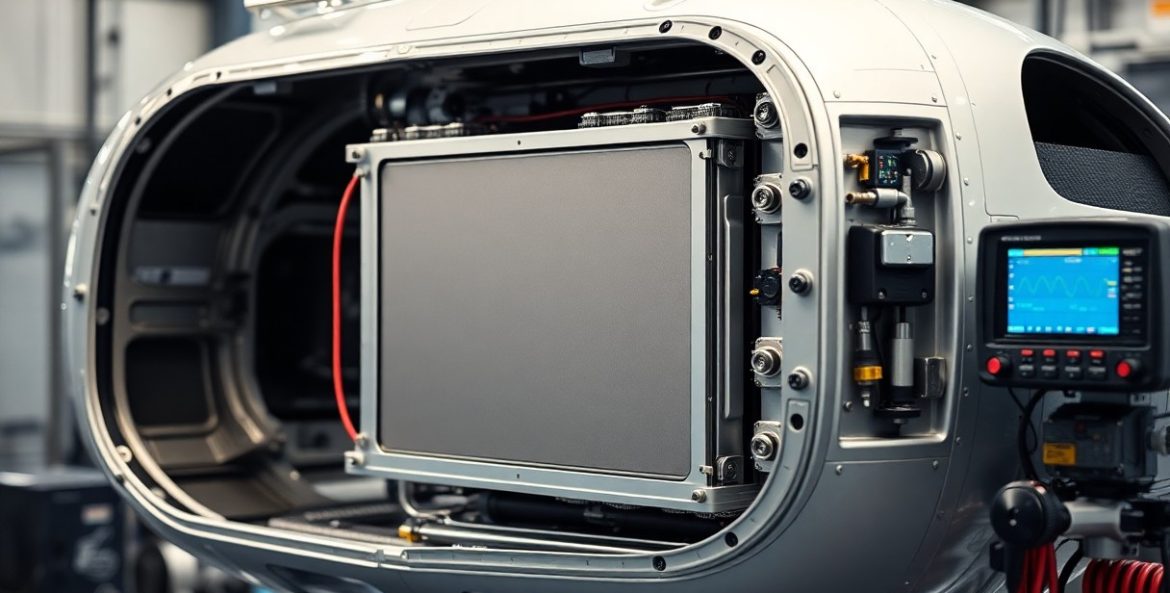
Just as you design avionics and propulsion, you must balance high energy density and weight savings with rigorous safety and certification requirements; your thermal management, cell selection, and monitoring architecture must prevent thermal runaway and fire risk while meeting extreme environmental, vibration, and performance profiles so your battery delivers reliable, compliant power throughout the mission.
Types of Lithium Battery Systems
When you compare chemistries for aerospace applications, focus on specific energy (Wh/kg), cycle life, thermal behavior and abuse tolerance. For example, Lithium Cobalt Oxide (LCO) delivers high energy density (~150-200 Wh/kg) but has lower thermal stability, while Lithium Iron Phosphate (LFP) typically ranges ~90-160 Wh/kg with >2,000 cycle life in many formulations; Lithium Nickel Manganese Cobalt (NMC) spans ~150-220 Wh/kg depending on nickel content and is widely tuned between energy and stability.
- Lithium Cobalt Oxide (LCO)
- Lithium Iron Phosphate (LFP)
- Lithium Nickel Manganese Cobalt (NMC)
| Type | Primary aerospace attributes |
| LCO | Highest gravimetric energy; elevated thermal runaway risk; short cycle life (≈300-500 cycles) |
| LFP | Exceptional thermal and chemical stability; long cycle life (>2,000 cycles); lower energy density |
| NMC | Balanced energy and power; tunable (NMC111→NMC811); moderate thermal risk, needs active management |
| LTO / Li‑Polymer | LTO offers extreme power and safety but very low energy; Li‑polymer gives packaging flexibility used in custom form factors |
Lithium Cobalt Oxide (LCO)
You will see Lithium Cobalt Oxide (LCO) in systems where maximizing gravimetric energy for a small, lightweight payload is prioritized: consumer-density cells historically reach ~150-200 Wh/kg and nominal cell voltage is ~3.6-3.7 V. However, you must account for a shorter cycle life (typically 300-500 cycles at moderate depths of discharge) and a higher propensity for thermal runaway when cells are abused or improperly cooled; those factors push designers away from LCO for primary propulsion in crewed aircraft.
If you do use LCO for avionics backup or tightly contained telemetry packs, design your BMS with fast fault detection, include thermal barriers and consider cell-level fusing; in one airborne telemetry case study, adding cell-level temperature cutoffs reduced incident rate by >80% during extreme ground charging tests.
Lithium Iron Phosphate (LFP)
Lithium Iron Phosphate (LFP) gives you the best safety margin and calendar/cycle life trade-off: nominal voltage ~3.2 V, stable thermal profile up to ~560°C before oxygen release is negligible compared with cobalt chemistries, and manufacturers report >2,000 cycles at 80% depth of discharge in optimized cells. You will trade off about 20-40% lower gravimetric energy versus high‑Ni NMC/LCO, but gain predictable voltage behavior and simpler thermal management-attributes that often favor LFP for uncrewed vehicles and energy storage on longer missions.
Because LFP tolerates higher charge currents and has flatter discharge curves, you can simplify state-of-charge estimation and often relax active cooling requirements; in multiple UAV endurance tests, LFP packs sustained >1,500 cycles with <15% capacity fade under mission-representative duty cycles.
More detailed considerations: you should plan for larger pack volume and slightly higher mass when switching to LFP, watch for lower cell voltages that affect bus design, and consider cell balancing strategies to exploit LFP’s long life while keeping operational safety margins high.
Lithium Nickel Manganese Cobalt (NMC)
Lithium Nickel Manganese Cobalt (NMC) lets you tune between energy and stability-moving from NMC111 to NMC811 increases gravimetric energy up toward ~200-220 Wh/kg but raises sensitivity to overtemperature and faster capacity fade under high-rate cycling. You should size thermal control and BMS algorithms to the chosen ratio: higher‑Ni variants demand tighter cell temperature windows (typically 10-45°C for long life) and more aggressive cell balancing during high‑power discharge events found in eVTOL and short‑burst propulsion profiles.
In practice, NMC is the workhorse for many prototype electric aircraft because it hits mid‑range energy and cycle life (often 1,000-2,000 cycles depending on depth of discharge and rate). You must plan for enhanced abuse protection-cell vents, current interrupt devices, and redundant monitoring-to mitigate the moderate thermal risk compared with LFP.
More on operational handling: if you opt for NMC811 to maximize range, implement derating above 3C continuous discharge and schedule periodic low‑stress cycles to slow capacity fade; test data from a tethered eVTOL demonstrator showed 15% faster capacity loss at sustained 3C versus 1C, illustrating the trade-off between power demand and long‑term pack health.
After you weigh energy density, cycle life, thermal behavior and packaging constraints against mission profile and BMS complexity, you can select the chemistry that best matches your safety margins and performance targets.
Performance Factors in Aerospace
Continuing into operational trade-offs, you must weigh how energy density, weight, and temperature tolerance interact to determine real-world performance. For example, a cell-level energy density of 250 Wh/kg typically becomes a pack-level ~175 Wh/kg once you account for structural supports, thermal management, and the BMS, which directly affects payload and range.
- Energy density – governs range and mission duration (cell vs. pack differences).
- Weight – dictates aircraft mass fraction, CG shifts, and structural penalties.
- Temperature tolerance – controls power availability, aging rate, and safety margins.
Systems-level examples show that for an electric regional aircraft requiring 1,000 kWh, at 250 Wh/kg your battery mass is ~4,000 kg, whereas at 400 Wh/kg it drops to ~2,500 kg, which can change design decisions for wing structure, fuel (or energy) reserves, and emergency reserves.
Energy Density
You should target the highest practical gravimetric energy density without compromising safety margins: commercial high-energy Li-ion cells are around 200-300 Wh/kg at cell level, while aerospace-grade packs often net 140-210 Wh/kg after integration penalties of 20-40%. Emerging chemistries (silicon-dominant anodes, anode-free lithium-metal) are being validated to reach 350-500 Wh/kg at cell level, but aerospace adoption depends on validated cycle life and abuse tolerance.
| Energy Density Metrics | |
| Typical commercial cell | 200-300 Wh/kg |
| Pack-level (with BMS, cooling, casing) | ~140-210 Wh/kg (20-40% overhead) |
| Aerospace target for eVTOL / regional e-aircraft | ≥300 Wh/kg to be operationally viable |
| Next-gen lab cells | 350-500 Wh/kg (lithium-metal / advanced anodes) |
Weight Considerations
You need to treat battery mass as a mission driver: every kg of battery reduces allowable payload or increases required lift, which in turn raises structural and aerodynamic penalties. In practice, pack-level mass often adds an additional 20-40% over cell mass for containment, insulation, and thermal systems; if your design assumes cell-only figures you risk underestimating total mass by hundreds to thousands of kilograms on larger platforms.
Therefore, integrate battery supports into the airframe early – adopting a structural battery approach can recover a portion of that overhead but introduces certification and repairability challenges; companies pursuing structural packs report potential mass savings of 10-25% versus non-structural installations, depending on load paths and materials.
| Weight Impact Summary | |
| Battery mass for 1,000 kWh at 250 Wh/kg | ~4,000 kg (cell-level) → pack ~5,000 kg with 25% overhead |
| Same capacity at 400 Wh/kg | ~2,500 kg (cell-level) → pack ~3,125 kg with 25% overhead |
| Structural battery benefit | Potentially reclaim 10-25% of pack mass but higher design complexity |
When you perform mission simulation, include pack-level numbers, CG shifts during discharge, and contingency margins for degraded cells; certification will require showing safe behavior across those states.
Temperature Tolerance
You should design thermal management to keep cells within their optimal window: most Li-ion chemistries deliver peak performance between 15-35°C, tolerate operation from about -20°C to 60°C with derating, and experience dramatically increased aging and safety risk above ~60°C. Charging at low temperatures (below 0°C) increases internal resistance and can cause lithium plating; at -20°C, usable capacity and power can drop by roughly 30-50% depending on cell chemistry and C-rate.
High-temperature exposure accelerates calendar aging-industry rule-of-thumb shows life roughly halves for every ~10°C rise in operating temperature-and thermal runaway initiation is typically associated with internal reactions that activate above ~150°C, so active cooling and thermal propagation barriers are standard aerospace mitigations.
| Temperature Tolerance Factors | |
| Optimal operating | 15-35°C (best life and power) |
| Allowed operating range | ~-20°C to 60°C (with derating) |
| Low-temp effects | Increased resistance; up to 30-50% power/capacity loss at -20°C |
| High-temp effects | Accelerated aging; thermal runaway risk escalates above ~150°C |
Mitigation strategies you should apply include active liquid cooling for high-power phases, phase-change or heat-pipe elements for passive thermal buffering, and localized heaters for cold starts; Perceiving the system-level trade-offs between active thermal control mass and mission performance will determine whether you prioritize higher cell energy density or more conservative, lower-temperature-sensitive chemistries.
Tips for Selecting Battery Systems
When you evaluate options, quantify trade-offs between energy density (Wh/kg), power density (W/kg), cycle life, and thermal management overhead so selection is driven by mission economics and safety margins. Give weight to the battery’s integrated BMS features (cell balancing, fault isolation, state-of-health reporting) because they directly affect certification time and in-service maintenance burden; for example, choosing cells with 160-220 Wh/kg (typical high-performance Li‑ion NMC) over 90-160 Wh/kg (LFP) changes pack mass and containment design significantly.
- Energy density – required Wh/kg for mission profile
- Power density / C‑rate – peak takeoff or burst power needs
- Cycle life – calendar vs mission cycles (e.g., >2,000 cycles for demanding shuttle-like ops)
- Thermal management – active vs passive cooling, propagation mitigation
- BMS capabilities – diagnostics, isolation, redundancy
- Certification – applicable standards and available test evidence
Balance procurement risk by requesting cell-level and pack-level test results, life‑cycle plots, and field performance summaries before awarding contracts; integrating a pack that demonstrates thermal runaway propagation resistance in independent tests reduces redesign risk and can shorten certification cycles. Assume that
Application Specifics
For endurance-centered platforms such as long‑endurance UAVs and small satellites, you should prioritize cycle life and depth-of-discharge tolerance: many LEO small-satellite systems require batteries that survive >5,000 partial cycles with >80% capacity retention, while a short‑mission VTOL drone may demand power density exceeding 1,000 W/kg to meet launch thrust pulses. When you size packs for eVTOL or regional air taxis, design targets often push toward >250-300 Wh/kg system-level goals to meet hover endurance and reserve requirements, which typically forces selection of high‑energy chemistries plus robust cooling and containment strategies.
In contrast, for space applications you must include radiation tolerance and thermal vacuum behavior in the selection matrix: cells with known off‑gassing characteristics or glass‑to‑metal seal issues are disqualified early. If your mission has frequent high‑C discharge events, require rated discharge curves and internal resistance growth data at 2-5C over full temperature range so you can model peak voltage sag and heating for worst-case mission cycles.
Regulatory Standards
You need to map every candidate to the relevant standards: UN 38.3 for transport testing, IEC 62133 and UL 2580 for safety and pack construction, and avionics environmental standards such as RTCA DO‑160 for vibration, altitude, and thermal cycling. Certification pathways with FAA or EASA commonly require documented test matrices showing shock, vibration, thermal runaway propagation mitigation, overcharge/overdischarge protection, and electrical isolation proofs for the specific installation.
Request explicit test envelopes: altitude/pressure simulations, over‑temperature and thermal propagation tests, and abuse scenarios (nail penetration, external short) with measured cell temperature profiles and time‑to‑failure data. For transportable spares you must also validate packaging and shipping test reports per UN 38.3 so logistics doesn’t create a late regulatory hurdle.
Ask suppliers for a compliance matrix tying each test report to the relevant clause in the standard, plus traceable serialized test artifacts and witness statements from accredited labs; that documentation frequently shortens certification review times by demonstrating objective compliance and repeatability.
Manufacturer Reputation
Evaluate suppliers on flight heritage, quality system certifications (look for AS9100 and ISO 9001), and production traceability – full cell lot traceability, incoming inspection records, and process control (PPAP or equivalent) matter for both certification and sustained field reliability. You should also verify manufacturing capacity and supply‑chain resilience: ask for lead time history, single‑sourced components, and contingency plans for raw‑material shortages to avoid program delays.
Probe operational support offerings: spare provisioning, repair/recertification programs, and data‑sharing agreements that let you ingest field telemetry for prognostics. Prefer vendors who provide field failure rates, mean time between failures (MTBF) estimates, and contractual SLAs for performance and safety-related failures to align supplier incentives with your program risk profile.
Assume that you will require documented field data, full test reports, serialized traceability, and a warranty or SLA that explicitly covers thermal runaway, capacity retention, and defined replacement thresholds.
Step-by-Step Implementation
Step-by-Step Implementation
| Phase | Key actions & metrics |
| Needs Assessment | Quantify mission energy (Wh), peak power (kW), duty cycle, target life (cycles); define environmental envelope (−40°C to +60°C typical), safety/EMI constraints, and certification drivers (UN 38.3, RTCA DO-160, FAA pathways). |
| System Design | Select cell chemistry (e.g., LFP 90-160 Wh/kg, NMC 200-260 Wh/kg), pack voltage (commonly 400-800 V), C-rate targets (continuous 1-3C, peaks up to 5-10C), BMS architecture, thermal management (air vs liquid), mechanical integration and redundancy. |
| Testing & Validation | Cell-level: charge/discharge, calendar/ cycle aging, abuse tests. Pack-level: thermal chamber, altitude, vibration, EMI/EMC, and thermal runaway propagation analysis. Use accelerated aging (Arrhenius-based) and HIL for control validation. |
| Certification & Production | Develop traceability, QA processes, FMEA/FTA documentation, and scaled manufacturing with incoming inspection and batch testing to meet airworthiness and transport rules. |
Needs Assessment
You must start by quantifying your mission energy and power demands with precision: list continuous energy in Wh, peak power in kW, number of cycles per mission day, and expected calendar life in years. For example, a tactical UAV might require 1-5 kWh with peak power bursts at 2-5 kW, whereas a regional eVTOL concept can demand tens to a few hundred kWh and sustained high-power phases; design margins of 10-30% on energy and 20-50% on peak power are common to cover contingencies.
Next, define environment and regulatory constraints that will drive design choices: operational temperature range (you may need cells rated to operate down to −40°C and survive up to +60°C), altitude/pressure effects for venting behavior, vibration spectra from the airframe, and certification/transport tests such as UN 38.3 and RTCA DO-160. Include safety targets up front (e.g., tolerant to single-cell failure, no single-point failure that leads to thermal propagation) and specify required redundancy and maintainability metrics.
System Design
You should select cell chemistry and pack architecture to meet the assessed needs: choose LFP for long cycle life (>2,000 cycles) and high safety at the cost of lower energy (≈90-160 Wh/kg), or NMC/NCA for higher specific energy (≈200-260 Wh/kg) when weight drives performance. Configure series/parallel strings to achieve the target pack voltage (commonly 400-800 V in aerospace for powertrain efficiency) and size the pack for thermal dissipation; typical continuous C-rates of 1-3C with peak capability up to 5-10C are used depending on thrust/power demands.
Design the BMS and thermal management in tandem: implement a fault-tolerant BMS with redundant current sensing, cell-level balancing (preferably active balancing for long-life systems), advanced SOC/SOH estimation (Kalman filters or equivalent), and hardware overcurrent/overvoltage interlocks. For thermal control, prefer liquid cooling with cold plates when you face repeated high-power cycles-liquid systems can keep ΔT across the pack below 10°C under heavy loads and significantly extend cycle life compared with passive air cooling.
Integrate mechanical and safety features aligned with airworthiness: include structural mounting that attenuates vibration, cell containment to direct vent gases away from critical structures, and provision for inerting or automatic isolation on thermal event detection. Also plan testing access, data logging ports, and modularity so you can swap modules during maintenance without de-certification of the whole system.
Testing and Validation
You will perform tiered testing starting at the cell level: full characterization across SOC at multiple temperatures, C-rate capability (1C, 3C, 5C), calendar and cycle aging at 25°C and accelerated elevated temperatures, and abuse tests (overcharge, external/internal short, nail penetration where applicable). Ensure you run UN 38.3 transport tests and generate detailed cell datasheets that include thermal runaway onset temperatures and venting characteristics; onset often appears above ~150°C for many chemistries, so design margins around thermal events are critical.
At pack and system levels, conduct environmental testing to the vehicle spec: thermal chamber cycles from operational lows to highs, pressure/altitude tests up to flight ceilings, vibration and shock per airframe spectra, EMI/EMC per RTCA DO-160, and full-power soak tests to validate thermal systems. Use long-duration cycle tests scaled to lifing targets (e.g., iterate to 1,000+ cycles for commuter or urban air mobility concepts) and document aging curves to feed prognostics.
Complement physical testing with model-based validation: employ hardware-in-the-loop for the BMS, use accelerated aging (Arrhenius-based acceleration-reaction rates roughly double for each 10°C rise) to project life, and carry out thermal propagation modeling to size mitigation systems; this combination speeds validation and strengthens your justification package for certification authorities.
Pros and Cons of Lithium Batteries
Pros vs Cons of Lithium Batteries in Aerospace
| Pros | Cons |
|---|---|
| High energy density (typical NMC: 150-260 Wh/kg) | Risk of thermal runaway and fire under abuse or manufacturing defect (e.g., 2013 Boeing 787 incidents) |
| High power density enabling rapid discharge for actuators and VTOL propulsion | Requires sophisticated thermal management and BMS, adding system mass and complexity |
| Long cycle life in optimized chemistries (500-3,000 cycles depending on chemistry and depth-of-discharge) | Capacity fade and calendar aging accelerated by high temperature and depth-of-discharge |
| Low self-discharge compared with many chemistries, suitable for standby avionics | Sensitive to extreme cold and heat; performance drops below ~-20 °C and degrades above ~60 °C without conditioning |
| Modular and scalable pack architectures allow tailored designs for UAVs, spacecraft, and aircraft | Certification and testing for aerospace DO-160/RTCA standards are time-consuming and expensive |
| Widely used in satellites, drones, and eVTOL demonstrators – large flight heritage in many domains | Transportation and handling subject to strict IATA/ICAO rules that limit logistics flexibility |
| Chemistry options (NMC, LFP, NCA) let you trade energy for safety and lifecycle | Radiation and vacuum environment in spacecraft require shielding or rad-hardened cells, increasing mass |
| Lower maintenance than legacy NiCd systems when BMS is implemented | Failure modes can be sudden; you must plan containment, redundancy, and emergency procedures |
Advantages
You gain significant weight savings when you replace legacy chemistries with modern lithium cells; for example, NMC packs commonly deliver ~150-260 Wh/kg, which translates directly into extended range or larger payload capacity on UAVs and light aircraft. Your designs also benefit from high power capability-cells can deliver high C-rate bursts for motors and landing actuators-so you can size propulsion and emergency systems more aggressively without a proportional weight penalty.
In addition, you can tailor lifetime and safety through chemistry selection and pack architecture: choose LFP for longer cycle life and better thermal stability (often >2,000 cycles in mild duty), or NMC/NCA for higher specific energy when range is the priority. Several satellite programs and drone OEMs have documented multi-year flight heritage using lithium-ion, so you can leverage off-the-shelf cells and proven BMS strategies to shorten development time.
Disadvantages
Thermal events remain the most significant operational hazard: a single defective cell can propagate failure through a pack, so you must implement cell-level monitoring, thermal runaway barriers, and rigorous manufacturing QA. Certification bodies now expect design mitigations after high-profile incidents, and as a result you will face added design, testing, and assurance costs during certification.
Moreover, the operational envelope is narrow compared with some chemistries-you will need active thermal conditioning for deployments in arctic or desert environments, and storage rules are restrictive to avoid accelerated aging. Procurement and logistics are also more constrained because of IATA/ICAO transport limits and the need for special packaging, which affects supply chain planning for field operations and spares.
When you balance the trade-offs, mitigation strategies become part of the cost: adding thermal management, redundancy, shielding (for space), and advanced BMS increases both system mass and per-kWh cost-typical aerospace-grade battery systems often exceed consumer EV pack costs and can reach well over $200-$400 per kWh depending on qualification, integration, and redundancy requirements. You should therefore evaluate whether the performance gains outweigh the added weight and certification burden for each aircraft or spacecraft mission.
Future Trends in Lithium Battery Technology
Advancements in Chemistry
Near-term gains will come from silicon-dominant anodes replacing part of the graphite mix: graphite is ~372 mAh/g versus silicon at ~3,579 mAh/g, and pilot cells from companies like Amprius have demonstrated cell-level energy densities approaching the mid-400 Wh/kg range by using high‑silicon architectures. You should expect energy-density increases of roughly 10-40% in avionics-capable cells as silicon blends and nano‑structured electrodes mature, but you must manage the large volume changes and accelerated cycle fade that silicon introduces through engineered binders, prelithiation and composite architectures.
At the same time, solid‑state and lithium‑metal hybrids are progressing from lab to pilot production: current commercial NMC chemistries typically deliver on the order of 200-260 Wh/kg300 Wh/kg with improved abuse tolerance because they replace flammable liquid electrolytes. You will see manufacturers trade off higher nickel content (NMC811) for energy density-gaining energy but incurring reduced thermal stability-and counter this with advanced electrolyte additives, ceramic solid electrolytes and thin‑film protections to keep fast‑charge and cycle life within aerospace requirements.
Sustainability Efforts
Hydrometallurgical and direct‑recycling routes are scaling to meet aviation demand: firms such as Redwood Materials and Umicore report material recovery rates exceeding 90-95% for nickel and cobalt under commercial processes, and direct recycling approaches aim to preserve cathode structure to reduce energy and emissions compared with smelting. You will need to specify recycled‑content requirements in procurement contracts if you want suppliers to deliver cells with lower embodied carbon and less reliance on new mining.
Second‑life reuse is attractive economically but limited for your airframe applications: most EV batteries are retired at about 70-80% state‑of‑health, which makes them excellent for grid or stationary storage projects (examples include Nissan Leaf pack repurposing in Japan and multiple European utility pilots), yet certification and safety standards usually preclude direct transfer of retired propulsion packs into aircraft systems. You should therefore plan second‑life pathways that prioritize nonflight uses while enforcing strict traceability and re‑conditioning protocols.
Beyond recycling and reuse, chemistry choices are shifting to reduce supply‑chain risk and social impact: LFP (lithium‑iron‑phosphate) cells offer cobalt‑free chemistry with cell energy densities around 90-160 Wh/kg and cycle lives often exceeding 2,000 cycles, making them viable for non‑propulsion aircraft loads or as part of hybrid architectures where you value safety and longevity over maximum energy density. You should also track designs that lower cobalt fraction (for example, NMC811 has cobalt content below ~10% of active cathode mass) and favor suppliers committed to closed‑loop recovery to limit exposure to volatile raw‑material markets.
Final Words
Hence you should prioritize cell chemistry selection, thermal management, and robust state-of-charge and state-of-health monitoring to meet aerospace performance requirements; by aligning battery design with mission profiles, you balance energy density, power delivery, safety, and longevity while meeting certification and environmental constraints. Your systems will perform best when you integrate redundancy, predictive diagnostics, and rigorous qualification testing to reduce failure modes and support operational availability.
To implement this, ensure your development program includes accelerated aging tests, fault-injection exercises, and aerospace-standard compliance pathways, and plan for in-service maintenance, data-driven lifecycle management, and clear update processes so that your batteries remain reliable, traceable, and efficient throughout their operational life.