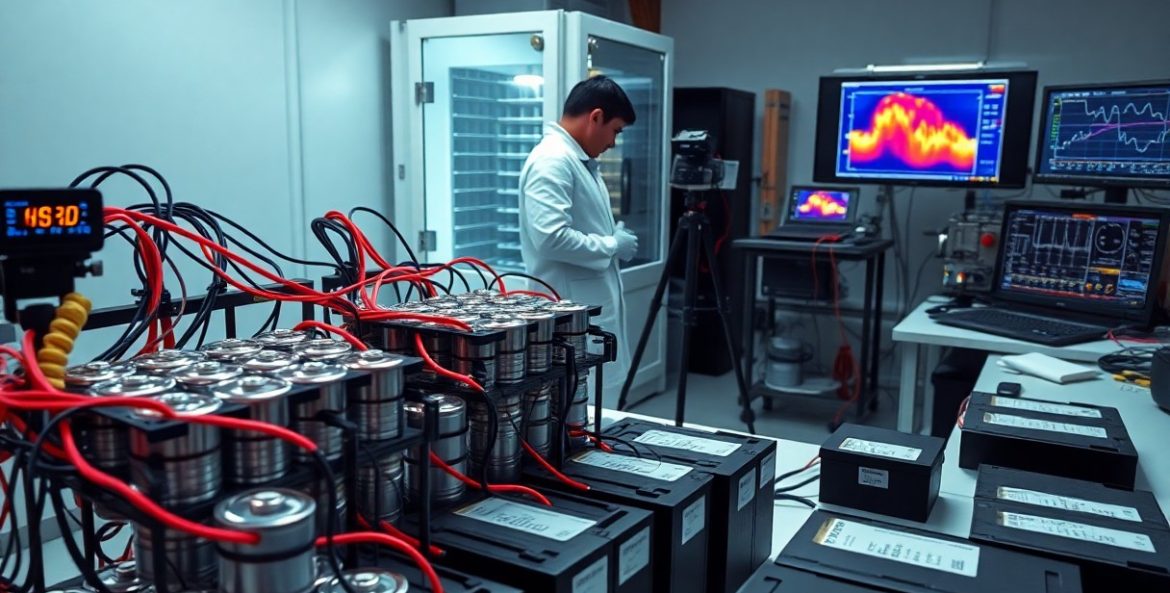
You rely on batteries every day, and rigorous testing explains how lab and field tests expose weaknesses so you avoid thermal runaway and fires, ensuring longer lifecycle and reliable performance. By simulating abuse, cycling, and aging, testing helps you detect manufacturing defects, verify safety systems, and extend warranty-backed life. This guide shows practical test types, interpretation tips, and how standards-driven validation protects your devices and users.
Types of Battery Testing
| Performance Testing | Measures capacity, energy efficiency, cycle life and C‑rate behavior (e.g., 0.5C, 1C, 2C); targets often >80% capacity after 500-1,000 cycles for consumer/automotive cells. |
| Safety Testing | Includes abuse tests (nail penetration, crush, overcharge to 150% SOC, external short circuit), thermal ramp and ARC to identify thermal runaway onset (typically 150-200°C) and peak fire temperatures (up to 400-600°C). |
| Environmental Testing | Thermal cycling (−40°C to +60°C), humidity, vibration and altitude to validate performance and prevent latent failures in field conditions; IEC/ISO profiles commonly applied. |
| Electrical Characterization | Electrochemical impedance spectroscopy (EIS), DC internal resistance, self‑discharge and coulombic efficiency (>99.8% for good cells) to quantify degradation mechanisms. |
| Calendar Life & Storage | Soak tests at 25-60°C for months to years to quantify capacity fade from ageing; provides inputs for warranty models and pack maintenance schedules. |
- Cycle life (repeated charge/discharge)
- Capacity and state‑of‑health tracking
- C‑rate and power capability tests
- Abuse: overcharge, nail penetration, crush, external short circuit
- Thermal characterization and propagation studies
Performance Testing
You run controlled charge/discharge profiles to quantify how capacity and energy efficiency evolve: typical protocols use 0.5C-2C cycles with periodic reference tests at 0.2C to measure true capacity. Data shows many NMC automotive cells targeting >80% capacity retention after 800-1,200 full cycles, while LiFePO4 chemistries often exceed 2,000 cycles under similar stress-this difference informs chemistry selection for your application.
You also monitor impedance growth via EIS and DCIR: a rise of >30% in internal resistance often correlates with noticeable power fade. Practical examples include conditioning tests where a cell stressed at 3C for 100 cycles reveals thermal gradients and accelerated SEI growth; those measurements feed cell balancing and thermal management strategies for the pack.
Safety Testing
You subject cells to standardized abuse protocols (UN38.3 for transport, IEC/UL standards for consumer/EV) and laboratory abuse beyond standards to find failure modes: deliberate overcharge to 150% SOC, nail penetration at controlled speeds, and external short circuit with monitored current can each provoke internal shorts that lead to venting or ignition. Thermal onset measured by ARC typically appears between 150°C and 200°C; knowing that onset lets you design separators and venting paths to limit cell energy release.
You examine system‑level propagation by chaining cells in a pack and initiating a single‑cell event: calorimetry and high‑speed thermography quantify heat release and propagation time-some tests record propagation in seconds, which defines spacing, thermal barriers, and active suppression needs. Historical failures, such as the Samsung Galaxy Note7 incidents traced to manufacturing defects and internal shorting, demonstrate how a single cell fault can become a product‑level safety crisis and why you must validate both cell and pack mitigations.
At pack level you validate BMS trip thresholds, current interrupt devices, and mechanical barriers; ARC and bomb calorimeter data that show heat release rates in kW per cell guide whether passive venting or active suppression is necessary. Manufacturers often set BMS overvoltage cutoffs and cell balancing strategies based on these tests to prevent conditions that lead to thermal runaway.
Thou ensure your test matrix includes realistic duty cycles, worst‑case abuse and propagation scenarios so your designs catch the rare, high‑energy failures.
Tips for Effective Testing
Plan your matrix to cover electrical, thermal, mechanical, and environmental axes simultaneously rather than in isolation; for example, run cycle tests at 1C and 2C with ambient chambers cycling between -20°C and 60°C to capture realistic stressors. Tie each test back to measurable goals for battery safety and battery lifetime-specify pass/fail criteria such as ≥80% capacity retention after 1,000 cycles or no initiation of thermal runaway under UL/UN abuse procedures. Include reference to standards like rigorous testing standards (IEC 62133, UN38.3, UL 2580/2054) to ensure results map to regulatory and transport requirements.
Design experiments with adequate sample sizes (commonly ≥30 units per condition for batch-level conclusions) and use statistical methods or Design of Experiments to separate variance sources; for instance, you might find manufacturing variance accounts for 40-60% of performance spread and must be addressed via inline QA. Instrument cells with internal temperature sensors, voltage taps, and high-speed data logging (≥1 kHz for abuse events) so you can correlate early electrochemical signatures with later capacity fade or safety events.
Best Practices
Use field-representative duty cycles instead of idealized constant-current profiles-simulate pulse loads, regen currents, and partial-state-of-charge operation seen in real applications. When validating packs for automotive use, run combined mechanical vibration + thermal soak + dynamic cycling sequences; a typical automotive protocol uses 1,000 vibration hours, thermal soak between -40°C and 85°C, and 500 full-depth cycles at C/2 to expose latent defects. Complement lab tests with accelerated aging (e.g., aging at 45°C to accelerate calendar fade ~2-3×) and periodic destructive analysis to verify failure physics.
- testing protocols: align test steps to industry standards and product use cases
- rigorous testing instrumentation: use IR cameras, pressure sensors, and high-speed ADCs for abuse capture
- battery safety checks: include nail penetration, overcharge, and external short tests per regulated methods
- battery lifetime validation: combine calendar and cycle aging with real-world profiles
Automate data pipelines so you can run anomaly detection across millions of datapoints; production-scale teams often find that a simple automated flag for outlier ΔV or temperature rise reduces field failures by >50% once integrated into process control.
Common Pitfalls to Avoid
Avoid underpowered sample sets and single-condition testing: testing only at 25°C or at a single C-rate will mask failure modes that emerge under combined stresses, and low-N studies can give false confidence. Neglecting manufacturing variation is another common error-internal weld defects, electrolyte contamination, or inconsistent formation cycles can produce a small fraction of units that fail catastrophically, so include supplier-level audits and inline non-destructive inspections like X‑ray or ultrasonic weld monitoring.
Relying solely on simulation or cell-level tests without pack-level validation often misses interactions such as thermal runaway propagation, busbar resistive heating, and BMS response delays; for example, a cell that passes isolated abuse tests can still propagate to neighbors if cell spacing and thermal barriers are not tested at the module level. Also, skipping destructive post-mortem analysis after unusual failures limits your ability to close the loop on root cause.
Case histories are instructive: high-profile recalls driven by latent manufacturing or design issues-such as batteries that produced internal shorts after stress or deformation-show that combining process controls with aggressive abuse testing prevents the majority of field incidents; use cross-functional reviews, correlate inline inspection metrics with field returns, and set threshold alarms for process drift detected via SPC to mitigate risk.
Recognizing that a single overlooked failure mode or inadequate abuse test can trigger expensive recalls and safety incidents, you must integrate accelerated aging, destructive analysis, and inline non‑destructive inspection to protect battery safety and maximize battery lifetime.
Step-by-Step Testing Protocol
Step-by-Step Summary
| Phase | Key Actions & Metrics |
|---|---|
| Preparation | Define sample size (typical qualification: n ≥ 30 cells or 3-10 packs), select representative chemistries, set environmental ranges (-40°C to 85°C), preconditioning soak (24 h at test temp), baseline capacity and impedance (EIS at 1 kHz, DCIR), install thermocouples and pressure sensors, verify instrumentation calibration ±0.5°C. |
| Execution | Run defined matrix: cycle-life (e.g., 1C CC-CV to 4.2 V, cut-off 3.0 V, 80% DOD, target 1,000 cycles), calendar-aging (45°C accelerated Arrhenius equivalents), abuse tests (overcharge to 150% SOC, nail penetration, short-circuit); log at 1 Hz for thermal events, sample diagnostics every 100 cycles, abort thresholds: cell surface temp > 80°C, pressure rise > setpoint, smoke detection. |
Preparation Phase
You standardize sample selection by pulling units from multiple production lots and defining statistical confidence-typically n ≥ 30 cells for a production qualification or smaller, focused cohorts for R&D (3-10 packs). You set preconditioning steps such as a 24‑hour soak at test temperature and bring cells to a controlled SOC (commonly 50% for baseline impedance, 100% for abuse tests) so initial conditions are consistent across runs.
You also implement safety and instrumentation controls: mount at least two thermocouples per cell (surface and core where feasible), install overpressure relief monitoring, and calibrate data acquisition to ±0.5°C and ±0.1% for voltage/current. Strong emphasis goes on remote operation and physical blast shielding for abuse sequences, while baseline measures (capacity, EIS at 1 kHz, DCIR) establish the metrics you’ll track for degradation.
Execution Phase
You execute the test matrix in strict sequence: initial baseline verification, cycling or calendar blocks, periodic diagnostic windows, then abuse tests if required. For cycle life, a common protocol is 1C CC-CV to 4.2 V with a 3.0 V cut-off at an 80% DOD target; you log every charge/discharge and run diagnostics (capacity, EIS) every 100 cycles to quantify trends.
You monitor safety in real time with automated abort logic-trigger conditions might include cell surface temperature exceeding 80°C, rapid pressure rise, or smoke detection, each configured to stop current and engage venting controls. Positive outcomes are measured against acceptance criteria such as >80-85% capacity retention at target cycle count or <20% increase in internal resistance over the test duration; if a cell shows a steep, nonlinear resistance jump you isolate it for failure-mode analysis.
You supplement the live runs with immediate forensic actions when anomalies occur: capture high-rate thermal imaging, preserve the failed unit for post-mortem (SEM, XRD, electrolyte analysis), and apply statistical tools (Weibull fits, 95% confidence intervals) to translate individual failures into batch-level reliability metrics.
Factors Influencing Battery Lifetime
- Environmental Conditions
- Usage Patterns
- Charge Protocols
- Manufacturing Quality
Environmental Conditions
High ambient temperature accelerates chemical side reactions; as a rule of thumb, reaction rates roughly double for every 10°C increase, so storing a lithium-ion pack at 40°C instead of 20°C can produce several-fold faster capacity fade and increased impedance over months. You should expect not only faster calendar aging but also a higher risk of thermal runaway when cells are both hot and mechanically or electrically stressed, which is why active cooling or thermostatic control is adopted in EV packs and grid storage systems.
Humidity and corrosive environments also matter: salt spray or condensation can degrade interconnects and BMS electronics, producing leakage paths and balancing failures that shorten useful life. You can mitigate these by sealing enclosures to at least IP54 or using conformal coatings; in field trials for telecom backup batteries, enclosures rated IP65 reduced premature electronic failures by more than 70% compared with unprotected systems.
Usage Patterns
The depth of discharge (DoD) is one of the biggest usage levers you control: a cell cycled daily at 100% DoD might reach end-of-life in the range of 300-800 cycles depending on chemistry, whereas limiting DoD to 20-30% can multiply cycle life to several thousand cycles. You should also watch charge and discharge rates-fast charging at >1C consistently raises internal temperature and promotes lithium plating and SEI growth; in practical terms, reducing peak C-rate from 1C to 0.5C can extend cycle life by tens of percent in many cell types.
State of charge during storage affects aging too: long-term storage at high SoC (near 100%) and elevated temperature greatly increases capacity loss, so industry practice is to store at ~40% SoC for months-long idle periods. You can implement BMS-controlled storage profiles and time-of-use charging to keep average SoC and peak rates within life-optimizing windows, a strategy used by grid-scale batteries to preserve capacity between dispatch cycles.
After you apply conservative DoD limits, moderate C-rates, and BMS-driven storage states, real-world deployments commonly see effective cycle life improvements of 20-100% depending on baseline behavior, with the biggest gains coming in applications that previously relied on repeated deep discharges and frequent fast charges.
Pros and Cons of Rigorous Testing
| Pros | Cons |
|---|---|
| Identifies failure modes early (e.g., dendrite formation, separator melt) before field deployment | High upfront cost: full validation labs and test matrices often add 10-30% to R&D budgets |
| Quantifies lifetime: accelerated cycle tests can project capacity retention over 1,000-3,000 cycles | Time-consuming: some long-term calendar aging tests require months to years to complete |
| Improves safety: abuse tests (nail penetration, overcharge, thermal ramp) reduce risk of thermal runaway in the field | May slow time-to-market when extensive certification (IEC 62133, UN 38.3, UL 1642) and iterative testing are required |
| Enables robust BMS calibration by providing high-resolution cell behavior data under varied conditions | Test conditions can be non-representative if not designed carefully, leading to false confidence |
| Reduces warranty and recall costs: catching defects pre-production lowers long-term liabilities | Resource allocation trade-offs: testing depth may divert engineering effort from feature development |
| Generates actionable metrics (impedance growth, SOH curves, thermal maps) for design optimization | Complex data sets require skilled analysis; misinterpretation can misguide design changes |
| Supports regulatory approval and customer trust, demonstrated in case studies like automotive cell validation programs | Testing for all possible abuse scenarios is impossible; residual risk remains despite rigorous protocols |
| Enables supplier auditing and material screening, reducing batch-to-batch variability | Smaller companies may face competitive disadvantage due to the capital intensity of comprehensive testing |
Advantages of Comprehensive Testing
You gain predictable performance by subjecting cells to standardized protocols: for example, running IEC-style cycle, calendar, and abuse sequences lets you map capacity fade and internal resistance growth so you can guarantee a specified end-of-life at 70-80% capacity after a target number of cycles. When you integrate accelerated aging (e.g., higher temperature and rate conditions) with statistical models, you can project real-world behavior and set warranty terms with confidence.
Data-driven tuning of the battery management system follows naturally. By feeding temperature-dependent charge/discharge curves and transient internal resistance measurements into your BMS, you reduce overcharge/overdischarge events and extend pack life. Automotive programs that run thousands of pack cycles and cell-level abuse tests have shown decreases in in-service failures and warranty claims, translating to measurable savings over the product lifecycle.
Potential Drawbacks
You must accept that thorough testing increases development cost and duration: outfitting labs, buying environmental chambers, and running long-term calendar tests can add substantial expense and delay. Smaller teams may find the incremental value of every new test diminishes, especially when testing portfolios expand to cover niche edge cases that contribute little to overall safety or lifetime improvements.
Over-reliance on standardized tests can also mislead you if the test matrix doesn’t reflect your product’s actual use profile. For instance, a smartphone subjected only to office-cycle tests may still fail under high-rate fast-charging used in ride-hailing fleets; therefore you need targeted scenario tests aligned with your application rather than blanket coverage.
Mitigate these drawbacks by prioritizing tests based on failure-mode analysis and by using a staged approach: perform focused screening and accelerated studies to catch high-risk issues, then invest in long-duration validation for designs that pass early gates, which balances cost, time, and the level of assurance you require.
Future Trends in Battery Testing
Driven by higher energy-density chemistries and more stringent end‑use requirements, testing is moving from batch, time‑consuming protocols to continuous, data‑rich qualification. You’ll see labs combine high‑throughput cyclers with in‑cell diagnostics – for example, integrating electrochemical impedance spectroscopy and fiber‑optic temperature sensing so you can detect early signs of internal shorting or incipient thermal runaway long before conventional voltage/current metrics drift. At the same time, digital twins that couple cell‑level electrochemical models with pack‑level thermal and mechanical simulation are already used in pilot programs to shorten validation cycles; in some projects they’ve accelerated qualification by roughly 2x-10x.
Expect testing programs to expand beyond initial safety and capacity checks to include lifecycle, second‑use, and recyclability metrics. You’ll be asked for standardized, timestamped datasets to demonstrate not only initial performance but residual life after 500-2,000 cycles (depending on chemistry), state‑of‑health (SOH) forecasting accuracy, and end‑of‑life recovery rates. National labs and OEM test centers are increasingly publishing open datasets and benchmarks so you can validate algorithms against common baselines while regulators push for more auditable test records.
Innovations in Technology
Automation and machine learning are changing how you design and run experiments: autonomous test rigs can run 24/7, triage anomalous cells, and redirect samples for destructive analysis when models flag aberrant behaviour. Practical examples include combinatorial test platforms that vary charge protocols, temperatures, and C‑rates across hundreds of cells and feed results into ML models (random forests, Gaussian processes, and deep networks) that learn degradation modes – this lets you identify harmful regimes such as repeated partial‑state‑of‑charge windows that drive lithium plating. Integrating on‑cell sensors (pressure, micro‑thermocouples, acoustic emission) gives you direct observables of failure precursors, so you can quantify the risk of venting, fire, or sudden capacity collapse rather than inferring it indirectly.
Sensors are complemented by advanced analytics: physics‑informed ML and Bayesian methods let you fuse short‑term accelerated test data with long‑term field data to predict calendar and cycle ageing with much tighter confidence bounds. You’ll also see more testbeds that simulate real operational stressors – rapid charging, vehicle vibration, and partial SOC cycling – in a single platform, reducing the need for multi‑year fleet trials. For emerging chemistries like solid‑state, test infrastructures are adapting to capture interface degradation and dendrite formation early; manufacturers project solid‑state to offer meaningful safety gains and 20-50% energy‑density improvements once cycle life and interface stability are resolved.
Evolving Standards and Regulations
Standards bodies and regulators are tightening what you must document and how tests are performed: established norms such as IEC 62133 and IEC 62619 remain central for cell safety, while ISO 12405 and UL 2580/UL 9540 govern pack and energy‑storage system testing. In parallel, regional frameworks like the UNECE R100 family for traction batteries and the new EU Batteries Regulation are adding durability, reparability, and traceability requirements; the EU rule introduces phased obligations through 2027 for labeling, carbon‑footprint reporting, and a digital battery passport that will force you to deliver auditable lifecycle data.
Consequently, your QA and compliance workflows must support third‑party conformity assessment, long‑term data retention, and clear chain‑of‑custody for test samples. Regulators increasingly expect not only pass/fail outcomes but access to raw test logs, calibration certificates for measurement equipment, and evidence of sample representativeness. Noncompliance risks market restrictions and fines, so you’ll need to align lab equipment, data management, and supplier agreements with evolving regulatory checklists.
Global harmonization efforts are underway to reduce duplicated testing and speed market entry: initiatives within ISO, IEC, and regional authorities aim to standardize digital test formats and acceptance criteria so your test reports can be reused across jurisdictions. For your product planning that means investing in interoperable data systems (APIs, standardized metadata) and participating in round‑robin interlaboratory comparisons – those steps will make it far easier to demonstrate conformity and to scale validation from prototype batches to full production.
Summing up
Ultimately rigorous, systematic testing exposes failure modes, validates cell chemistry and pack design, and lets you trust that safety systems will operate under realistic stresses; by subjecting batteries to controlled cycling, thermal extremes, mechanical abuse and accelerated aging, you get quantifiable metrics that guide engineering changes and quality control so your products or devices perform safely in the field. Testing data also enables better battery management algorithms and informed warranty decisions, reducing the likelihood of unexpected degradation or hazardous events for your users.
When you insist on comprehensive test protocols, you shorten development cycles and lower long‑term costs by avoiding recalls and improving longevity through targeted design improvements and predictive maintenance strategies; that translates into longer service life, more predictable replacement schedules and higher user confidence in your products. Consistent, transparent testing practices create the framework for safer, more durable batteries that align with regulatory standards and real world use, protecting both people and investments.